About This Event:
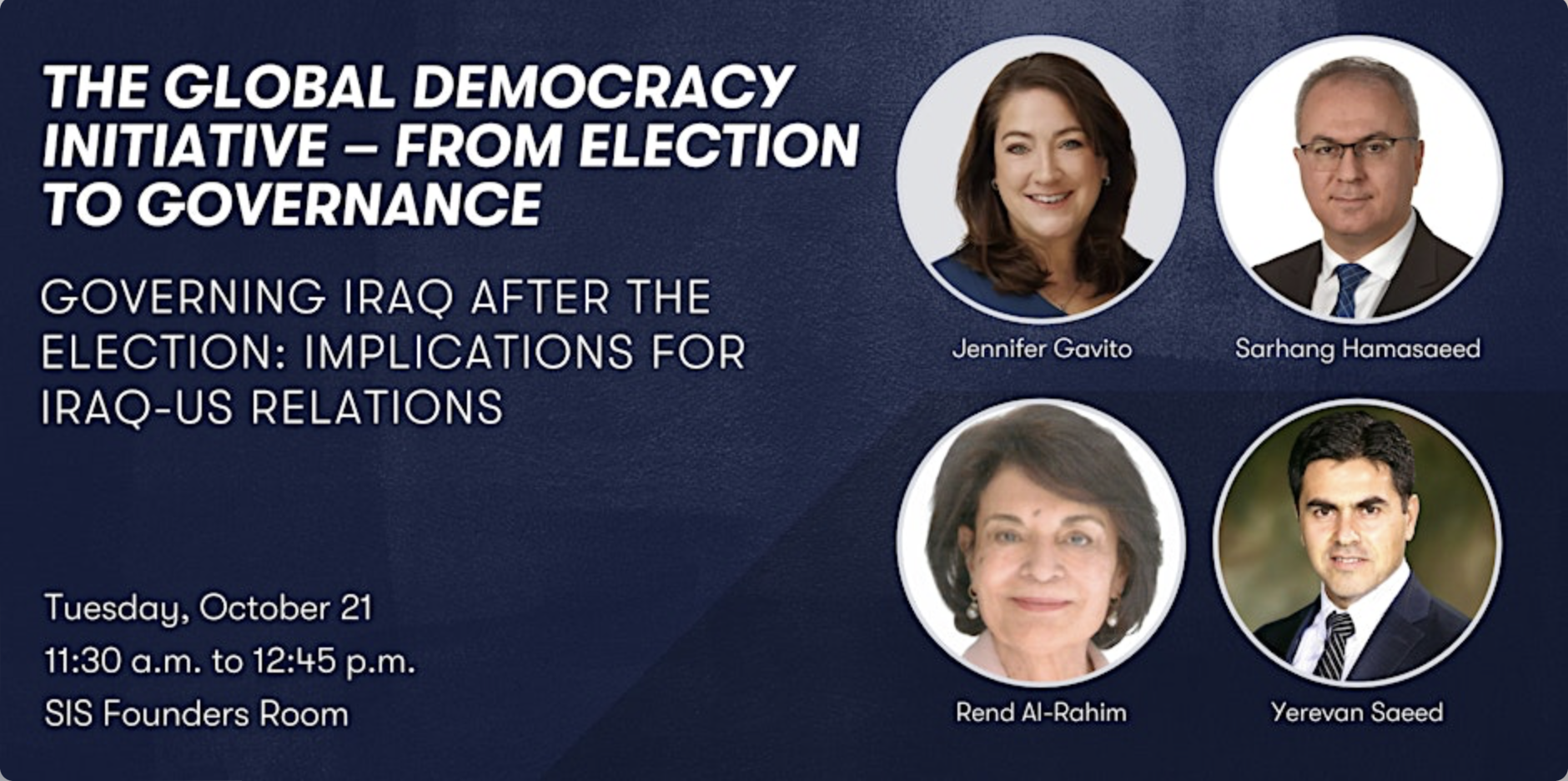
Co-sponsored by the School of International Service (SIS) Dean’s Office, the Global Kurdish Initiative for Peace at SIS is pleased to host panel discussion on the implications of Iraq’s parliamentary elections on the country’s domestic politics and its impact on the U.S.-Iraq relations.
Iraq is going to hold its parliamentary elections on November 11, 2025. More than a hundred coalitions, parties, and independent lists representing a broad political spectrum, from forces hostile to Washington to those seeking an unconditional alliance, will seek to contest 329 seats.
In recent years, Iraq has tried to adopt a balanced approach toward its neighbors and the West. Whether this will continue or shift could be influenced by the distribution of parliamentary seats and the post-election negotiations to form the largest bloc capable of establishing the next government.
The current Prime Minister, Mohammed Shia al-Sudani, generally considered a moderate figure with limited power, is seeking a second term. He has formed his own list and fielded his candidates. However, history is not on his side. Since 2003, only one Iraqi prime minister has secured a second term. Political parties have traditionally preferred to elevate weak or relatively unknown figures to the premiership to ensure they are manageable and do not threaten entrenched political and economic interests.
Speakers include Jennifer Gavito, Senior Advisor at the Cohen Group and former Acting Principal Deputy Assistant Secretary of State for Near Eastern Affairs; Sarhang Hamasaeed, former Director for Middle East Programs at the United States Institute of Peace; and Rend Al-Rahim, Iraq’s first ambassador to the United States and former president and co-founder of the Iraq Foundation. The discussion will be moderated by SIS Professor Yerevan Saeed.
The panel will conclude with a Q&A session and Middle Eastern cuisine will be served at the end of the event.
Bios:
Ms. Jennifer Gavito joined The Cohen Group as a Senior Advisor in 2024 and co-leads the firm’s Middle East practice. A career Senior Foreign Service officer with the rank of Minister-Counselor, Ms. Gavito spent over 25 years at the intersection of international and economic policy in senior diplomatic positions in Washington and throughout the Middle East and Europe, on the staff of the National Security Council, and as a senior advisor to the Department of Defense.
Ms. Gavito served most recently as the Acting Principal Deputy Assistant Secretary of State for Near Eastern Affairs where she coordinated policy recommendations for the Secretary of State and other senior U.S. government leaders and oversaw the work of 22 diplomatic posts in 18 countries throughout the Middle East. Prior to that, she was the Deputy Assistant Secretary of State for Iraq and Iran. She concurrently served as Deputy Assistant Secretary of State for Press and Public Diplomacy, leading hundreds of staff in Washington and throughout the Middle East in strategic communications strategy and engagement. Prior to retiring from government service, Ms. Gavito was nominated by President Biden in January 2024 to serve as the U.S. Ambassador to the State of Libya.
Ms. Gavito has held a range of leadership roles at U.S. embassies and consulates around the world. She was Minister-Counselor for Political Affairs at the U.S. Embassy in London from 2018–2021, U.S. Consul General to Bavaria from 2015–2018, and Political Counselor at U.S. Consulate General Jerusalem from 2012–2015. Earlier assignments include, among others, Senior Foreign Policy Advisor to the Director for Strategy, Plans, and Programs (J-5) at the U.S. Africa Command; Deputy Consul General at U.S. Consulate General Dubai; Director for Syria and Lebanon at the National Security Council; Deputy Director for North Africa at the Department of State; and head of the Economic and Commercial Section at U.S. Embassy Beirut. She began her career in public service at the U.S. Department of the Treasury.
Ms. Gavito speaks fluent German and also has Arabic and French language skills. She received the 2024 Presidential Rank Award from President Biden for her extensive contributions to public service. She is also the recipient of the Joint Civilian Service Meritorious Commendation Medal from the Department of Defense and is a six-time recipient of the State Department’s Superior Honor Award.
Ms. Gavito is originally from Kansas City, Missouri but claims Colorado as home. She obtained a BA in Economics and International Service from American University. She and her husband Anthony are the proud parents of two teenage boys.
Sarhang Hamasaeed is a professional with more than 20 years of experience as a leader, manager, strategist, trainer, analyst, writer, and public speaker. His expertise spans development, governance, and peacebuilding across governmental, non-governmental, private sector, and media organizations.
From February 2011 until July 2025, he worked at the U.S. Institute of Peace (USIP) in Washington, DC, serving as director of various Middle East programs from 2016 onward. His areas of focus included political and conflict analysis, problem-solving dialogue processes, reconciliation and post-conflict stabilization, ethnic and religious minorities, and organizational development. In addition, his policy work encompassed analysis of U.S. bilateral relations with countries in the region and the broader U.S. role in the Middle East.
Since 2014, he has been a regular lecturer at the U.S. State Department’s Foreign Service Institute, covering topics such as challenges and opportunities to governance in Iraq, the fight against ISIS and violent extremism, and broader Middle East dynamics.
In events and briefings, he covers Iraq, Syria, Yemen, and the Gulf as well as regional (e.g., Iran, Türkiye/Turkey, and the GCC) and global power competition (e.g., the U.S and China). He provides analysis and interviews to U.S. and international media. He has served as a member on the Task Force on the Future of Iraq, the Rebuilding Societies Working Group, and U.S.-Europe-Iraq Track II Dialogue — all initiatives by the Atlantic Council’s Rafik Hariri Center for the Middle East.
His prior positions include deputy director general at the Council of Ministers of the Kurdistan Regional Government of Iraq (2008-2009), where he managed strategic government modernization initiatives through information technology with the goal of helping improve governance and service delivery; program manager for the Research Triangle Institute International (2003-2004), where he managed civic engagement and local democratic governance programs in Iraq; planning and relations manager at Kurdistan Save the Children (1997-2002); and correspondent for the Los Angeles Times and other international media organizations.
He holds a master’s degree in international development policy from Duke University (2007) and is a Fulbright alumnus.
Rend Al-Rahim is a nonresident senior fellow with the Iraq Initiative in the Atlantic Council’s Middle East programs. Al-Rahim is the former president and co-founder of the Iraq Foundation, a Washington-based nonprofit promoting democracy, human rights, and civil society in Iraq. A leading expert on Iraqi politics and civic development, she served as Iraq’s first ambassador to the United States from 2003 to 2005, following the fall of Saddam Hussein.
Al-Rahim has advised and collaborated with numerous institutions, including the United States Institute of Peace—where she was a senior fellow—and academic centers such as Princeton University, Georgetown University, and the University of Pennsylvania. She has testified before the US Congress and remains a frequent commentator on Iraqi affairs in international media.
She is the co-author of The Arab Shi’a: Forgotten Muslims and has contributed widely to scholarship on Iraq’s constitution, transitional justice, and national reconciliation. Al-Rahim holds a BA and MA from the University of Cambridge and an MA from the University of Sorbonne.
Yerevan Saeed (moderator) is the Barzani scholar-in-residence in the Department of Politics, Governance & Economics at American University’s School of International Service, where he also serves as director of the Global Kurdish Initiative for Peace. Saeed is a nonresident senior fellow with the Iraq Initiative in the Atlantic Council’s Middle East programs. His research focuses on the political economy, energy politics, conflict resolution, and Kurdish studies, with emphasis on Iraq, Turkey, Iran, the Gulf states, and the broader Middle East.
Saeed has held academic and research positions including lecturer at the University of Kurdistan Hewler, visiting scholar at Arab Gulf Institute, and associate fellow at the Middle East Research Institute.
Professionally, he worked as a Middle East specialist at Stratfor in 2013 and served as the White House correspondent in Washington, DC, for Rudaw TV in 2015, covering U.S. foreign policy and regional developments. From 2003 to 2007, Saeed worked in Kurdistan and Iraq as a journalist and translator for prominent international outlets including the New York Times, NPR, the Wall Street Journal, BBC, and the Guardian. These experiences continue to shape his research and policy perspectives.
A regular contributor to scholarly and policy discourse, Saeed’s work has appeared on the Atlantic Council, Arab Gulf States Institute, the Wilson Center, the New Lines Institute, The Diplomatic Courier, The Hill, Fikra Forum (The Washington Institute), the Middle East Institute, Al Jazeera, Majalla Magazine, and Rudaw.
He is frequently quoted by global media, including CNN, Voice of America, NPR, S&P Global, Petroleum Economist, Voice of Russia, and the National, and often presents at international conferences.



 Loading ...