Subscribe
to receive news by email

Poll
Will the Trump Administration Shift U.S. Policy in Favor of Palestine?
- No (87%)
- Yes (13%)
 Loading ...
Copyright © 2026 Arab America
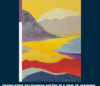
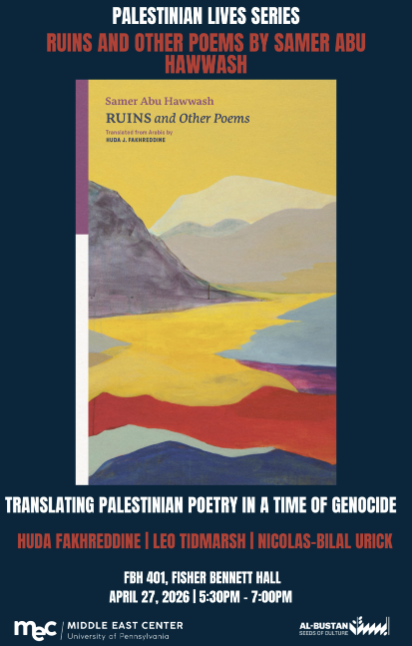
Go topRuins and Other Poems by Samer Abu Hawwash: Translating Palestinian Poetry in a Time of Genocide
Date/Time
Date(s) - 04/27/2026
5:30 pm - 7:00 pm

Location
Fisher bennett hall, FBH 401
Categories
Cost:
Free USD
Contact Person:
Email:
mec-info@sas.upenn.edu
Website:
https://mec.sas.upenn.edu/events/2026/04/27/ruins-and-other-poems-samer-abu-hawwash-translating-palestinian-poetry-time
Phone:
215-898-6335
Organization:
University of Pennsylvania Middle East Center
PHILADELPHIA, PA
In these poems, Samer Abu Hawwash stands upon ancient and modern ruins, engaging with the archetypal Arabic qasida and its echoes in the present, set against a backdrop of exile, displacement, and genocide.
The site of the ruin, the journey, and the return home are the three movements of the archetypal Arabic form with which Samer contends in his book-length poem. Writing in and from the moment of crisis, the poet keeps returning to ruins, forfeiting the journey and the hope of return and resolution, rearranging the elements of poetry in the Arabic tradition in search of closure or consolation—in a gesture, a shadow, a memory, an object. The five poems that follow “Ruins” in this book root themselves in monumental loss. When “it no longer matters if anyone loves us” and “we will lose this war,” nothing remains but the poem, the witness, the signpost in the wasteland of history.
BIOS
SAMER ABU HAWWASH (b. 1972) is a Palestinian poet, novelist, editor, and translator, born in Lebanon. He is the author of 10 poetry collections including his debut collection Life is Printed in New York (1997), I’ll Kill You Death (2012), One Last Selfie with a Dying World (2015), Ruins (2020), and From the River to the Sea (2024). He is also the author of three works of fiction: The Journal of Photographed Niceties (2003), Valentine’s Day (2005), and Happiness or A Series of Explosions that Rocked the Capital (2007). Abu Hawwash is the translator of more than 20 volumes of poetry and prose from English including works by William Faulkner, J.G. Ballard, Sylvia Plath, Charles Bukowski, Langston Hughes, Jack Kerouac, Yann Martel, Hanif Kureishi, Denis Johnson, Marilynne Robinson, and many others. He lives in Barcelona, Spain where he currently works as the director of the Culture & Society section at Almajalla Magazine.
HUDA J. FAKHREDDINE is a writer, translator, and Associate Professor of Arabic Literature at the University of Pennsylvania. She is the author of Metapoesis in the Arabic Tradition (Brill) and The Arabic Prose Poem: Poetic Theory and Practice (Edinburgh University Press), and the co-editor of The Routledge Handbook of Arabic Poetry (Routledge). Her translations include Jawdat Fakhreddine’s poetry collection Lighthouse for the Drowning (BOA Editions), The Universe, All at Once: Selections from Salim Barakat (Seagull Books), and Palestinian: Four Poems by Ibrahim Nasrallah (World Poetry). She is also the author of a book of creative nonfiction, Zaman saghīr taḥt shams thāniya (A Brief Time Under a Different Sun) and a poetry collection, Wa min thamma al-ālam (And Then the World). She is co-editor of Middle Eastern Literatures.
NICOLAS-BILAL URICK is a Ph.D. student in the department of Middle Eastern Languages and Cultures specializing in modern Arabic Literature. He is particularly interested in the relationship between Arabophone multilingualism and the Mahjar movement’s development of distinct literary forms. He holds additional interests in modern Persian literature, Biblical and Christological influence in Arabic and Persian poetry, and transnational literary salon culture. His study of the Mahjar likewise informs an interest in the broader history and contemporary reality of Arab-American literature.
Bilal works in Arabic, English, French, and Persian. He likewise reads in Russian and Spanish.
Bilal holds a Bachelor of Arts (B.A.) with Highest Honors from Swarthmore College in Swarthmore, Pennsylvania, where he wrote his Honors thesis on the migration of Romantic literary forms across Arabic and English cartographies.
LEO TIDMARSH received his BA in French and Arabic from the University of Oxford in 2024. His dissertation there was entitled ‘Resistance to political incarceration during the “Years of Lead”: Writing the body and temporality in Youssef Fadel and Abdellatif Laâbi,’ in which he employed close reading and elements of queer theory in analysing the ways in which Moroccan authors, writing in French and Arabic, presented non-normative images of temporalities and corporealities to challenge state oppression.
Throughout his studies, Leo has taken an interest in modern Francophone and French literature, particularly in the 20th century, focussing on texts by Algerian, Moroccan, and Caribbean authors reacting to violence, both present and historical, and looking at the ways in which such acts of violence have been imagined and presented differently across various forms. Leo is looking to continue to expose tactics of resistance in carceral texts written in French and Arabic across North Africa and the Arab world, putting to use both queer and feminist lenses.