

Subscribe
to receive news by email

Poll
Will the Trump Administration Shift U.S. Policy in Favor of Palestine?
- No (87%)
- Yes (13%)
 Loading ...
Copyright © 2026 Arab America
Go topExploring the Silk Road
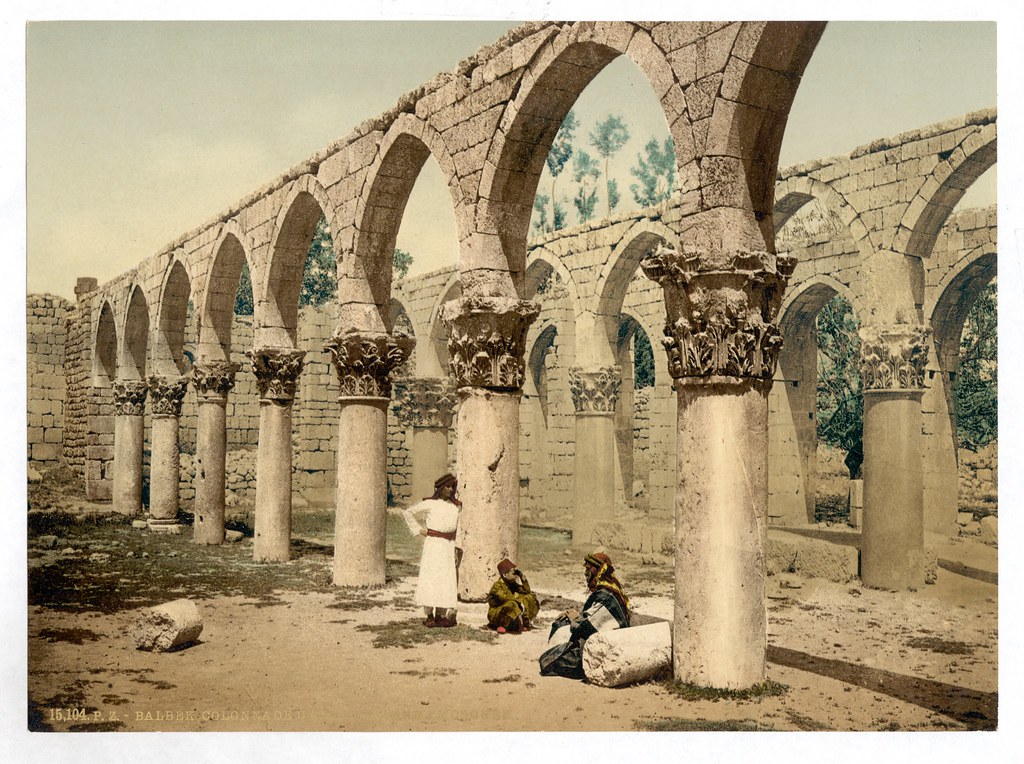
“Colonnade of the ancient mosque, Baalbek, Holy Land, (i.e., Ba’labakk, Lebanon)-LCCN2002724961” by Fæ is licensed under CC BY 2.0.
By: Diksha Tyagi/Arab America Contributing Writer
Despite its name, the Silk Road was much more than just one path. It was a complex system of overland and maritime routes that connected the Middle East, North Africa, Europe, and Asia. Though named after the trade of Chinese silk, these paths in fact exchanged much more, from spices and gold to art and religion. The Arab world’s geographical position made it a focal point of these networks. Interestingly, new discoveries of the Silk Road led by Arab researchers have deepened our understanding of the region’s archeological and cultural heritage.
The Silk Road in the Arab World
The geographical position of the Arab World has made it a natural intersection between numerous nodes of civilization, both ongoing and ancient. Before silk became a major commodity, the Arabian Peninsula was central to the Incense Trade Routes. These flourished from the 3rd century BCE to the 2nd century CE. They began in modern-day Yemen and Oman, crossing over land to the Mediterranean and over sea to India. On account of this advantage, the Arab world possessed vast trading cities and commercial expertise for long-distance exchange.
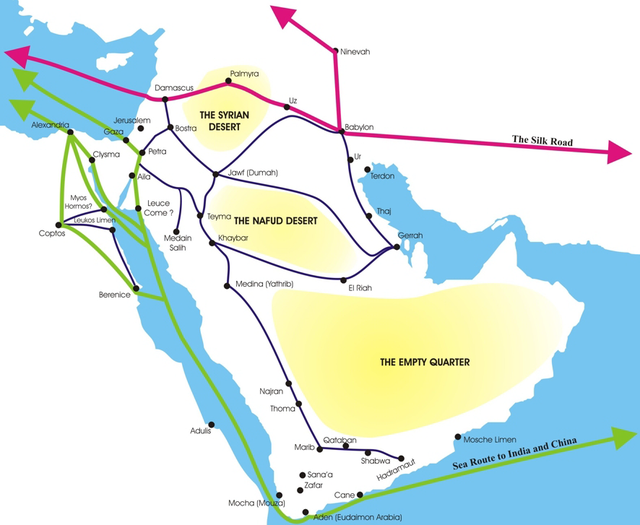
Photo by Gibson’s book: Qur’anic Geography, CC BY 4.0 via Wikimedia Commons
The Silk Road connected numerous parts of Eurasia from the 2nd century BCE to the 15th century AD. As the Silk Road networks expanded, Arab cities were poised to become essential commercial hubs. Cities and ports across the Arab world saw Arab merchants organize caravans, oversee maritime trade, and develop complex economic systems.
More than economies, Silk Road routes also spread Islamic culture, law, and scholarship across Eurasia. These exchanges helped lead to the Islamic Golden Age. In this era, Arabic scholarship influenced and expanded upon Greek, Persian, and Indian texts. Finally, the wealth that trade generated allowed urban centers and numerous institutions to develop in Arab cities, from libraries to mosques and more.
Technological Discoveries
Recent research has been transforming our understanding of ancient Arab civilization. Drones, laser scanning, photogrammetry, and satellite analysis in Saudi Arabia and Central Asia have uncovered numerous traces of ancient human activity. Remote sensing work, has revealed “extensive Bronze Age funerary avenues” linking major oases of the country. Researchers have been able to see when and how the development of these tombs occurred, dating back to the 2nd century.
Though collaborative work on the international scale has partly allowed for these discoveries to take place, it was propelled by local Arab work. “Local researchers, students, and members of the public” in Saudi Arabia participate in the work. This work has allowed the entire international community to profit. Drones have revealed and mapped landscapes and movement patterns around the Silk Road, helping better understand the history of the ancient Arab world.
Legacies of the Silk Road
Though these discoveries hold significance for archeologists, they also carry additional advantages. Digitized reconstructions that have reconstructed pre-Silk Road landscapes. This has placed previously gatekept information on a much more widespread platform, increasing knowledge of ancient Arab history. Community involvement on such a local scale allows this to flourish even further. Individuals are given the ability to access and even discover their own cultural heritage, helping build a sense of shared cultural identity across the entire Arab world.
Additionally, these uncovered sites can add to sustainable cultural tourism. The Arab world, with its vast history, already features numerous ancient sites that take visitors back to that time. These discoveries deepen the Peninsula’s background even more, giving opportunities for shared exploration and scientific cooperation.
Knowledge of the Arab world’s complex economic and cultural systems, combined with the increasing discovery of ancient sites, shows us Arab societies’ many contributions to global history. Globalization is often attributed to the western world. However, societies were connected for centuries before, and Arab regions were central contributors. Through facilitating the connections of goods, ideas, and individuals, the Arab world shaped early architecture, scholarship, and trade. Today, through the world’s increasing technological prowess, we’re able to understand and better appreciate the many roles that Arab societies have played and continue to play in global relations.
Want more articles like this? Sign up for our e-newsletter!
Check out our blog here!