
Subscribe
to receive news by email

Poll
Will the Trump Administration Shift U.S. Policy in Favor of Palestine?
- No (86%)
- Yes (14%)
 Loading ...
Copyright © 2026 Arab America
Go topGaza, but Slower: Settler Terrorism, West Bank and the Destruction of Hebron
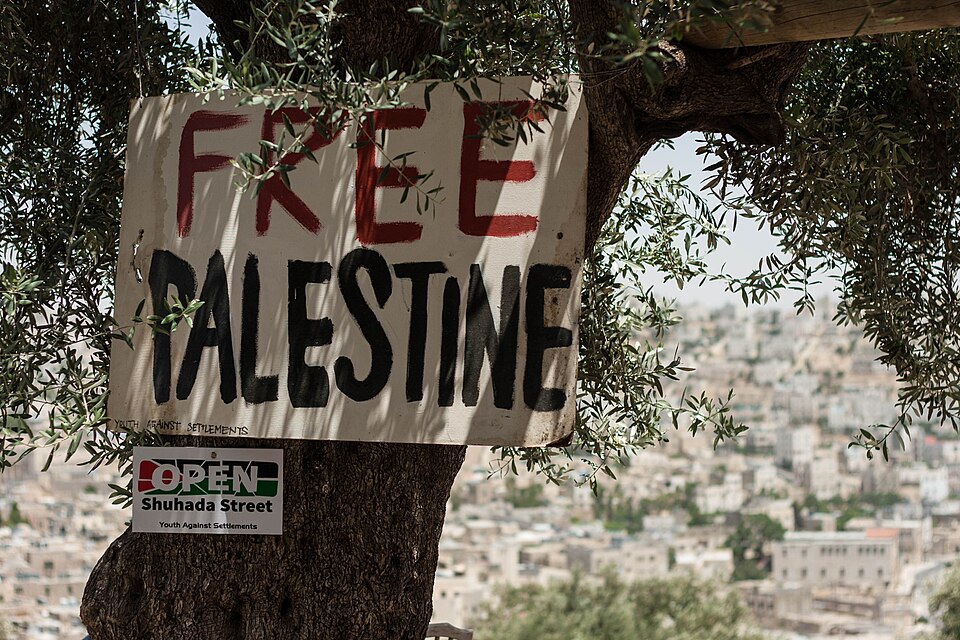
Moritz Schmitz von Hülst, Olive Tree at Tel Rumeida, Hebron. June 29, 2014 (via Wikimedia Commons)
By: Rami Balin / Arab America Contributing Writer
Siege of Hebron & West Bank Lockdown
On October 25, 2026, a journalist looks out on a neighborhood in Hebron (Al-Khalil), tracing his gaze with the camera in his phone. He is not alone – others wearing blue vests with the word “PRESS” written on them are nearby, some filming, some making notes on their phones, others calling, talking to people, delivering the news in any way they can. In front of them, pale houses on the hill are quiet, as if nothing is amiss, except – the journalist zooms in – there are black X marks spray-painted on the walls. These, he explains, mark the houses that Palestinians have already been expelled from. The silence over their rooftops and between their walls feels different now. In one house, a clothesline remains, white sheets still fluttering in the wind, with no one to take them down when they dry.
This is how the siege of Hebron and the lockdown of the West Bank started. It was ordered by Netanyahu as the Israeli elections draw closer, set for October 27, with Netanyahu aiming to get the support and votes of settlers amid growing tensions in the political arena where his popularity is constantly diminishing. The drastic measures follow the shooting by two Palestinians at a checkpoint near Hebron. Two Israeli soldiers were killed, with several others wounded. The two Palestinian attackers were also killed. Unsurprisingly, the Israeli establishment and the western media instantly classified this act of anticolonial resistance as terrorism, amplifying the image of Palestinians as nothing more than attackers without a cause other than violence, or in more indifferent accounts, cogs in the machine of perpetual violence where the culprit is left unnamed and unacknowledged.
Many referred to the deaths of Israeli soldiers as a tragic event while the deaths of Palestinians attackers were deemed self-explanatory, their motifs left unknown and unquestioned. The attack comes after weeks of settler raids on olive harvests, economic collapse and other factors that turn Palestinian lives into hell of endless hurdles, uncertainty and instability. To entities such as the Israeli Occupation Force (IOF), a “safe and orderly olive harvest” constitutes, as is the case with all of historic Palestine, the absence of Palestinians on their land to pick olives in the first place, achieved by means of constant intimidation, physical violence and removal of Palestinians from that land by force.
Escalation of Settler Attacks
This incident happened on October 16, the same week as the violent assault on Heidi Levine, a Jewish Washington Post journalist who came to document the olive harvest in Palestine and was almost killed by a mob of dozens of Israeli settlers in the Palestinian village of Abu Falah in the West Bank. She was beaten, sustaining numerous injuries while her camera, phone and even jewelry were stolen by the settlers. By her own admission, Levine was only left alone because Palestinians started throwing rocks and physically standing between her and the mob, knowing full well that the settlers were armed and that they were risking their lives by resisting. The Israeli army arrived at the scene, didn’t intervene, but shot a Palestinian in the leg.
No arrests were made that day, although subsequently ten settlers were detained in connection with the assaults on Heidi Levine and a group of European diplomats a day later – a performative gesture, considering the damage done was causing a significant reaction from the Western media and others, including European and US government officials. This comes at the same time as the arrest of more than eighty protective presence activists. More than 120 Palestinians have been attacked by settlers in the last month alone, some receiving grave injuries, including Saket Mohammed whose skull was cracked. Mohammed became the fourth American citizen to be severely injured in a span of a week.
Settler-Colonial Terrorism
In her accounts of the settler assault, Levine said it was a “despicable act of terror carried out by masked cowards,” explicitly calling the settlers “Jewish terrorists,” seemingly flipping the narrative by juxtaposing their violence with the selflessness of Palestinians who put their bodies on the line to defend her. This is a very strong statement, considering that for many the words “Jewish” and “terrorist” still don’t belong in one sentence due to the hyper-racialized image of the “terrorist” constructed by the Western media and other institutions.
In framing this assault, the mainstream media have described this dynamic as out of control rogue settlers roaming around and attacking peaceful activists and Palestinians, which is definitely true. However, to soften the blow, most have resorted to the talking points used by the Zionist left, presenting the settlers as the problem that Israel currently faces, along with Netanyahu, deliberately omitting the structure of settler-colonial violence and the people who uphold it. There is ample evidence that settlers in the West Bank are coordinating closely with the army, whereas the government supports and encourages the settlements and outposts in the first place. Settler-colonialism and violence are the foundations of the Israeli state since its inception in 1948 and even before that; they are the status quo and modus operandi all in one, and will not disappear even if Netanyahu loses power.
Gaza in Slow Motion
Armored cars in the streets, Israeli snipers in the windows, soldiers kicking Palestinians from their houses, besieging whole neighborhoods, preventing Palestinians from reaching them, and demolishing houses after giving their inhabitants a five-minute warning to leave or be demolished with them. Such a model is not new: since 2024, this exact tactic has been implemented in Jenin and Tulkarm refugee camps where journalists have mostly not been allowed to enter to document the destruction of whole neighborhoods. However, this practice goes back much farther, having become something of a tradition for the Israeli authorities. By trying to appease the settlers, Netanyahu isn’t doing anything radically new; he is allowing for a natural continuation of the growing violence, refusing to contain it in Gaza. In a sense, Gaza is a blueprint for the West Bank as it is for the South of Lebanon where Israel still has a sizeable presence without any intentions of leaving. The same violence is being perpetuated in the West Bank. It is not as accelerated, committed slowly instead, but its consequences are no less dire long-term.
Want more articles like this? Sign up for our e-newsletter!
Check our blog here!