
Subscribe
to receive news by email

Poll
Will the Trump Administration Shift U.S. Policy in Favor of Palestine?
- No (86%)
- Yes (14%)
 Loading ...
Copyright © 2026 Arab America
Go topThe Kingmakers Israel Didn’t Expect
By: Ghassan Rubeiz / Arab America Contributing Writer
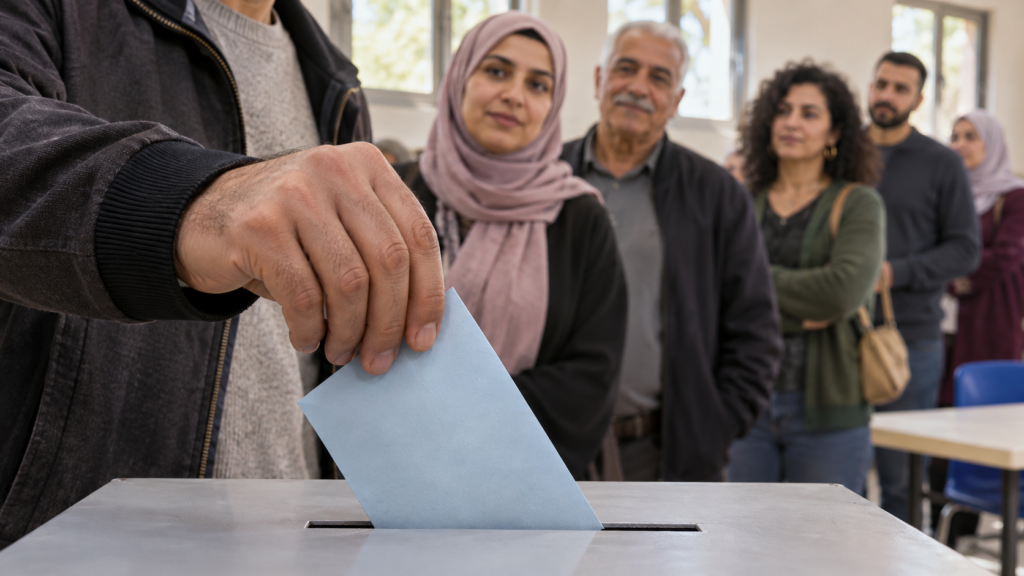
In twelve days, Middle East politics shifted. On October 27, Palestinian citizens of Israel turned out in record numbers to end Benjamin Netanyahu’s long rule. On November 3, as Americans voted, President Trump announced the end of $4 billion in annual military aid to Israel, framing it as a deal with Netanyahu. A day later, after his party’s heavy losses, Vice President JD Vance blamed the Iran war and said voters want to change America’s relationship with Israel. On November 8, Netanyahu’s main rival, Gadi Eisenkot, received the mandate to form a new government. If he succeeds, he will be Israel’s first Mizrahi prime minister.
A new era is opening. Palestinians are choosing participation over exclusion. Washington no longer treats unconditional support for Israel as a given.
The irony is historic. In 1917, British Foreign Secretary Arthur Balfour endorsed a “national home for the Jewish people” in Palestine, where Jews were under 10 percent of the population. A century later, Palestinian citizens of Israel, a minority of about 20 percent, intend to seek influence within the institutions of the Jewish state.
Palestinian politics has passed through distinct stages: armed confrontation under British rule and in 1948; the PLO’s quest for liberation and recognition; the civil resistance of the first Intifada; the hope and disappointment of Oslo; then, after Hamas seized Gaza, renewed armed struggle and a deepening split with the West Bank. A new stage is taking shape: influence through the ballot box.
The numbers are remarkable. Arab turnout roughly doubled, to about 80 percent. The Joint List and Ra’am won a record 19 seats. Both recommended Eisenkot, giving him 67 of 120 Knesset members. Not since Yitzhak Rabin’s government in the 1990s has a majority depended on Arab parties, and never on this scale.
This is more than a vote against Netanyahu. It is political realism. Arab states are divided and weak; Hamas’s war brought ruin, not liberation. Jihadi politics has failed. Palestinian citizens are investing where their numbers count. That is political maturity. They are offering partnership.
Partnership has a price, and the terms are emerging. The first Arab demand is safety at home: a funded, serious campaign against the organized crime that has made Arab towns the most violent in Israel. Eisenkot insists on national service for all citizens. A compromise is within reach: civil rather than military service for Arab citizens. Ra’am has signaled openness. The Joint List still resists.
The talks also reach beyond Israel’s borders. A new cabinet could declare that Israel’s presence in Gaza is temporary, conditioned on the demilitarization of Hamas. In the West Bank, it could confront settler violence. Arab parties cannot win a Palestinian equality of opportunity or a state of their own through a coalition deal. But they can push the next government to begin rolling back the occupation.
Whether Eisenkot accepts remains uncertain. He ruled out Arab partners during the campaign. Ahmad Tibi of the Joint List expects a minority government backed by Arab parties from outside the cabinet, as Rabin’s was in 1992. Whatever Eisenkot decides, many Palestinian citizens have concluded that participation offers more than abstention.
Washington is changing too. Unconditional support for Israel is being questioned across the political spectrum, including by growing numbers of Jewish Americans. The Vice President’s remarks show the question has reached the heart of the governing party. In 1956, President Eisenhower pressed Israel to leave Sinai while backing its security, judging America’s interests independently. That tradition may be returning.
The two shifts reinforce each other. A Washington less willing to underwrite occupation gives Israelis reason to seek security through inclusion. An Israeli government that includes its Arab citizens is easier for Americans to support.
Israel, too, may be reassessing. Security remains voters’ first concern, but many doubt that military superiority alone can deliver it. Overall turnout of 78 percent, the highest since 1999, reflected fatigue with perpetual war and isolation. A quiet question has opened: does lasting security depend on inclusion and justice, not only on territory and force?
The road to equality remains long. If Arab parties are shut out this time, Palestinian citizens should not abandon the ballot box. Shared political work brings Arabs and Jews into contact. Research backs this claim. Experience of US White and Black soldiers during WW2 in interracial contact helped reduce prejudice- through attitude change. (Green, Donald P., and Oliver Hyman-Metzger. “The Vietnam Draft Lottery and Whites’ Racial Attitudes: Evidence from the General Social Survey.” American Political Science Review, 2024).The task of Palestinian leaders is to turn turnout into lasting leverage, and leverage into a credible vision of Jewish-Arab partnership.
After more than a century of conflict, the Palestinian struggle is not ending. It is entering a new phase, defined less by resistance from outside the system than by the hard pursuit of influence within it. Eisenkot has the mandate. To use it well, he should work with Israel’s Arab citizens. They have bet on conciliation. Israel should not make them regret it.
Ghassan Rubeiz is the former Middle East Secretary of the World Council of Churches. Earlier, he taught psychology and social work in his country of birth, Lebanon, and later in the United States, where he currently lives. He has contributed to political commentary for the past twenty years and delivered occasional public talks on peace, justice, and interfaith subjects. You can reach him at rubeizg@gmail.com
The views and opinions expressed in this article are those of the author and do not necessarily reflect the position of Arab America. The reproduction of this article is permissible with proper credit to Arab America and the author.
Want more articles like this? Sign up for our e-newsletter!
Check our blog here!