
Subscribe
to receive news by email

Poll
Will the Trump Administration Shift U.S. Policy in Favor of Palestine?
- No (86%)
- Yes (14%)
 Loading ...
Copyright © 2026 Arab America
Go topGaza Insists on Life: Against Dehumanization of Resilient Victims
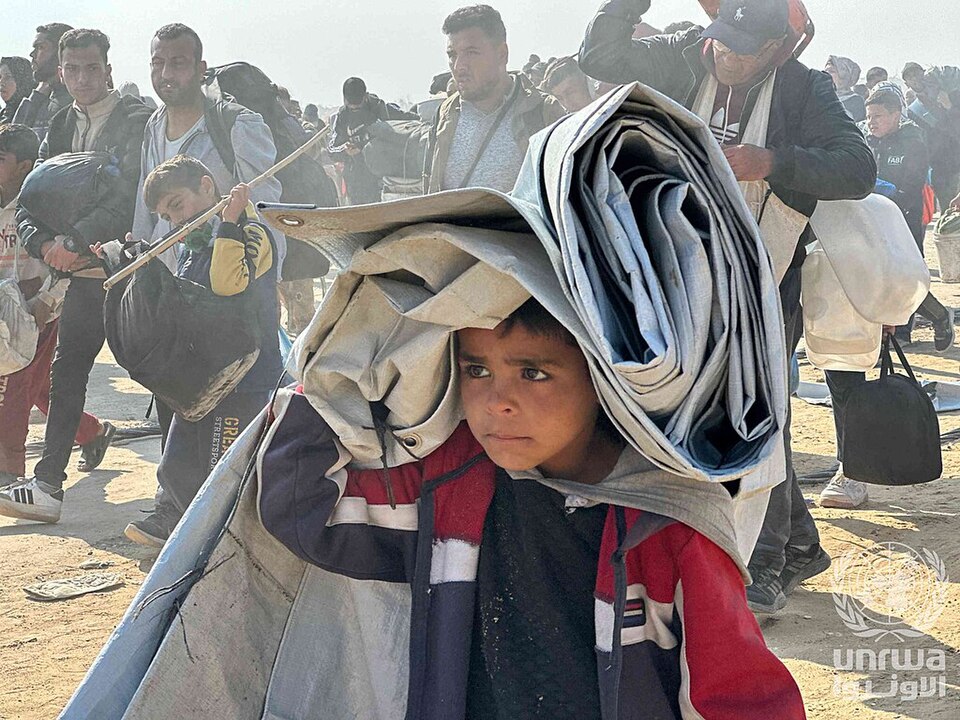
Return of displaced people via Al-Rasheed Street after ceasefire, January 2025, Gaza Strip. © 2025 UNRWA Photo by Hussein Jaber (Wikimedia Commons)
By: Rami Balin / Arab America Contributing Writer
As we have witnessed this livestreamed genocide for over three years now, many have come to view Palestinians as incredibly resilient. It is true – Palestinians in Gaza have persevered, enduring immeasurable losses and facing horrors that no words in any language are capable of describing. Against all odds, they have survived, becoming symbols of sumud, steadfastness, which is a part of Palestinian Indigenous knowledge. Despite that, by assigning the category of resilience to Palestinians, many people, including well-meaning activists, have placed them on a pedestal, painting a picture of monolithic victims with endless potential for withstanding any calamity that comes their way for unlimited amount of time.
In a conversation about the book “We Are Still Here,” a collection of stories written by university students from Gaza describing their experiences of the genocide, young writer Heba Abu Hussein insists: “People often say, you are so strong or you are heroes because you keep surviving. But honestly, I don’t like that idea. We are not superheroes. We are just ordinary people who have been forced to live through extraordinary circumstances, we don’t want to be admired for surviving. We want the chance to live a normal life.” She fervidly argues against the frame imposed on her people and herself, against a gaze that ensures she is seen as an embodiment of a resilient Palestinian rather than herself.
Heba Abu Hussein is not addressing an audience of Zionists – her words are meant for the people in solidarity with Palestine, those who are vocal about the Palestinian cause. How then is this discourse formed in response to the Zionist racist dehumanization of Palestinians?
The Palestine Exception
The settler-colonial violence inflicted on Palestinians daily has benefitted from the “Palestine exception” trope that places Palestine and Palestinians outside of the international law, or any kind of normative structures, rendering it a place where settlers can do whatever they want, committing any crimes they wish to commit without these crimes being recognized as such, let alone prosecuted. Whether they are wearing a uniform and therefore have the symbolic authority of the state attached or not, they are still settlers, a part of the same structure that functions across historic Palestine, from Jenin refugee camp to Gaza. This framework of exception affirms Palestinians’ place not only outside of the law but outside of the category of the human altogether. Rooted in racism, this status quo has formed the hegemonic discourse on Palestine and its resistance movements, rendering Palestinians faceless, voiceless, and lacking any kind of agency. In the best-case scenario, they are unfailingly suffering victims, with the cause for their suffering going unnamed and unaccounted for.
In his book “Perfect Victims and the Politics of Appeal,” Mohammed El-Kurd dismantles the structures, “the social and institutional order” that ensures the perpetuation of this dehumanizing discourse, tracing how it’s constructed, by whom, and how it is resisted. His critique then falls onto those who try to prove Palestinian humanity, including Palestinians themselves – the tactics of humanization. In his argument, attempts at humanizing Palestinians validate the need to humanize them in the first place, playing into the discourse of inherently racialized exception. No western straight cisgender white man will ever need to answer degrading questions in an attempt to appeal to the makers of the hegemonic discourse who are not predisposed to listen or sympathize in the first place. A Palestinian activist from East Jerusalem’s Sheikh Jarrah, Mohammed El-Kurd has experienced weaponization of this discourse first-hand, navigating the ever-present dialectic pitfalls that became more prominent after the onset of the genocide in Gaza.
In the midst of violence still perpetuated by Israel in Gaza, many activists have shown awareness of such discursive traps, with many rejecting them and attempting to shift the conversation by taking Palestinian resilience as a starting point, as a lens through which to discuss Palestinian culture, history and Indigeneity. Countering the system that insists on Palestinians’ perfect victimhood, this approach, however, is not unproblematic.
Towards a Different Discourse
October 10, 2026, marked a year since the ceasefire in Gaza. It is a ceasefire only in name: the killing never stopped, with Israel murdering approximately 1,467 people and wounding more than five thousand since the truce was announced. Ceasefires are meant to bring an end to hostilities and are usually viewed as the first step to achieving some form of peace, but in Gaza, “peace” exists only according to the Zionist regime and its supporters. Genuine peace begins when restorative justice is reached, until Palestinians in Gaza, and in all of historic Palestine, have their basic human rights, have the option to lead life as they choose, unhindered by the colonial system that currently defines every aspect of their every day. This bare minimum is still regarded as a mythical barely achievable utopia, particularly in the context of the violence currently being inflicted on Palestinians daily, from the massacres of people by the Israeli army to the prevention of food and other supplies from entering Gaza Strip and the subsequent impossibility of rebuilding and sustaining the population trapped within the area.
The “utopia” can’t wait, and the real work begins when we can all admit that Palestinians aren’t exceptional. They aren’t all-forgiving, all-enduring, endless, to be taken for granted. While it is important to recognize their struggle, idealizing it can ultimately lead to dehumanization, or super-humanization, the other side of the same coin. At the end of the day, there is a limit to what Palestinians can withstand, and steadfastness itself is not priceless. Life in Gaza, before and during the past three years, has had an immense toll on Palestinians: health and mental health issues, life-altering injuries and amputations, unlivable conditions, including constant exposure to chemicals and carcinogens, curtailed access to basic necessities and a myriad other aspects that fundamentally alter people’s existence, not to mention loss of life from all of the above. These are no small challenges, and the effects of most of them are going to be felt not just in the present and near future but for generations to come. For anyone, this is too much to bear.
The constant stream of images out of Gaza presents us ample evidence of Israeli crimes, but it also got us somewhat used to quotidian suffering of Palestinians. Another murdered child does not cause an immediate uproar – there have been so many of them. Just a few days ago, a three-year-old girl named Miriam got carried out of the fire in her bombed home after witnessing her mother burn to death. The world should have stopped – but it didn’t. We have gotten accustomed to this.
Made an exception to all rules, Palestinians were deemed less than human by the Zionist colonizers of Palestine. At the same time, they became trapped not only in the cyclical settler-colonial violence but in the images and tropes made of their suffering. Palestinian lives aren’t monuments to their own steadfastness – they are ongoing, despite the losses, rooted in the now. Affirming them is imperative, and the language we use to describe these lives makes a difference in global perceptions of Palestinians, their needs, and possibilities for their futures.