Subscribe
to receive news by email

Poll
Will the Trump Administration Shift U.S. Policy in Favor of Palestine?
- No (87%)
- Yes (13%)
 Loading ...
Copyright © 2026 Arab America
Go topHow Climate Change Threatens Arab Archaeology
By: Ramsey Zeidan / Arab America Contributing Writer
Anthropogenic climate change is by no means a new issue. As of recent, however, scientists are sounding the alarm on a new facet of global warming: archaeology. Industrial activity and urban development in tandem with worsening climate have endangered key archaeological sites. The Middle East is faced with a time of reckoning: will it unite against climate change to protect its history?
An Emerging Problem
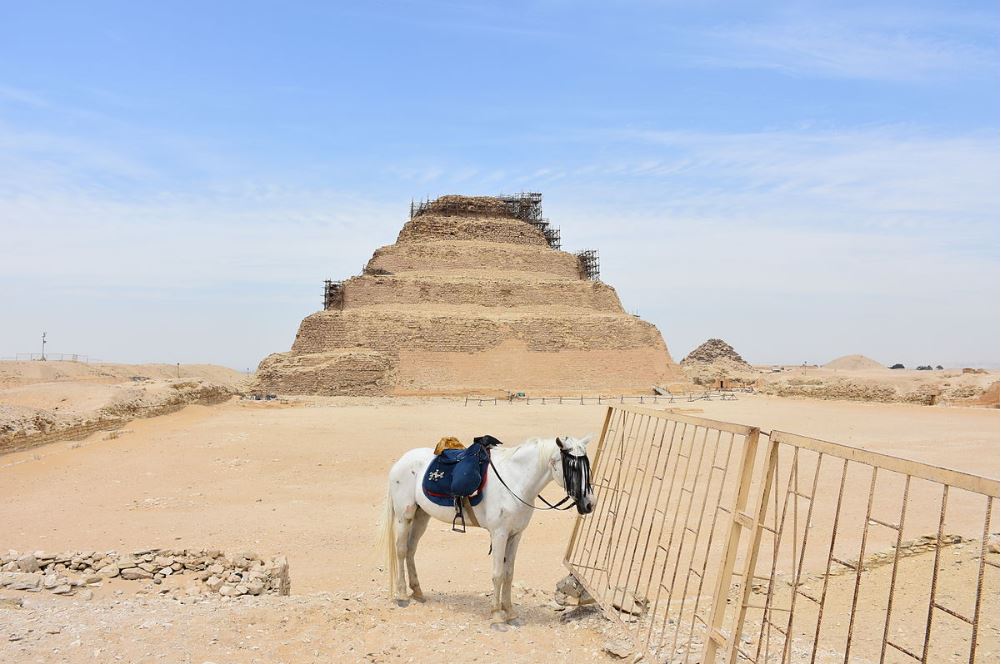
Experts were aware of climate change’s threat to livelihood and current human development, but focus hasn’t been placed on archaeology until recently. A study from 2022 found the majority of the Mediterranean’s UNESCO heritage sites are under imminent threat from climate change, and by extension, the Middle East faces a similar problem. Droughts, wind and water erosion, and anthropogenic activity exacerbate the often-harsh weather that ruins archaeological sites. For example, archaeologists warn that hundreds of pyramids could soon be entombed by sand. Sandstorms and arid weather are markedly worse thanks to global warming, worsening this problem.
Nevertheless, a key player in preserving valuable archaeological sites has made leaps and bounds of progress. The Endangered Archaeology in the Middle East and North Africa (EAMENA) project at Oxford developed a database bringing together satellite imagery and published reports to compile threatened archaeological sites. As evidenced by their work, EAMENA has already demonstrated why climate change is a real threat.
Case Studies – Human Activity
The Eastern Desert of Egypt has quite an unforgiving mountainous climate. It also happens to be home to ancient Roman army forts, which connected the Nile Valley and the Red Sea. According to EAMENA, these Roman military sites are crucial to understanding Roman history in modern-day Egypt. Unfortunately, these sites are facing looting, vandalism, and most importantly, pollution from nearby human activity. EAMENA noted that whether intentional or not, construction of roads through these sites exacerbates their destruction. One building in particular named El-Hamra is less than 10 meters away from a main road, putting it at major risk for damage from pollution. Combine the threat of worsening desert climate and pollution from industrial activity, and it’s a recipe for disaster.
Another case study documented on the EAMENA website is the Madaba Ring Road project in Jordan. Upon examination, a prospective transportation project was found to cut through over 140 potential historical sites. Cultural heritage assets and archaeology that were otherwise lost to time were shored up thanks to EAMENA. Once again, the primary cause was industrial development.

Case Studies – Global Warming
The most immediate threat global warming poses to the archaeological sites of the Middle East is coastal erosion. A spatial analysis study published in the Journal of Island and Coastal Archaeology found a clear link between climate change and exacerbated disturbances to fragile archaeological sites. For example, coasts of the Levant contain dozens of ports, quarries, and occupation sites that now lie below sea level. Additionally, coastal sites in Sudan and Libya are also under constant threat of degradation.
To illustrate this threat, a good example is the port city of Qana in Yemen, which thrived circa 1st century BCE to 7th century CE. Qana features moorings, artifacts and even valuable shipwreck remains. Split by an isthmus on the coast, harbor sites in Qana have been greatly eroded by sediments. The site is continuously disturbed by storms and tides worsened by climate change. Moreover, scientists predict that sea level rise will also worsen flooding, further damaging valuable architecture.
What’s the Solution?
The obvious solution is to slow and reverse the effects of climate change, which is sadly unrealistic given our trajectory. Though it is possible to combat climate change by mitigating greenhouse gas emissions, it requires drastic, immediate change. So, what other options do we have?
To preserve what may be inevitably lost to time, archaeologists and historians have resorted to digitizing texts, artifacts and architecture. In countries like Syria and Iraq, cultural heritage agencies affiliated with the UN are making strides. Adapting methods like 3D visualizations used to preserve heritage during conflict for climate change has proven successful. In a race against time, researchers are also striving to document as many climate-affected sites as possible. EAMENA has been up and running since 2015, and it is still possible for the project to expand and succeed.
Droughts, coastal erosion, and a lacking budget make this problem more prominent than ever. The most important step to preservation is convincing governments to invest in their nation’s cultural heritage. Without history, people cannot move forward effectively. The cultural heritage of the Middle East is some of the richest in the world, and we cannot afford to lose it.
Want more articles like this? Sign up for our e-newsletter!
Check out our blog here!