
Subscribe
to receive news by email

Poll
Will the Trump Administration Shift U.S. Policy in Favor of Palestine?
- No (87%)
- Yes (13%)
 Loading ...
Copyright © 2026 Arab America
Go topHow Egyptian Political Satire Transformed Youth Political Discourse
By Claire Keefe/Arab America Contributing Writer
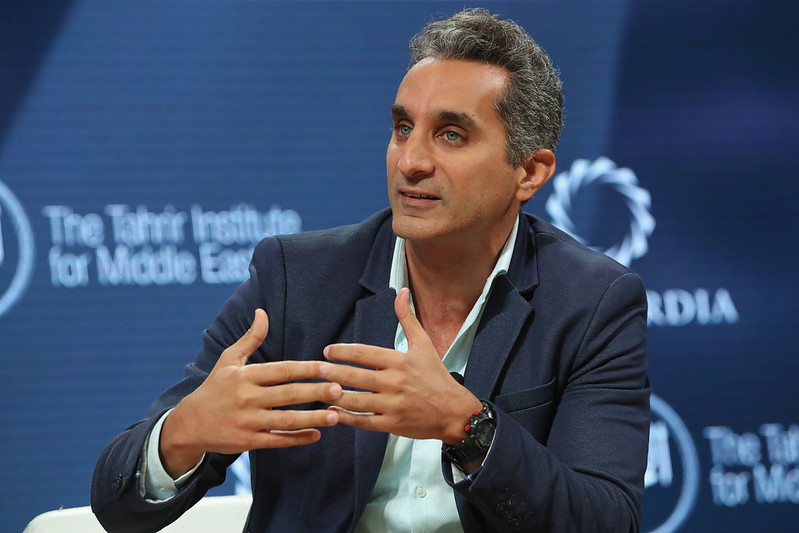
In the decade following the Egyptian Revolution of 2011, the country of Egypt experienced not only a political upheaval but also a cultural shift in how citizens, especially younger generations, interacted with politics. One of the most influential forces behind this transformation was the satirical television show Al-Bernameg, which was hosted by Bassem Youssef. By using strategies such as humor, media critique, and strong commentary, the program redefined political discourse. Ultimately, this made politics easier to access and participate in everyday life.
Satire as a New Political Language
Before the taking off of Al-Bernameg, political discussion in Egypt was typically dominated by formal rhetoric and controlled narratives. Public discourse was usually cautious, resulting in limited space for dissent or open criticism. Youssef’s show broke away from this country’s tradition by introducing satire as a mainstream outlet of political engagement. Inspired in part by programs like The Daily Show, Al-Bernameg used humor not only to entertain the audience but also to question authority and uncover issues in political messaging.
A key element of the show’s popularity was its use of colloquial Egyptian Arabic, as it is the most widely understood Arabic dialect heavily influenced by film and media. By abandoning formal language in favor of everyday speech, Youssef made complicated political issues more understandable and relatable. This change empowered younger audience members to become more involved with politics in their own words, fostering a more personal and quicker connection to current world events.
Breaking Barriers to Political Participation
One of the most meaningful impacts of Al-Bernameg was its ability to draw once disengaged youth into political conversations and settings. For many young Egyptians, politics had long felt distant or even too risky to discuss openly. The show changed this dynamic by creating an inviting theme that was both engaging and disarming.
By using comedy, Al-Bernameg encouraged audiences to challenge authority and think deeper about political developments. It humanized political figures, often showing them as imperfect or contradictory, which ultimately made them seem less intimidating. In doing so, the show helped dismantle the idea that politics were only meant for elites or experts.
The Rise of Digital Political Culture
The influence of Al Bernameg reached far beyond television screens. Clips from the show circulated widely on platforms such as YouTube and Facebook, where younger generations of people shared and reinterpreted its content. This digital spread expanded its reach and helped contribute to the emergence of a more participatory political culture, especially among younger generations.
Young Egyptians even began to adopt the show’s tune, sarcasm, and boldness in their online interactions. Memes and parody videos became common forms of political expression. In this way, Al-Bernameg did not merely reflect changing attitudes; it actively shaped a new mode of participation that blended entertainment with civic discourse.
Criticism
Despite its popularity and influence, Al-Bernameg also highlighted the limitations of satire in politically constrained environments. As tensions in Egypt intensified, the show faced increasing scrutiny and censorship. It was ultimately taken off the air in 2014, underscoring the risks of challenging authority, especially through humor.
The show was seen to have played a prominent role in inciting and laying the ground for the Egyptian 2013 military coup against the country’s first democratically elected government and supporting its aftermath crackdown, killing of protesters, and massacres. El Bernameg endorsed the media clampdown that followed, which included the arrests of several media personnel, despite these actions being carried out by the military without due process.
For many young viewers, this creation was a reminder that while satire could open space for dialogue, it remained vulnerable to political pressure. The show’s cancellation showed the boundaries of free expression in Egypt and the challenges of sustaining critical media in restrictive contexts.
Impact on Youth Political Engagement
Although Al-Bernameg no longer airs, its legacy and impact continue to shape how young Egyptians talk about politics. It helped break barriers and normalize criticism. Additionally, it encouraged independent thinking and made political discussion more socially blended. Today, its influence can still be seen in online discourse, where humor and satire remain a main piece to how young people interpret and respond to political events.
In the end, Al-Bernameg helped transform political communication in Egypt by shifting it from a formal process to a more dynamic and comfortable exchange. By speaking the language of the people and embracing the strength of humor, the show empowered a generation to engage with politics in a new and meaningful way, an impact that remains strong despite its absence from the air.
Citations
Al Bernameg. (n.d.). In Wikipedia. Retrieved April 7, 2026, from https://en.wikipedia.org/wiki/Al_Bernameg
Kadry, M. (2016).The effect of El Bernameg TV show on Egyptian young viewers’ evaluation of Egyptian media figures [Master’s Thesis, the American University in Cairo]. AUC Knowledge Fountain.
https://fount.aucegypt.edu/etds/560
Want more articles like this? Sign up for our e-newsletter!
Check out our blog here!