Subscribe
to receive news by email

Poll
Will the Trump Administration Shift U.S. Policy in Favor of Palestine?
- No (87%)
- Yes (13%)
 Loading ...
Copyright © 2026 Arab America
Go topHow the Iran War Debate Lost Its Soul
By: Ghassan Rubeiz / Arab America Contributing Writer
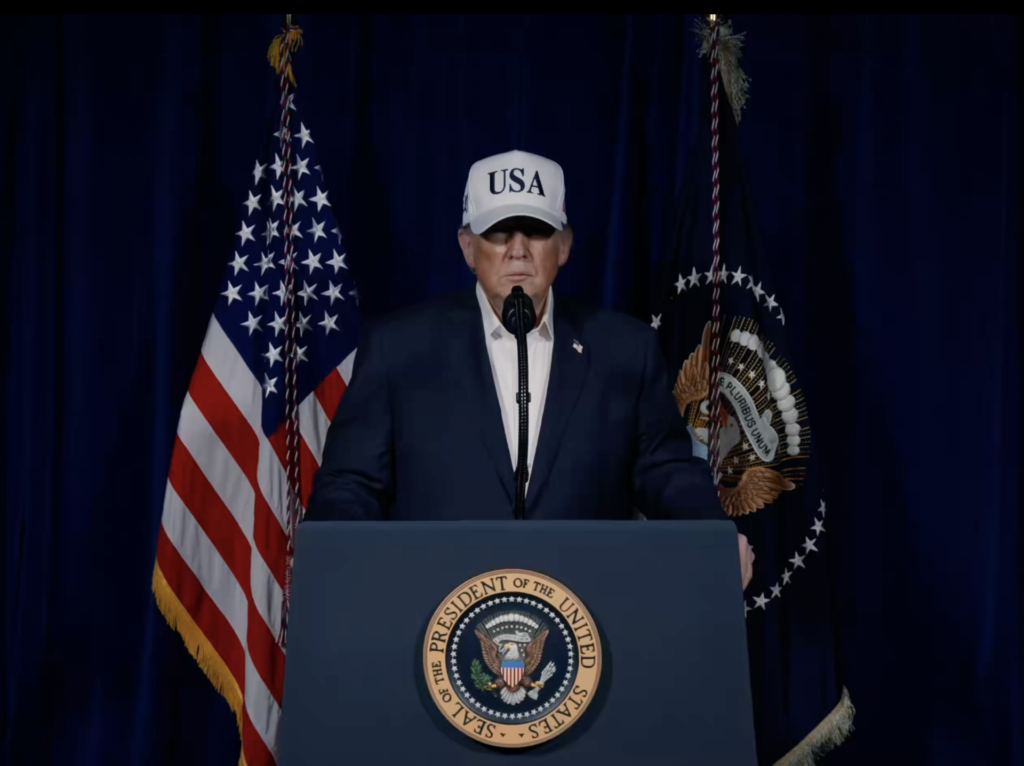
A stunning moral deficit in world politics widens as the Iran war continues. As Pope Leo XIV delivers an admonishing Easter message for “Those who have weapons to lay them down”, President Trump sends a corresponding, profane message to Iran: “Open the F—n’ Strait, you crazy b—–ds, or you’ll be living in Hell. “Just watch”, he continued, before ending sarcastically with the phrase “Praise be to Allah.”
Alarming, it is. Without a clear legal mandate or defined political objective, the United States and Israel have launched a devastating war against one of the oldest and most populous nations in the Middle East — and the world’s attention has focused almost entirely on the pocketbook.
Media coverage of the war with Iran is concerned almost entirely with economic anxieties—oil prices, shipping routes, market volatility, and the supply chains, etc.—while the moral stakes of the conflict have nearly vanished from public debate. The unabating Gaza genocide is forgotten by the world community. The ongoing ethnic cleansing in the West Bank is ignored. The current Israeli invasion and depopulation of South Lebanon is not getting the attention it deserves. Iran’s devastation is treated as a distant inconvenience rather than a human catastrophe.
The central questions of justice, sovereignty, accountability, and the right of people to live without perpetual siege have all been superseded by technical discussions about how to neutralize Iran’s defenses, keep oil prices low, or stabilize global trade. As the English historian E.P. Thompson once warned, societies can become “morally anesthetized” when violence is normalized. That is precisely what is happening.
Little attention is paid to the deeper structural issues that have shaped the region for decades: the concentration of wealth and power in some states and the grinding poverty in others; the absence of a regional security framework that includes both Israel and Iran; the demographic fragility of the Gulf monarchies; or the unresolved question of who is permitted nuclear capability and who is punished for pursuing one. Nor is there a consistent standard for condemning political violence—whether committed by individuals, militias, or governments.
Criticism of Iran’s regime is common, but acknowledgment of Iran’s legitimate grievances is rare. Few recall that the United States conspired with Britain to overthrow Iran’s first democratically elected government in 1953, replacing Prime Minister Mohammed Mossadegh with a monarchy aligned with Western interests. Fewer still mention that Washington supported Iraq during the Iran–Iraq war, a conflict that lasted nearly eight years and cost hundreds of thousands of Iranian and Iraqi lives. Meanwhile, Israel’s nuclear arsenal—developed with Western assistance—remains outside international scrutiny, even as Iran faces sweeping sanctions for its nuclear activities. As the political scientist Richard Falk once observed, “Selective legality is the enemy of genuine order.”
President Trump’s speech of last week and this week offered no clarity about how he intends to end the war. Will he deploy ground troops? Attempt to destroy Iran’s deeply buried nuclear sites? Declare victory and leave the international community to manage the closure of the Strait of Hormuz? Allow Israel to continue its bombing campaign after announcing an end to U.S. operations? And what incentives, if any, exist to bring Iran to the negotiating table? The latest from Trump is a new attack to “return Iran to the stone age” since it has refused to make a deal to open the Strait of Hormuz.
The world is left waiting—not only for the next military move, but for any sign of a political horizon. The problem is not simply strategic ambiguity. It is the near-total absence of a moral compass guiding the conversation.
The war began under the assumption that Iran—weakened and isolated after absorbing earlier strikes without mounting an effective defense—was on the verge of collapse. But Iran’s resilience in the current phase of fighting has surprised both Trump and Netanyahu, leaving them at a strategic impasse. Israel appears determined to continue the war, confident that its economy can absorb the strain and that its military technology will benefit from battlefield testing. Trump, meanwhile, faces mounting domestic and international pressure and appears increasingly uncertain about how to proceed.
The region’s conflicts are rooted not only in nuclear enrichment or missile ranges, but in decades of unaddressed grievances, political exclusion, and a persistent refusal to engage with the moral dimensions of war and peace. Until these issues are acknowledged—until the conversation shifts from economic metrics to human consequences—the Middle East will remain trapped in a cycle of violence, miscalculation, and moral blindness. A war prosecuted without a political endgame and debated without moral guidelines is a flawed strategy. In fact, it is a catastrophe in slow motion.
Ghassan Rubeiz is the former Middle East Secretary of the World Council of Churches. Earlier, he taught psychology and social work in his country of birth, Lebanon, and later in the United States, where he currently lives. He has contributed to political commentary for the past twenty years and has delivered occasional public talks on peace, justice, and interfaith topics. You can reach him at rubeizg@gmail.com
The views and opinions expressed in this article are those of the author and do not necessarily reflect the position of Arab America. The reproduction of this article is permissible with proper credit to Arab America and the author.
Want more articles like this? Sign up for our e-newsletter!
Check our blog here!