

Subscribe
to receive news by email

Poll
Will the Trump Administration Shift U.S. Policy in Favor of Palestine?
- No (87%)
- Yes (13%)
 Loading ...
Copyright © 2026 Arab America
Go topInfluence Without Intervention: China’s Influence in the Arab World
By Ben Samuels/Arab America Contributing Writer
In the Arab World, a region often shaped by military intervention, China wields influence without resorting to direct armed force, unlike countries such as the U.S. It consistently maintains a strategic position in geopolitical conflicts and international affairs. The Arab World shows these patterns. While China is rarely in mainstream coverage of recent conflicts, the U.S. is often criticized for its military involvement. Conversely, China builds economic partnerships and trade to extend its reach, while limiting its role in military campaigns. This approach lets China increase its influence in the Arab World while avoiding international criticism.
China’s Role in Saudi Arabia
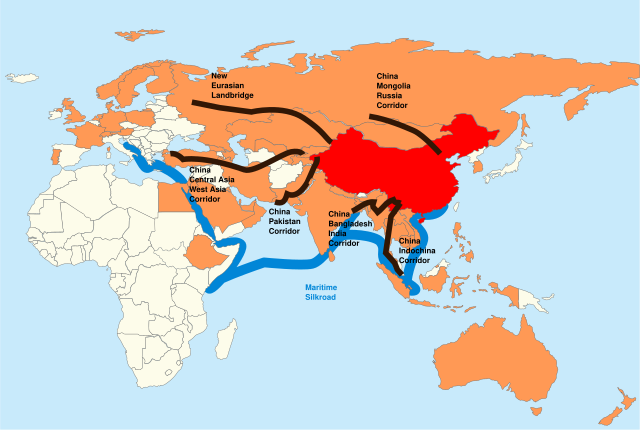
China’s influence in the Arab world has mainly advanced through economic partnerships and trade deals. This includes the Belt and Road initiative. The goal is to expand China’s global influence by investing in infrastructure in nations such as Saudi Arabia and Egypt. In Saudi Arabia, the Carnegie Endowment notes that China has aligned parts of the Belt and Road with the Saudi 2030 vision. That vision is central to Saudi innovation and economic growth. For example, during King Salman’s 2017 visit to China, the two nations signed fourteen agreements worth $65 billion. These included sectors like energy, education, and space science. This deal shows how China uses its initiative to advance Saudi Arabia’s interests, ensuring that both countries’ interests are served.
Saudi Arabia’s drive to move away from oil has accelerated these agreements with China to speed up diversification. However, this is more than an economic deal for China. The Belt and Road plan allows China to become ingrained in a nation’s long-term plans and infrastructure. In addition, between 2005 and June 2024, China’s total investment in Saudi infrastructure reached $53.85 billion. Of these funds, $31.45 billion came between 2016 and 2024. In total, China invested $13.93 billion in Saudi Arabia from 2005 to June 2024. Of this, $9.02 billion was invested from 2019 to June 2024. This shows the scale of China’s investment in Saudi Arabia. If the Saudis use these deals as a lifeline for their 2030 vision, China holds a dominant, long-term role.
China’s Role in Egypt
China also has a high interest in Egypt due to the Suez Canal’s importance. China has an export-focused economy. Each year, 12–15% of global trade passes through the Suez. This makes the canal a key sector for China. Chinese firms operate ports on the Suez to maintain some control. The Middle East Institute reports: “This coincides with significant Chinese investments in the Suez Canal Economic Zone, a 455-sq-km special economic zone along an important trade corridor.” The zones aim to attract foreign investment. China has taken advantage of this opportunity. Like Saudi Arabia, China has become embedded in the economic futures of nations like Saudi Arabia and Egypt through monetary investment.
Non Interference
Another main part of the Chinese plan to spread influence is an approach that avoids military intervention. The U.S has maintained a very high level of influence in the Arab World, both through economic investment and military intervention. This choice is very high risk as the U.S has faced harsh international backlash for operations in Iraq, Palestine, and most recently Iran.
China has chosen to stay away from this for various reasons. Besides avoiding international backlash, conflict would significantly disrupt trade and economic expansion, a main priority of the Chinese government in the region. For example, China hasn’t had to get involved in military operations in the Israel-Iran war, even though it has massive implications for the Arab World trade. This is due to their non-interference plan and their long-term investment plan, which has remained strong.
Conclusion
Overall, China’s influence in the Arab World remains tied to a non-military-oriented strategy that relies on trade deals to advance economic interdependence, and it ties China into long-term investment plans that will keep it interconnected with Saudi Arabia and Egypt for the foreseeable future. The lack of military intervention keeps China out of international trouble and protects its economic interests while remaining ingrained in the future of the Arab World.
Want more articles like this? Sign up for our e-newsletter!
Check our blog here!