Subscribe
to receive news by email
Poll
Will the Trump Administration Shift U.S. Policy in Favor of Palestine?
- No (87%)
- Yes (13%)
 Loading ...
Copyright © 2026 Arab America
Go topJerusalem’s Linguistic Battle Over Arabic
By: Emma Campbell / Arab America Contributing Writer
A City Where Language Holds Power
Jerusalem functions as both a sacred city and a contested linguistic landscape. Within its boundaries, language is not neutral – it holds power, belonging, and resistance. Processes of Judaization1, and more specifically Hebraization2, deliberately elevate Hebrew’s prestige as a language while marginalizing Arabic. Since 1948, Israel has aspired to fully control the Palestinian region in support of Zionist ideology. These efforts intensified after 1967, when Israel began to illegally occupy East Jerusalem and West Bank territories through unlawful settlements.
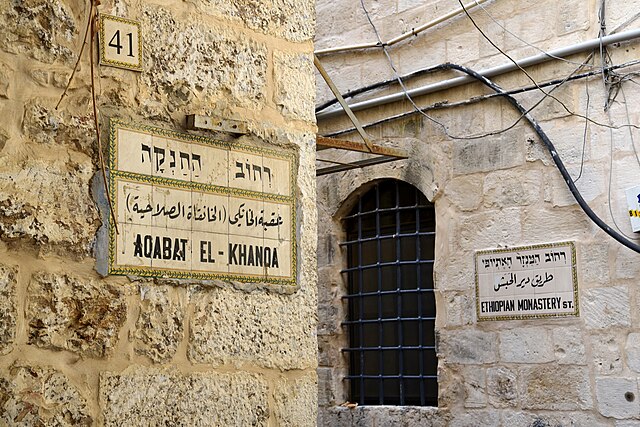
Central to these political aims is the manipulation of public signage. Through these mediums, a Hebrew-dominant linguistic landscape has become a tool for advancing a singular Israeli national identity at the expense of Palestinians. Since signage is the most visible and is used in everyday encounters with language, it is the clearest site where Arabic’s marginalization and persistence can be observed. Signs are not only functional markers but also symbolic texts, representing hierarchies of power, variation, and identity.
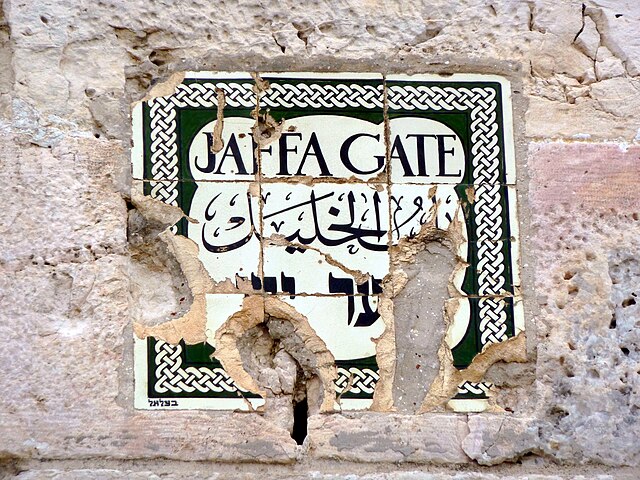
Hebraization of Public Space
With Israel’s seizing of Palestine in 1948, administrations have endeavored to Hebraize, and therefore Judaize, the space within the Palestinian region. Public signage became central to this process, subtly shaping collective narratives and authority. Following the 1967 illegal occupation of East Jerusalem and the West Bank, the Old City’s linguistic landscape was strategically reshaped to assert Hebrew dominance. Signs consistently placed Hebrew above Arabic and English, visually reinforcing hierarchy.
Hebrew was further privileged through distinctive typefaces and full vocalization, evoking religious authority, while Arabic lacked comparable diacritical marking. These practices elevated Hebrew’s symbolic prestige and diminished Arabic’s visibility. The absence of Harakaat in Arabic signage also reflects variation. While Hebrew is presented in a “high” standardized form, Arabic is visually stripped of its full phonological richness, reinforcing its subordination.
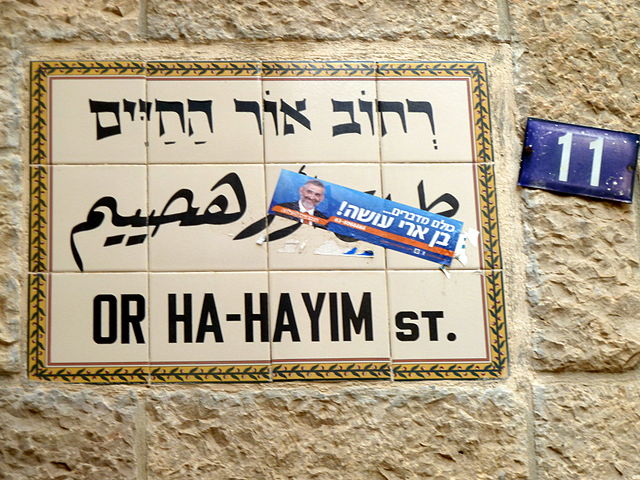
Language as a Battleground
Arabic’s persistence in Jerusalem’s signage constitutes enduring resistance to Hebraization and Judaization, maintained through community-driven prestige negotiations and symbolic attachment to place. Code-switching becomes part of the struggle, as Hebrew is imposed as the “high prestige” language within official signage. On the other hand, Arabic retains covert prestige through community use and symbolic attachment.
Palestinians may use Hebrew in official contexts to access institutions, but Arabic (whether Standard or colloquial) remains the language of identity, solidarity, and cultural continuity. Usage of Hebrew and code-switching are pragmatic strategies, enabling survival in a system that legally and symbolically privileges Hebrew. Some language transferring also occurs, with Hebrew lexical items entering Palestinian Arabic within bureaucratic and commercial domains, alongside Arabic colloquialisms seeping into Hebrew slang. These bidirectional influences highlight the permeability of linguistic boundaries, even as prestige hierarchies remain rigid.
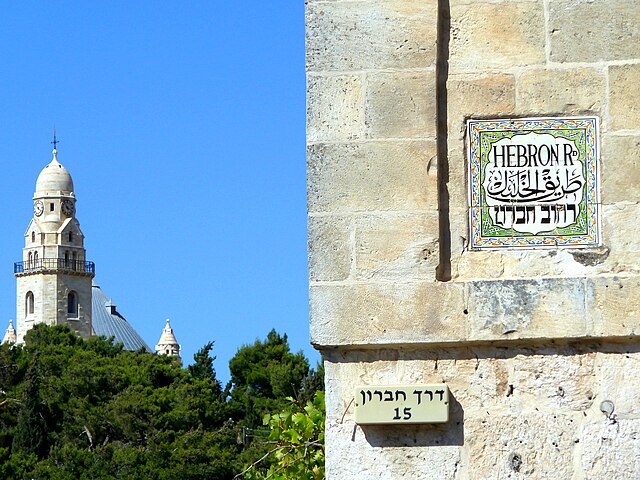
Variation and Identity
Variation within Arabic in Jerusalem, particularly between Standard Arabic and Palestinian colloquial forms, further complicates this dynamic. As signage often privileges formal Arabic, colloquial identity markers are erased. Standard Arabic functions as the “High” variety, associated with religion, heritage, and authority. Colloquial varieties are valued for their role in expressing intimacy and belonging. The coexistence of Standard Arabic in signage and colloquial Arabic in speech reflects a layered prestige system: higher prestige attached to Standard Arabic, and lower prestige attached to colloquial language.
Additionally, linguistic variation is encoded in social categories like class, region, and identity. Features like the pronunciation of ‘q’ versus ‘g’ index rural or urban identities, revealing layered prestige hierarchies. These findings underscore that linguistic choices in Jerusalem are not merely communicative but also carry ideological weight.
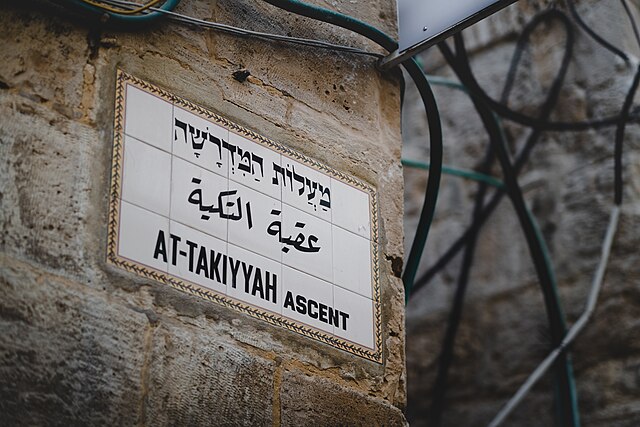
Endurance Amid Erasure
Jerusalem’s signage demonstrates that language is both a site of suppression and a medium of resilience. Official signs shaped by Hebraization elevate Hebrew’s prestige while diminishing Arabic’s visibility. Informal signs, however, assert Arabic’s persistence, utilizing both Standard and colloquial varieties to sustain identity. Ultimately, signage in Jerusalem is not merely functional but deeply political. It materializes contested hierarchies, encodes identity negotiations, and reveals strategies of resilience.
Want more articles like this? Sign up for our e-newsletter!
Check out our blog here!
Footnotes
- Judaization is “a policy through which the Israeli government aims to drive out any non-Jewish religious influences in Jerusalem in order to reinforce the Israeli claim to the area” ↩︎
- Hebraization is a subset of Judaization, focusing on the strategic sociolinguistic erasure of Arabic in favor of Hebrew – invoking significant language prestige ↩︎
Further Reading
Amer Dahamshe & Yonatan Mendel, Street Signs and Linguistic Landscape in the Old City of Jerusalem (2021)
Mylène Socquet‑Juglard, The Persistence of Silenced Toponymic Landscapes in Disputed Territories (2022)
International Court of Justice, Legal Consequences arising from the policies and practices of Israel in the Occupied Palestinian Territory, including East Jerusalem (2024)
Abdulkafi Albirini, Modern Arabic Sociolinguistics: Diglossia, Variation, Attitudes, and Identity (2016)
Elana Shohamy & Hanan Abu Ghazaleh‑Mahajneh, “Linguistic Landscape in Jerusalem: A Comparative Study of Arabic Visibility” (2011)
Melissa Buchweitz & Abed Al‑Rahman Mar’i, “Arab Teachers’ Perspectives on Language and Identity in East Jerusalem” (2023)
Ahmed Ech‑Charfi, “The Expression of Rural and Urban Identities in Arabic” (2021)
Thair Kizel, The Sociolinguistic and Pragmatic Factors that Influence Arabs in Israel to Speak Hebrew (2017)
Nadia Abdulgali Shalaby, “Language Attitudes in the Arab World” (2021)
Camelia Suleiman, Jerusalem and the Limits and Affordances of Sociolinguistics (2023)
Alaa El Sharkawi, The Arabic Language: A Living Tradition (2017)
Al‑Quds Jerusalem, “What Does Judaization Mean and How Is It Implemented?” (2021)