Subscribe
to receive news by email

Poll
Will the Trump Administration Shift U.S. Policy in Favor of Palestine?
- No (87%)
- Yes (13%)
 Loading ...
Copyright © 2026 Arab America
Go topMonarchy vs Republic - How ruling styles have created animosity between Arab states
By: Taim Al-Faraje / Arab America Contributing Writer
The post-independence Arab World was filled with conflict on multiple fronts. Almost immediately after independence, or for some states during colonization, the First Arab-Israeli War began. Other conflicts include the Iran-Iraq War, the Tripartite Aggression, the Libyan-Chadian border conflict, etc. One may think these wars would be the biggest restraint on Arab success, growth, and unity. However, it was the split between monarchies and republics that plagued the Arab World the most.
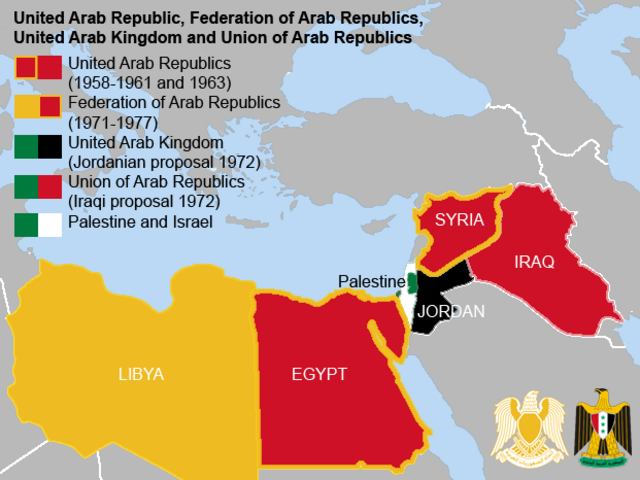
State Republics like Egypt, Syria, Iraq, and Libya were always present and optimistic at the negotiation table when it came to uniting the Arab World. These negotiations took place countless times, and conceptual unity arose from these talks quite often, such as with the Federation of Arab Republics. However, countries such as Jordan, Morocco, and the Gulf countries did not feel so warm towards the concept of losing their kingdom for the unification of the Arab states. This led to disagreements and animosity between these states, which led to conflict and war.
Statements and actions by republican leaders against Arab kingdoms
Outspoken leaders of republican states, like Libya’s Gaddafi or Egypt’s Nasser, often spoke about how Arab monarchies were harmful to the Arab world, a blessing to the oppressors, and needed to be eliminated if the Arabs wanted to see any advance.
Nasser vs. Jordan
Soon after, Syria and Egypt united and formed the United Arab Republic (UAR), with Nasser as its leader. Nasser became more outspoken on the issue of Arab kings and their unwillingness to give up power, even if it meant a stronger, united, popular force would take their place. Since the UAR was open to other Arab countries joining, such as Yemen, which intended to join the United Arab States process, Nasser saw the Arab countries that discouraged the unity as a threat to Arab prosperity.
A famous feud took place between Nasser and King Hussein of Jordan. Nasser viewed Hussein and Abdallah (the predecessor of Hussein) as selfish, unconcerned with the well-being of their people, and too open to foreign intervention. A major reason for this sentiment towards Jordan was that during the 1948 Arab-Israeli War, King Abdallah secretly negotiated with Zionist leaders to confirm his governance over the West Bank. Arguably, putting the thought of an independent Palestinian state to the side, among other reasons.

His feelings manifested, and he took action. Four days after the Iraqi revolution of 1958, which saw Iraqi Communists (supported by Nasser) overthrow their own king, Nasser declared that the “banner of freedom” would fly in Jordan, hinting at a people’s revolution against Jordan. Soon after, he directly called out the Jordanian monarchy:
“The king of Jordan sided with imperialism. … What is Hussein doing today, my brothers? What is he doing in his fortress in Amman? He says he is “continuing the mission”; what mission is Hussein continuing today? The mission of King Abdallah, who betrayed us in 1948. Today, Hussein — my brothers — continues the mission of his grandfather King Abdallah in 1948, who deceived us, and deceived the Arabs everywhere… Today — my brothers — there is treason and occupation in Jordan, [but] the treason shall end, and the occupation shall end, and the people of Jordan shall be victorious.”
This eventually led to a successful Nasser-led assassination of the Jordanian Prime Minister and other government targets, symbolizing Nasser’s role as the leader of Arab affairs and the leader of Arab unity. Anyone who stood in his path risked their dignity and, more importantly, their life.
Gaddafi vs. The Gulf
Gaddafi, ruler of Libya, was wildly against the monarchies of the Arab World, taking inspiration from Nasser and the Egyptian Free Officers. Although his rough impression of the monarchies never manifested into action, he constantly made remarks towards them, taking advantage of summits and meetings to speak up.

One of these instances occurred at the 2008 Arab League Summit. In his speech, Gaddafi detailed his dissatisfaction with the divided state of the Arab World. He felt that they put so much effort into fighting and spying on each other, instead of putting this effort towards a better cause. In it, he detailed that “[The summit is taking] place in Syria, which is an Arab country. But the relations Syria has with Russia, Iran, and Turkiye are 1000 times better than her relations with her Arab neighbors.” His point was that even though the Arab countries have shared political interests, culture, and religion, they maintain better relationships with everyone but each other. Instead, they fight in the way of each other when enemies have economically colonized and continuously manipulate them.
Conclusion
All in all, the uniting of the Arab states into a republic would produce immense benefits for all its citizens. Instead of enabling and cooperating with outside interference, the Arab World would benefit from having friendlier relations with its neighboring states than with those across the oceans.
Want more articles like this? Sign up for our e-newsletter!
Check our blog here!