

Subscribe
to receive news by email

Poll
Will the Trump Administration Shift U.S. Policy in Favor of Palestine?
- No (87%)
- Yes (13%)
 Loading ...
Copyright © 2026 Arab America
Go topMy Culture Is Not Your Costume: A Look at Orientalist Moroccan Fashion
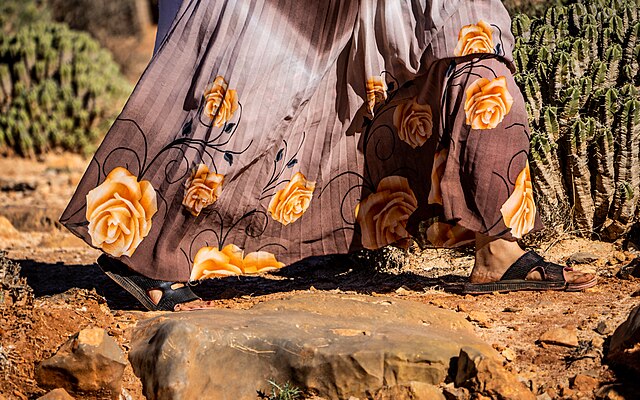
By Mitzi Tapang / Arab America Contributing Writer
When was the last time you felt good about an outfit you whipped up from your closet, despite, say, doing it on a whim? When was the last time you stopped and wondered whose shirt you’re actually wearing, jeans you’re donning, and shoes you’re strutting with? In an ever-growing web of capitalist relations, the decision that goes into picking an outfit does not simply mark a conscious desire to impress an employer or to look good for a friend you’re meeting after a decade. Each stitch, each twist, delicately dusted and crafted, may well be anchors of collective identity. That is to say: fashion is not passively fashion, but it is, for most of its invocations, an act of fashioning.
Along with the rapid turn of events over the century is the constant flux of discourse surrounding fashion, particularly concerns about traditional and modern ways of expression. After all, what persisted throughout the margins of history is the idea that fashion is the gateway to individual branding. In a manner, it acts so much as a signpost that dictates “Beware! You’re in, or perpetually out!” Fashion is tied to a community that carries the identification card of high society and, likewise, exclusivity (i.e., haute couture).
Moroccan fashion, in particular, is an interesting case because on one hand, it played a huge role in narratives of their resistance and emancipation; yet on the other, its image within realms of stylistic culture does not register as plainly as it does when one mentions Jane Birkin and her eponymous impact in Hermes, or Chanel, as in Coco Chanel’s Little Black Dress. Here, in the very midst of fashion’s embedded value system and expected coherence is where fashioning happens.
Moroccan Fashion and the Plight of the French Protectorate
During the French Protectorate in Morocco, France controlled the key levers of rule while keeping the sultanate in place formally, so Morocco was governed as a protectorate rather than an outright colony. In practice, that meant French authorities directed military defense, foreign policy, and much of the administrations, while also expanding economic control through infrastructure and land.
Under the Protectorate, dress could mark someone as urban or rural, Arab or Amazigh (Berbers), elite or common, religiously conservative or modernist, so it became a visible way to make identity legible in public. Ideas on “authentic” local dress came into great prosperity when nationalist writers and activists realized it could be mobilized as evidence of a distinct Moroccan community and as a rebuttal to colonial claims that Moroccans were culturally “lesser than” or weak.
The Berber Dahir of 1930 was a major rallying point because many Moroccans believed the French sought to divide the country and weaken Islamic and national unity. Above all, the Protectorate created the political conditions in which Moroccan identity or Moroccan-ness became something nationalist actively defined and defended. In such a climate, ordinary practices like wearing a local turban, caftan, haik, or regionally specific fabric could acquire nationalist meaning because they publicly asserted belonging to a collective. Dress, as overt and external to the group, turned into a sign that condensed protest into an immediate form.
Between the Fraught and the Fluid
As part of the broader project of modernizing and nationalizing Moroccan society, nationalists promoted the education of women for the development of the country. They began to send their daughters to schools where expectations of mobility and public participation inadvertently clashed with older forms of seclusion.
Since the traditional female outer garment, the haik, was highly impractical for school-going girls, many were allowed to adopt the more practical male outer garment, the djellaba. This provided them with freer movement and visibility in public spaces. This was, of course, met with strong resistance from conservative men, in equally conservative urban centres such as Fez.
Seen as a threat to established gender and religious norms, the trend, however, spread rapidly, and the djellaba itself became subject to dynamic fashion trends, with new colors and fabrics. With each added element was the continuous attempt to reshape its social and political resonance in a time where European algorithms worked earnestly.
The Timeless Spectacle of the Orient
In his seminal work, Edward Said contends that the Orient is a material part of European civilization and culture, not just adjacent to it. It is the source of its civilizations and languages, whose cultural fabric becomes contestant to its “deepest and most recurring images of the other.” Within the framing of the East as a British and French colonial and cultural enterprise, the Orient is at once categorized as unchanging and outside the timeline of European progress.
This symptomatic treatment of the radicalized Other finds itself, unwittingly so, beneath the foundations of fashion and what is considered fashion-able. Quite literally, Western clothing is fashion because it is dynamic, modern, and reflective of personal choice. Anything in opposition, that is non-Western, is uniform, ritualistic, and rooted in collective belonging. The primary goal is to turn cultural specificity into a simplified spectacle, or as an exotic “costume” that further bleeds into modern day fashion lingo.
On Modern Algorithms
At least in editorial fashion, stylistic practice and capitalism cannot be separated. Both sell a kind of lifestyle that is utmost aspirational and consumerist-friendly. And as far as consumerist-ideals are concerned, there are particularities within our established canons of taste and value. Particularities, that are in great part, played against the intentional backdrop of primitive exoticism.
Perhaps one potent discovery that emerged out of European observations and ‘travels’ is the importance placed on imperial uniqueness or the insistence of the English elite abroad to wear their European clothing to “avoid the temptation of going native.” Yet it is also this temptation that puts inexplicable emphasis on ethnic and geographical mobility that operates behind capitalist virtues, as seen in Dior’s Cruise 2020 show at El Badi Palace in Marrakech.
Fashion, as we know it, is indeed fashioning the ways we inhabit particular associations that are frankly violent beyond means of differentiation. It is this faux sensibility to ethnic-ness and the naive, surface-level introspection of national identity that bears, in consonance, the famous lament, “my culture is not your costume.”
Want more articles like this? Sign up for our e-newsletter!
Check out our blog here!