

Subscribe
to receive news by email

Poll
Will the Trump Administration Shift U.S. Policy in Favor of Palestine?
- No (87%)
- Yes (13%)
 Loading ...
Copyright © 2026 Arab America
Go topNorth vs. South Yemen: Ideological Roots and Lasting Impacts
By: Taim Al-Faraje / Arab America Contributing Writer
Preface
The areas referred to as “North” (green) and “South” (red) Yemen coincide with those shown in the photos below.
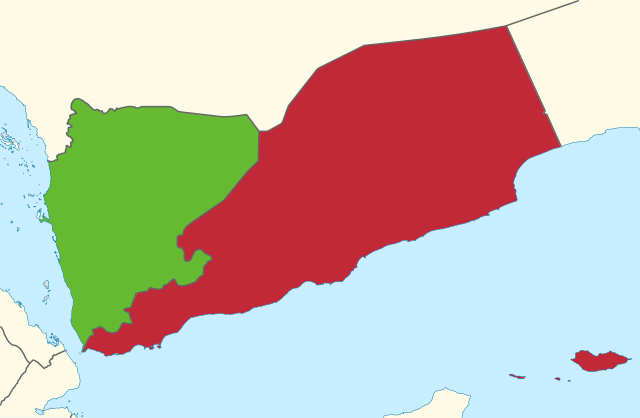
On a modern map, Yemen is one country spanning from the Red Sea to Oman. However, this was not always the case. The areas of today’s Yemen were divided going back 100’s of years. The north took the primary interest of major dynasties such as the Ayyubids, Mamluks, and Ottomans, as its location is right on the Red Sea, giving advantages militarily and economically.
On the other hand, South Yemen has a much more complicated history. The area was ruled by dozens of local tribe leaders, causing heavy fragmentation. This would continue to affect the area during British rule, which began with the occupation of Aden in 1839. They spread their influence throughout the Aden Protectorate until 1963, when local pressures forced the British into making Yemen a federation of Arab states, called the Federation of South Arabia. The Federation of South Arabia contained a group of rulers all governing areas within Yemen, giving the Arabs their local control, although South Yemen largely remained under British control in economics and foreign affairs until 1967.
In the Arab world, especially at this time, many Arab governments espoused ideas of Pan-Arabism, Arab Nationalism, and anti-colonialism, almost all popular liberation movements, and much of the Arab population. Across the Arab world, the issue of Yemeni unification was a major one, and all people wanted to see its success. Previous attempts at Arab unity, such as the United Arab Republic and the Federation of Arab Republics, had failed. By the time unification for Yemen seemed plausible, people had largely lost hope in a united Arab state. The unification of Yemen would put the dream back on its feet, being a light in the darkness of Arab politics.
North Yemen Between Their Colonial Era and Unification

As mentioned in the introduction, North Yemen had been a focus territory for empires that had any stake in the Arab region. Until today, the area of North Yemen is crucial as it connects the Arabian Sea (and effectively the Indian Ocean) to the Red Sea, which continues to Europe. This is why the Houthis, who largely control post-Arab Spring North Yemen, hold such an important role in the Arab-Israeli feud. The article will touch on this later.
North Yemen’s history over the past 100 years differs sharply from that of South Yemen and the rest of the Arab world because North Yemen was never formally colonized by the West. After the end of Turkish colonization in 1918, the Yemeni Imams who had previously ruled North Yemen and retained some of their power among the people established the Mutawakkilite Kingdom of Yemen. This took place as a result of the collapse of the Ottoman Empire and the power vacuum it created in the area. The monarchy was anti-West for the most part and supported the Arabs in the first Arab-Israeli War, even sending troops to help fight.
Nasserist Involvement With North Yemen
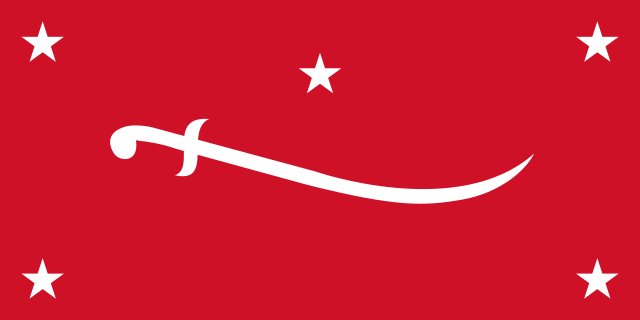
Although North Yemen wasn’t in support of the West, Abdel Nasser and the Arab Socialists believed all Arab monarchies were dangerous and reactionary, which led to Nasser’s funding of a coup that would overthrow the monarchist Imam of North Yemen. This led to the beginning of the North Yemen Civil War, one side being the Republicans, whom Nasser had funded. Their goal was to establish an Arab-Nationalist socialist state in Yemen that would, like Egypt, oppose the Arab monarchies.
Saudi Arabia funded the royalist imams on the other side of the war because they aligned more closely with its goals. The war ended in 1967 when Nasser and King Faisal agreed to withdraw from North Yemen after the Arabs suffered major losses in the Third Arab-Israeli War, although the war did not truly end until 1970 as Saudi Arabia continued funding the royalists under the table. Despite this, the Republicans successfully defended the capital and retained power until unification with the South.
Unfortunately, efforts of Pan-Arab unification failed as Abdel Nasser died in 1970, the year civil war ended in North Yemen, and Anwar Sadat did not emphasize Pan-Arabism. After beginning the Arab-Israeli Peace Process just a few years later, he lost the trust of all Arab leaders, effectively giving up any goal of Arab unification. This reflects his reversing of Nasserist policies and prioritization for Egypt-first policy.
South Yemen Between Their Colonial Era and Unification

Britain had somewhat comfortably ruled South Yemen until 1963 when an insurgency began with the goal of liberating South Yemen. The two parties who fought for independence during the insurgency were the National Liberation Front (NLF), whose main backer was the Soviet Union, and the Front for the Liberation of Occupied South Yemen (FLOSY), whose main backer was Egypt. Both fought alongside each other during the struggle, which ended victoriously in 1967. They exemplified similar characteristics, such as being anti-imperialist and Arab-nationalist, but their differences shone after independence. The NLF, backed by the Soviets, wanted to establish a Communist state, while the FLOSY, backed by Nasser, wanted to establish an Arab socialist state.
In the years following the insurgency, the NLF purged all non-communist members of their party and violently suppressed opposition, becoming the ruling party of Yemen. This led to the establishment of the Marxist state they had been dreaming of in 1970, becoming the first and only communist Arab state during its time. After this, they implemented a number of social reforms, aimed at increasing literacy, women’s rights, and putting an end to tribalism in Yemen. Although the Marxists put less emphasis on wider Arab unity, they greatly benefitted the people of Yemen, and were quick to sign unification agreements with North Yemen in 1990.
United Yemen from 1990 Until Today
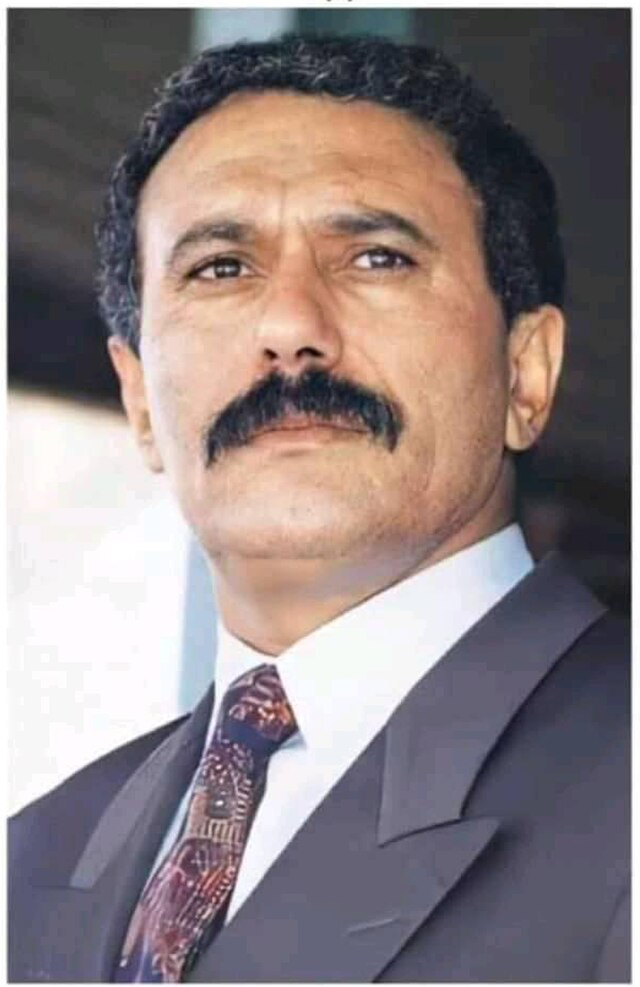
Between 1990 and 2011, Ali Abdullah Saleh ruled Yemen, having previously served as President of North Yemen since 1983. The Soviet Union backed South Yemen, but as the Soviets began to dissolve in the late 1980s, South Yemen lost the majority of its power. This led to North Yemen’s republican government dominating the new government of unified Yemen. Although loved at first, hatred for his regime grew gradually. It reached a peak in 2011 as a result of alleged dictatorship, totalitarianism, corruption, unemployment, poverty, and more.
After the Arab Spring began in 2010, a wave of uprisings flooded the Arab world, eventually making its way to Yemen as civil disobedience turned into riots and a full scale insurgency, lasting years. Although the original insurgency only lasted a year, a civil war broke out in 2014 and has continued until today, effectively splitting the country back into North and South. In modern times, the Houthis control the North; they began as a tolerant Shia theological movement and have since become one of the most controversial political forces in the Arab-Islamic world. Their main backers are Iran and Russia, and they’re characterized by their Khomeinism, alleged anti-Sunnism, and extreme anti-West/anti-Israel policy. Since the start of the Gaza War, many have praised the Houthis for supporting the Palestinian side and intercepting Israeli vessels traveling through the Red Sea.
South Yemen as of Now
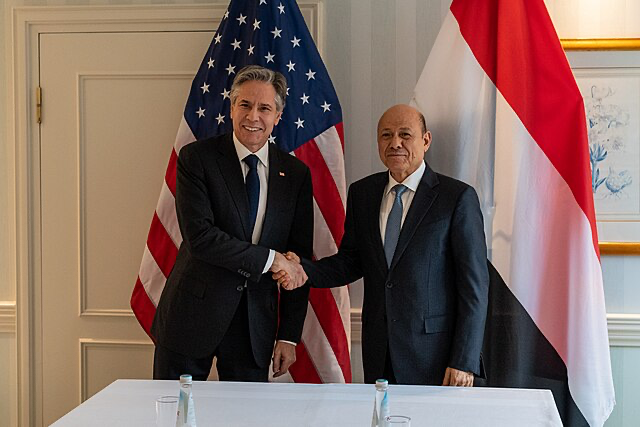
The Presidential Leadership Council controls southern Yemen, centralizes its power in Aden, and holds international recognition as Yemen’s official government. Their main backers have been Saudi Arabia, the UAE, and the USA, although in light of recent events, the UAE’s support for the PLC has been contested. They have increasingly supported the STC, which had been affiliated with the PLC until December of last year, when it broke with the PLC and declared its intention to establish a new South Yemen separate from the rest of the country. Due to the recency of these events, it’s hard for me to touch on them in this article. Despite the fact that the PLC is a vocal supporter of Palestine, it has faced scrutiny for not partaking in military action against Israel.
As of right now, the conflict in Yemen is a major step backwards since the time of unification. The people of Yemen deserve nothing but the best, and I hope one day to see a united Yemen where all Yemenis have access to basic needs and are in a position of strength, justice, and prosperity, alongside their Arab brothers.
Want more articles like this? Sign up for our e-newsletter!
Check our blog here!