
Subscribe
to receive news by email

Poll
Will the Trump Administration Shift U.S. Policy in Favor of Palestine?
- No (87%)
- Yes (13%)
 Loading ...
Copyright © 2026 Arab America
Go topNUSACC Leads U.S. Business Delegation to Tunisia
Where Ancient Carthage Once Dominated Trade, Tunisia Today Strengthens Commercial Relations with the USA
The National U.S. – Arab Chamber of Commerce (NUSACC) – America’s #1 commercial gateway to the Middle East and North Africa (MENA) region – has just completed a high-level trade & investment mission to the Republic of Tunisia. Delegates met with senior government officials, private sector leaders, academia, non-governmental organizations (NGOs), and multilateral entities (like the World Bank). The visit was strongly supported by the U.S. Embassy in Tunis and the Tunisian Embassy in Washington DC.
“We are grateful to the people of Tunisia for their heartfelt hospitality and their strong desire to promote commercial relations with the United States,” noted David Hamod, President & CEO of NUSACC. “Our delegation members identified opportunities in key sectors, including what we characterized as the ‘three securities’: Food security, national security, and financial security.”
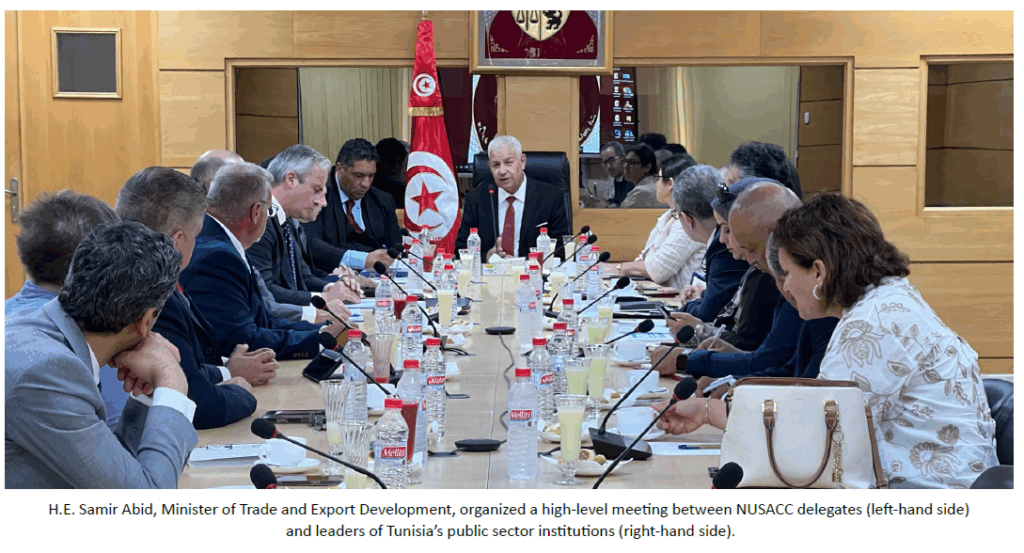
The high-level delegation was carefully curated by NUSACC, based on the companies’ expertise and their keen interest in Tunisia. Companies included Euronet Worldwide, General Atomics Aeronautical Systems Inc. (GA-ASI), Sorghum United, and Sukup Manufacturing Co.
“The U.S. Embassy in Tunisia is deeply committed to supporting the American private sector as companies explore opportunities in Tunisia,” noted Hon. Joey Hood, U.S. Ambassador to Tunisia. “American businesses bring innovation, expertise, and a spirit of collaboration that can drive job creation and economic growth. Tunisia offers unique advantages for U.S. companies, including its strategic location, skilled workforce, and growing sectors like aerospace, technology, and agribusiness.”
He concluded, “We are grateful to NUSACC for leading this high-level, multi-sectoral delegation to Tunisia.”
“The Embassy of Tunisia was proud to support NUSACC’s trade and investment mission to the Republic of Tunisia,” said H.E. Hanène Tajouri Bessassi, Tunisia’s Ambassador to the United States and a former recipient of NUSACC’s Ambassador of the Year award. “The Chamber has consistently proved to be an invaluable partner over the years, and NUSACC’s exceptional efforts have significantly strengthened Tunisia – U.S. commercial relations.”
“We especially commend David Hamod, NUSACC’s President and CEO, for being a true friend of Tunisia over the decades,” she added. “The Embassy extends its sincere appreciation to Team NUSACC for the Chamber’s impactful initiatives and continued success.”
NUSACC’s successful mission to Tunisia would not have been possible without strong support from the Chamber’s private sector partners in Tunisia. These included (in alphabetical order):
* AmCham Tunisia
* CONECT International
* International Food Show Africa (IFSA)
* Tunisian African Business Council (TABC)
* Tunis Chamber of Commerce & Industry
* UTICA – the Tunisian Confederation of Industry, Trade, and Handicrafts
U.S. Commercial Relations with Tunisia
Commerce has been driving U.S. – Tunisia relations since 1797, when the two nations signed the Treaty of Peace and Friendship, just two decades after America declared its independence from Great Britain. Tunisia was one of the first countries in the world to establish such a treaty with the young United States of America.
At a time when U.S. companies are looking to diversify markets and supply chains, Tunisia today offers a compelling proposition: A reform-oriented economy, a highly capable workforce, and an open door to Europe, Africa, the Middle East, and beyond.
The Potential Impact of Tariffs
During the delegation’s week-long visit to Tunis, many conversations revolved around tariffs, which the U.S. Government plans to raise to 25 percent for certain countries (including Tunisia) on August 1, 2025.
In 2024, according to the U.S. Census Bureau, total U.S. goods exports to Tunisia reached $500.9 million, while U.S. goods imports from Tunisia reached $1.12 billion. This trade imbalance of -$621.8 million makes Tunisia a target for reciprocal tariffs.
The anticipated hike in tariffs is a major setback for Tunisian exporters who, after many years, are finally gaining a foothold in the U.S. market. This is led by sales of olive oil, which grew to $480 million in 2024. According to the U.S. International Trade Administration (ITA), olive oil is by far the top export item to the USA, making up 59 percent of Tunisia’s goods exports to the United States in 2024, followed by fertilizers and insulated wires.
America’s top exports to Tunisia include soybeans, vinyl polymer, and ethylene polymers, according to the ITA. Put another way: U.S. grain exports to Tunisia play an important role in that nation’s food security efforts while, at the same time, if all U.S. aerospace categories were combined, they would cumulatively rank #2 in U.S. exports to Tunisia.
Tunisia’s imports from the USA reflect that nation’s growing economic diversity.
Driving Investment Through Innovation
Tunisia may be North Africa’s best-kept secret for innovation-driven investment. Anchored by strong ties to Europe and Africa – with growing economic linkages with the United States – Tunisia offers American businesses a cost-competitive market with skilled labor and preferential trade access to Africa, Europe, and the Arab world.
Home to more than 12 million people, with GDP growth on track to reach 2.8 percent in 2025 (according to the African Development Bank), Tunisia is on a roll economically, driven in part by innovation.
Tunisia’s innovation infrastructure includes:
• 200+ industrial zones
• 11 technoparks
• 10 competitiveness clusters
Tunisia’s success stories in innovation have helped to make that nation a potential hub in Africa for R&D and tech services.
ICT infrastructure and the digital economy are focal points for Tunisia’s innovation initiatives. In 2024, Tunisia has 2,250 Gb/s of national bandwidth and a diversified digital economy:
• 2,200 ICT companies
• $4.4 billion turnover
• 40,000+ direct jobs
Significant public investment is flowing into cybersecurity, fintech regulation, and mobile-based service infrastructure, further enhancing Tunisia’s potential for U.S. tech partnerships.
Tunisia’s Startup Act – the first of its kind in Africa – provides robust incentives for entrepreneurs and foreign investors, including grants, tax holidays, and fast-track visas. Over 700 startups are currently operating in Tunisia across fintech, edtech, and healthtech sectors.
Tunisia’s #1 Asset: Its People
In 1956, when Tunisia declared independence from France, President Habib Bourguiba spelled out a groundbreaking vision that granted citizenship rights and equality for the women of Tunisia. Today, nearly 60 years later, Bourguiba’s vision for equal rights continues to have an outsized influence, including impacts in education and the workforce.
Tunisia’s highly educated workforce is a major asset, with nearly 30 percent of university graduates specializing in science, technology, engineering, and mathematics (STEM) fields.
Tunisia produces 60,000 university graduates annually, with 18 percent in engineering or Information and Communications Technologies (ICT). Labor costs are globally competitive, with average engineering wages of between €300 and €400 per month, according to FDI Benchmark.
Tunisia today is working to align higher education with marketplace needs, and U.S. companies are playing a role in that process. Such alignment is important. The unemployment rate for university graduates is around 30 percent and, according to the African Development Bank, about 40 percent of graduates hold humanities degrees for which there is little market demand.
Tunisia as a Manufacturing Hub
There are more than 4,000 foreign companies operating in Tunisia, employing approximately 450,000 people (one in six Tunisians). Over 70 U.S. companies are active in Tunisia, collectively employing over 12,000 Tunisians, according to the Foreign Investment Promotion Agency (FIPA).
U.S. FDI reached TND 117 million ($37.5 million) in 2024, according to FIPA. This was on the strength of multi-year American corporate commitments exceeding $100 million in the automotive sector by such U.S. firms as Lear Corporation and Visteon, as well as Pursuit Aerospace.
Tunisia’s manufacturing sector – particularly in automotive components, aerospace, and textiles – benefits from proximity to European supply chains and preferential market access through the EU Association Agreement.
Tunisia’s strategic location in North Africa – across the Mediterranean Sea from Europe and within three hours of most Arab world capitals – supports Tunisia’s ambitions as a regional export platform. It is integrated into AfCFTA, COMESA, and the AGADIR Agreement, giving tariff-free access to over 625 million consumers. The country maintains 52 double taxation treaties and 54 bilateral investment agreements, according to FIPA, helping to create investor certainty and market diversification.
The Potential for Economic Reform
Foreign Direct Investment (FDI) inflows rose to $936 million in 2024, up 21 percent from 2023, according to the U.N. Conference on Trade and Development (UNCTAD). FIPA says that FDI in Tunisia grew over 26 percent year-on-year in the first quarter of 2025 to $231.1 million.
Tunisia’s economy is gaining momentum, but there is room for economic reform. Tunisia faces persistent structural challenges that hinder sustained economic growth and job creation.
For example, high public debt – exceeding 80 percent of GDP – is a strain on the national budget. Inflation remains elevated, and unemployment – a key economic indicator – is hitting youth and university graduates particularly hard.
Tunisia’s decision to undertake structural economic reforms consistent with that nation’s vision are starting to pay off. The economy has shown resilience in the face of such external shocks as COVID and the war in Ukraine, which hit Tunisia especially hard.
Recognizing the central role of youth in crafting the future, the Government of Tunisia is taking important steps to overcome the challenge of high unemployment by launching – with support from multilateral entities – a process of reforming higher education to meet demands of the rapidly evolving job market.
In April 2025, for example, Tunisia signed an agreement with the World Bank that dedicates $100 million to strengthen higher education and employability in the marketplace. The goal of this program will be to equip graduates with skills needed for such emerging sectors as the digital economy and green technologies.
For Tunisia, making further progress in economic reforms would have a major positive impact on job creation and long-term FDI inflows.
U.S. – Tunisia Security Partnership
Tunisia has undergone a dramatic security transformation in the past decade, in part because of U.S. assistance. Ten years ago, in 2015, Tunisia was on the front lines of the fight against the Islamic State (ISIS). Today, Tunisia is one of the safest, most secure nations in Africa and the MENA region.
Since its designation as a Major Non-NATO Ally in 2015, Tunisia has received consistent Foreign Military Financing (FMF) from the United States, currently standing at around $45 million annually. These funds support counterterrorism, border security, and military training initiatives, with Tunisia typically matching U.S. funds to emphasize mutual cooperation.
The U.S. Department of Defense views Tunisia as a key regional security partner. Tunisia hosts joint training programs with U.S. forces, shares intelligence on transnational threats, and actively supports regional peacekeeping and maritime security. The U.S. Embassy in Tunis says that Tunisia is “exporting stability,” with its security forces playing a proactive role in regional crisis prevention.
This evolving security partnership reinforces Tunisia’s image as a reliable and forward-leaning ally, providing the kind of stable, secure environment that enables sustained U.S. private sector engagement.
Tourism as an Economic Driver
According to Tunisia’s National Tourism Office, the Republic of Tunisia is on track to receive over 11 million visitors in 2025, up 11 percent year-on-year. These are Tunisia’s highest numbers since the onset of the COVID pandemic.
“Tourism is now among the top sectors contributing to the inflow of foreign currency into the national economy,” says Mohamed Mehdi Haloui, head of the National Tourism Office. Key indicators for visitor numbers, overnight stays, and revenue are all showing upward trends based on improved air connectivity, a resurgence in traditional European markets, and more effective promotional strategies.
According to the World Bank, tourism in 2024 accounted for 10 percent of the global economy, contributing $10.9 trillion to global GDP. That sector supported 357 million jobs worldwide, approximately one in every ten jobs, highlighting its central role in the marketplace.
Tourism in Tunisia is a major economic driver, contributing an estimated 14 percent of that nation’s GDP and creating or sustaining hundreds of thousands of jobs. COVID eviscerated tourism in Tunisia – and around the world – and nations are only now reaching full recovery. In the words of Director General of the Tunisian National Tourism Office (ONTT) Haloui, “We are back on the map.”
To read the full report, please click here.