Subscribe
to receive news by email

Poll
Will the Trump Administration Shift U.S. Policy in Favor of Palestine?
- No (87%)
- Yes (13%)
 Loading ...
Copyright © 2026 Arab America
Go topPathbreakers of Arab America—Betty Shamieh

By: John Mason / Arab America Contributing Writer
This is the ninetieth in Arab America’s series on American pathbreakers of Arab descent. The series features personalities from various fields, including entertainment, business, sports, science, the arts, academia, journalism, and politics. Our ninetieth pathbreaker is Betty Shamieh, a Palestinian American playwright, author, screenwriter, and actor. Betty became the first Palestinian American to have a play premiere off-Broadway with the 2004 premiere of ‘Roar.’ Samieh has authored 15 plays and is the recipient of many honors.
Distinguished playwright and author Betty Shamieh sheds a bright light on issues of Arab women’s integration into the complex American landscape
Betty Shamieh is a Palestinian American born in San Francisco, California, in 1971. She earned her credentials as a playwright, author, screenwriter, and actor through her studies and degrees from Harvard University and the Yale School of Drama. Shamieh became the first Palestinian American to have a play premiere off-Broadway with the 2004 premiere of ‘Roar,’ a drama about a Palestinian family. In 2004, she was a Clifton Visiting Artist at Harvard University and was selected as a Playwriting fellow at Harvard University’s Radcliffe Institute for Advanced Studies in 2005.
Some of Shamieh’s honors include a Sundance Theatre Institute residency award, a New York Foundation for the Arts fellowship, a New Dramatists Van Lier fellowship, a Ford Foundation grant, a Yaddo residency, an Arts International grant, and a Rockefeller Foundation residency in Bellagio, Italy. She was also awarded a playwriting grant from the National Endowment for the Arts and Theatre Communications. Her off-Broadway play, the ‘Roar,’ was the New York Times Critics’ Pick for four consecutive weeks.
Shamieh, according to her website, is currently a professor at Marymount Manhattan College in New York City. She also serves on the Screenwriting/Playwriting Advisory Board for the New York Foundation for the Arts and is working on a commission from Time Warner/Second Stage Theatre, as well as a first novel. Shamieh performed in her play of monologues entitled ‘Chocolate in Heat – Growing up Arab in America’ at its sold-out premiere at the New York International Fringe Festival in August 2001. The play has been performed twice off-Broadway and at over 20 university theaters and venues.
As a Palestinian American, one of Samieh’s strengths is in promoting intercultural dialogue between Arab and Western cultures. Based on that strength, she was one of 20 young artists recognized by UNESCO for promoting intercultural dialogue. In that vein, she developed a solo show, ‘The Alter-Ego of An Arab American Assimilationist.’ Performing in the play herself, Betty told an interviewer of ‘The Montreal Review,’ that “nothing compares to the joy and challenge of performing in my own work, particularly comedic work. I believe the field of solo performance has its roots in the ancient oral tradition of storytelling.”
In that same interview, Shamieh was queried about how “the inherent link between your Palestinian American identity and your expressions as an artist comes across in versatile ways.” Despite what the interviewer described as “the constant messages of defeatism that were rife in your community,” Betty replied, “The main goal for many immigrants is to assimilate into their new culture. The reason for this is the belief that a person cannot succeed if they clearly identify themselves as different, a belief rooted in fear. Because there are so few people of Arab descent working in the arts in America, there was – in our community – a perception that we are being excluded.”
Continuing in the same interview, Shamieh noted that she believes the cultural weave and warp of America includes racism, but at the same time, “one can choose to see it as a challenge that can be overcome. The role we play in our own marginalization is what I tend to emphasize when speaking to Arab and Arab American audiences, because I believe it is the only aspect of our experience that we can influence or control.” She further averred, “Being connected to two cultures, particularly two cultures that are sometimes at war, gives one insight into what is common about all human beings.”
Shamieh’s new novel, ‘Too Soon,’ addresses the next generation of Palestinian Women’s role in the American family and society
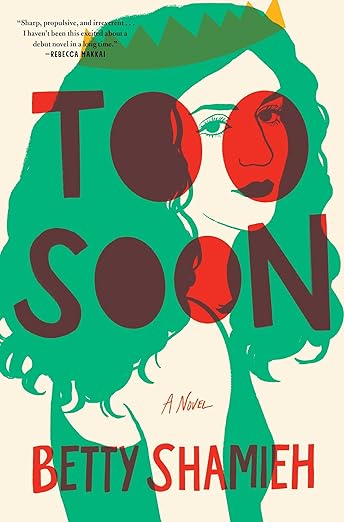
Shamieh describes parts of ‘Too Soon’ in her own words:
In the first chapter of my book, ‘Too Soon,’ we find a grandmother who, despite having chafed considerably under the yoke of marriage and motherhood, rings up her last unmarried American granddaughter to unsettle her about her life choices and cajole her into focusing on finding a man in time to have children, though the freedom of being an unfettered artist and intellectual is exactly the kind that the grandmother always craved.
My takeaway from writing and reading other sagas about three generations of Palestinian American women in this current cultural moment was that redemption takes many forms…..Through the act of uncovering our grandmothers’ secrets, we writers face the dark truth that we will soon contend with our own secrets. We are living through a time that is arguably as traumatic as any other in the Palestinian story. It’s myopic to believe the powerlessness we feel in the face of so much unrelenting violence, an impotence so immense it cannot be fully processed, will not inevitably affect how we parent, probably not all for the good.
In yet another interpretation of Shamieh’s work, a review of her play, ‘The Black Eyed,’ we get a harsher view of Arab women’s disempowerment. Here we see “the traumatic effects of the discrimination, oppression, and exploitation that Arab women have been enduring for long years in Palestine and today in the United States [in their role as] immigrants and minority.”
A further assessment of ‘The Black Eyed’ reflects an even more devastating view of the oppression of Arab women: “The playwright’s unique representation of different ages, by creating a woman character that symbolizes that era with her story, ends with today’s marginalization of Arab people due to the USA media’s discriminative representation of Islamic nations. This paper from a Marxist-feminist perspective demonstrates how Arab American playwrights, such as Betty Shamieh, work hard to display the difficult conditions Palestinian women live with due to the never-ending war with a criticizing but touching tone.”
While the truth sometimes hurts, it is from brave souls like Betty Shamieh that we arrive at an understanding of the feelings underlying the truth. Long live such literary interpreters of culture and society as Betty Shamieh.
Sources:
“Betty Shamieh,” Wikipedia Series on Arab Americans, 2025
“Betty Shamieh,” Betty Shamieh Website
“Interview with Betty Shamieh,” Interviewed by Mohammad Aslam, ‘The Montreal Review,’ 2012
“Interview with Betty Shamieh,” ‘Works by Women,’ 2017
“Betty Shamieh on the Next Generation of Palestinian Fiction,” ‘Literary Hub,’ 1/22/2025
“Arab Women and the War in Palestine: A Study of Betty Shamieh’s ‘The Black Eyed,’” Academia, no date
John Mason, Ph.D., focuses on Arab culture, society, and history and is the author of LEFT-HANDED IN AN ISLAMIC WORLD: An Anthropologist’s Journey into the Middle East, New Academia Publishing, 2017. He has taught at the University of Libya, Benghazi, Rennselaer Polytechnic Institute in New York, and the American University in Cairo; John served with the United Nations in Tripoli, Libya, and consulted extensively on socioeconomic and political development for USAID and the World Bank in 65 countries.
The views and opinions expressed in this article are those of the author and do not necessarily reflect the position of Arab America. The reproduction of this article is permissible with proper credit to Arab America and the author.
Want more articles like this? Sign up for our e-newsletter!
Check out our blog here!