
Subscribe
to receive news by email

Poll
Will the Trump Administration Shift U.S. Policy in Favor of Palestine?
- No (87%)
- Yes (13%)
 Loading ...
Copyright © 2026 Arab America
Go topPathbreakers of Arab America—Heather Raffo
By: John Mason / Arab America Contributing Writer
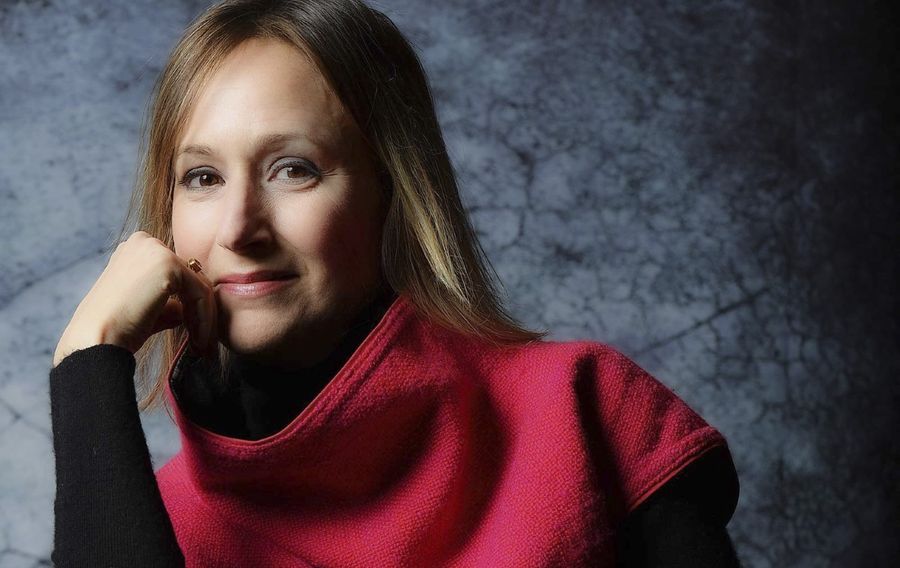
This is the ninetieth in Arab America’s series on American pathbreakers of Arab descent. The series features personalities from various fields, including entertainment, business, sports, science, the arts, academia, journalism, and politics. Our ninetieth pathbreaker is Heather Raffo, an American born to mixed Iraqi-American parents. She is an eminent playwright who addresses issues as sensitive as Iraqi women affected by war and repression; an American Marine deeply affected by war in Falluja; and her two countries, Iraq and the U.S., both facing serious issues of internal division.
Award-winning Iraqi American playwright and actress, Heather Raffo, shows Iraqi women reacting to warfare as an example of how art can remake the world
Raffo was born in Michigan to an Iraqi-born father from Mosul and an American mother. She grew up in Okemos, Michigan, and has lived in New York City for thirty years. Heather holds a BA from the University of Michigan, where she studied Literature and Theater, and graduated Magna Cum Laude in Literature. She then received an MFA from the University of San Diego, followed by studies at the Royal Academy of Dramatic Art in London.
Heather visited Iraq with her family a few times as a youth. There, she discovered her father’s birthplace, his Chaldean religious affiliation, and his role as a civil engineer. During her time in Iraq, Heather visited the house where her father was born and the churches built from marble by her grandfathers. She discovered that the Chaldean community in Iraq predated Christianity, as they were some of the first to convert to the faith, thereby having existed as a connected community for almost 2,000 years.
Even as a Christian, Heather felt that her people were “part of an ancient melting pot of many ethnic and religious minorities. if they were living outside the country, Iraq was the home to which they might someday return. I’m not sure that is true today. When ISIS overtook Mosul in 2014, many Christians felt Iraq was simply no longer a place they would belong.”
She noted that she had “almost 100 family members in Iraq at the start of the 2003 war; I now have just two cousins living there. My family is scattered across the world. Yet, throughout the war, due to my family’s strong connection to the country, I felt I had an identity that would still be part of the fabric of the place. I feel now that much of that identity is being abandoned; many of my links are being severed.” These are aspects of Raffo’s life experience that have become intimate elements of her plays.
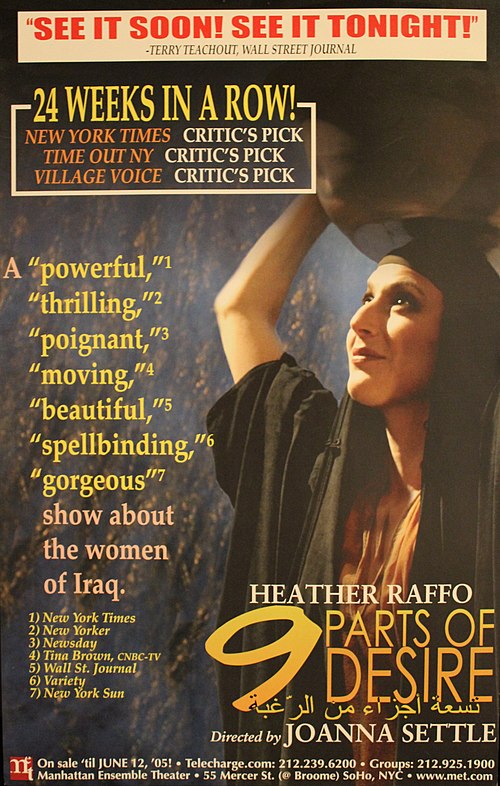
Raffo is perhaps most famous for her notable role in the one-woman play ‘9 Parts of Desire,’ her play that focuses on the lives of women in Iraq. Heather conceived of the play during one of several visits with Iraqi relatives. She attributed it also to a trip to the Saddam Art Centre in Baghdad, where she saw only billboard-sized portraits of Saddam Hussein, and in a back room at the Centre, a painting of a nude woman clinging to a barren tree. As Heather later noted about the painting, she took a photo of it, and on returning to the U.S., she “devised a way of replicating the painting into a play.” It was a decade later that she completed the play, which features monologues by nine highly distinct Iraqi women, all played by herself in some versions.
In commenting on what she thought her fellow American citizens might say about ‘9 Parts of Desire,’ Heather noted:
“I’d love to hear an American say, ‘That Bedouin woman is just like my aunt.’ But at the same time, I want American audiences to walk out a little confused, not able to say, ‘Oh, I get it,’ but rather to understand how difficult it is to grasp the psyche of people who have lived under Saddam for 30 years with American support, then had a war with Iran, resulting in 1.5 million deaths, followed by 13 years of sanctions and two wars under American firepower.”
Perhaps needless to say, that kind of response to her play drew media attention to Heather. It has brought her attention through numerous public appearances and interviews on U.S. television. She has spoken about ‘9 Parts of Desire’ to the National Press Club, as well as being featured in ‘O: The Oprah Magazine.’
Following the big success of ‘9 Parts of Desire’ in London, Los Angeles, New York, Seattle, Chicago, Philadelphia, and Washington, DC, the play was translated for international productions in France, Brazil, and Turkey. Heather was given high praise by ‘New Yorker Magazine’ writer John Lahr, who called her play “an example of how art can remake the world.” In May 2013, ‘9 Parts of Desire’ was performed for the first time in Iraq by students from The American University of Iraq – Sulaimani, with Heather in the audience.
Beyond Heather’s one-woman play, she is also credited with other acting roles, including as Sarah Woodruff in the world premiere of ‘The French Lieutenant’s Woman,’ the off Broadway/National Tour of ‘Macbeth’ where she played Lady Macbeth, ‘The Merry Wives of Windsor’ as Mistress Page, and ‘The Rivals.’
Raffo’s plays find parallels between the trauma of repression heaped on Iraqis by wars and sanctions, and other catastrophic events and testimonies
Such articles as Magda Romanska’s “Trauma and Testimony” about Raffo’s ‘9 Parts of Desire,’ underscore the tragic conditions of Iraq as expressed by nine Iraqi women of different backgrounds and age groups. The performance of the play, often featuring one actress playing the nine roles, was successful in the U.S.” Romanska finds a parallelism between Iraqi trauma marked by repression, sanctions, and wars, and narrated by women, and other catastrophic events and testimonies. She links staged discourse with traumatic syndromes and dramatic theory.”
In a review of another play/opera of Raffo’s, ‘Falluja,’ a BBC commentator finds that this “Iraq war opera helps heal post-conflict trauma.” The opera is about a young U.S. Marine wounded while fighting in the Iraq War. When he returned home, he found himself “battling post-traumatic stress disorder (PTSD).” That war was an attempt to clear the city of Falluja of insurgents based there, in which casualties were heavy. This operatic play concerns the mental scars created by seeing friends and comrades killed in and around Falluja. Though the focus is on one American marine, Raffo roots her play in a strong Iraqi point of view.
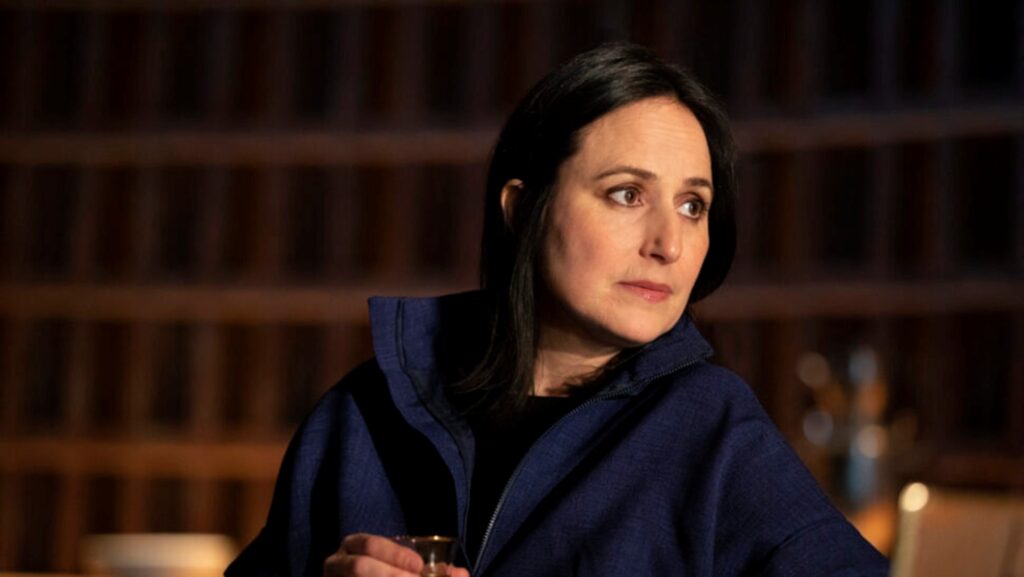
Yet another Raffo play has captured recent attention, her drama ‘Noura,’ which premiered in 2017. It is the “story of an Iraqi immigrant family’s Christmas dinner disturbed by the arrival of a visitor who stirs up long-buried memories from the past.” ‘Noura’ gives a nod to Ibsen’s ‘Doll’s House,’ with its stories of women leaving home. For Raffo, ‘Noura’ is “the story of a woman’s restless mind pushing against the confines of her home life and her past.”
Heather tells us she was motivated to create ‘Noura’ by such things as “the fracturing of Iraq, to a shifting American identity…and the rise of polarizing ideologies to modern marriage and motherhood.” She continued, “It is at the explosive intersection of these issues that the characters of Noura attempt to balance their individual pursuits with a search for community. I believe it is a balance with which many of us struggle.”
Raffo equates contemporary Iraq, a country now “completely segregated by neighborhood,” to an America for which she depicts the divides as “similarly increasing at an alarming rate.” As she notes, “Many communities are becoming more isolated rather than more inclusive, defending our identity with hostility rather than seeing how our differences can be discussed with each other. How do we pursue a vital sense of belonging, but not at the expense of turning tribal? How can we embrace our individuality while upholding a multi-faceted identity?”
Raffo examines her role in this situation, describing herself as “an artist, a mother, a wife, and an American woman with Middle Eastern heritage.” Heather Raffo is an Arab American treasure, not only because of her role as a vibrant playwright but also because of her thoughtful contribution to asking key questions about how people and their nations find space to be different, yet remain unified.
Sources:
–“Heather Raffo,” Wikipedia Series on Arab Americans, 2025
-“Trauma and Testimony in Heather Raffo’s ‘Nine Parts of Desire’,” by Magda Romanska, Alif: Journal of Comparative Poetics, 2010
-“Iraq war opera helps heal post-conflict trauma,” Vincent Dowd, BBC World Service, 8/20/2013
-” Heather Raffo’s Noura Opens at Playwrights Horizons December 10, Olivia Clement Playbill, 12/10/2018
-“Playwright’s Perspective: Noura,” Heather Raffo, Playwright, Author’s website
John Mason, Ph.D., focuses on Arab culture, society, and history and is the author of LEFT-HANDED IN AN ISLAMIC WORLD: An Anthropologist’s Journey into the Middle East, New Academia Publishing, 2017. He has taught at the University of Libya in Benghazi, Rensselaer Polytechnic Institute in New York, and the American University in Cairo. John served with the United Nations in Tripoli, Libya, and consulted extensively on socioeconomic and political development for USAID and the World Bank in 65 countries.
The views and opinions expressed in this article are those of the author and do not necessarily reflect the position of Arab America. The reproduction of this article is permissible with proper credit to Arab America and the author.
Want more articles like this? Sign up for our e-newsletter!
Check out our blog here!