Subscribe
to receive news by email

Poll
Will the Trump Administration Shift U.S. Policy in Favor of Palestine?
- No (87%)
- Yes (13%)
 Loading ...
Copyright © 2026 Arab America
Go topPathbreakers of Arab America—John Bowab

By: John Mason / Arab America Contributing Writer
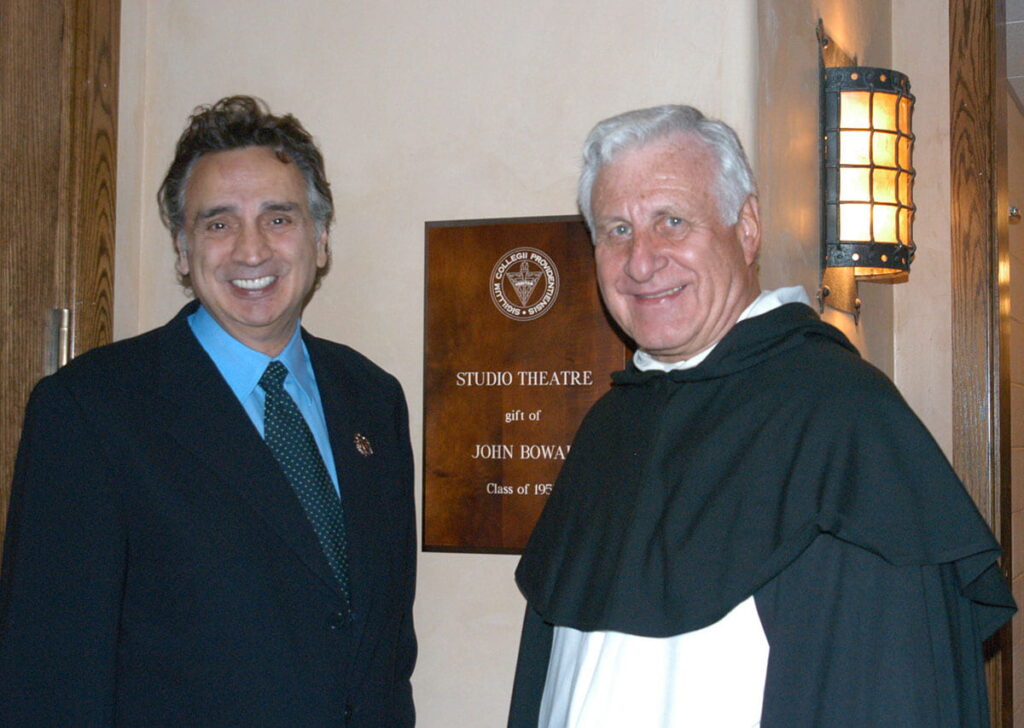
This is the one-hundred and seventh in Arab America’s series on American pathbreakers of Arab descent. The series features personalities from various fields, including entertainment, business, sports, science, the arts, academia, journalism, and politics. Our one-hundred and seventh pathbreaker is John Bowab, a prominent director of stage and screen credited with 400 television productions and 140 theatrical productions on tour. Bowab is part of a small group of Syrian Christians who settled in the Blackstone Valley of Rhode Island and who made it into the entertainment business.
Renowned Director and Producer of Live Stage and TV, Bowab, participated in numerous Broadway and Hollywood hits
John Bowab was born in Pawtucket, Rhode Island, on December 22, 1933, to Syrian Christian Arab immigrant parents (from Damascus, Syria), Wadad and George Bowab. The name ‘Bowab’ derives from two possible roots: first, the Arabic term for the baobab tree, translated as ‘the fruit of many seeds’ and, second, Arabic for ‘a position of trust or authority,’ namely someone who secures a building,’ or more commonly as a ‘doorman.’ His family arrived in the late nineteenth century in the Blackstone Valley, which includes the cities of Pawtucket and Central Falls. It also became home to other Syrian Christian families who valued hard work and success.
According to an interview with Bowab, his family had a particular reaction to his career choice. He revealed that in an interview, which at the outset smacks of perhaps innocent cultural stereotyping:
“John Bowab’s family, being Syrian immigrants, had a mixed reaction to his career choices, particularly his transition from theatre to television and then to Hollywood. Bowab’s family likely appreciated his dedication to the arts and his contributions to the entertainment industry, but they may have been concerned about the demands and challenges of a career in Hollywood. Bowab’s decision to direct national touring productions of Broadway shows and his involvement in television sitcoms and specials for stars like Jay Leno and Bob Hope also required a significant commitment to his craft, which may have been a concern for his family. Bowab’s endowment of the Patricia Morison Master Class Series at Providence College is a testament to his family’s support and his commitment to giving back to the community and the arts.”
John Bowab’s credits as a director span the Broadway catalog, almost too numerous to list, but including credits for ‘Call Me Madam” for Reprise in 2000; the 1998 Lincoln Center all-star version of ‘Sweet Charity;’ directing Angela Lansbury in three additional tours; directing the 1990/1991 Debbie Reynolds ‘The Unsinkable Molly Brown’ tour; direction of the Town Hall versions of ‘She Loves Me,’ starring Madeline Kahn; and Richard Kiley’s ‘Knickerbocker Holiday.’
Bowab has directed 140 productions on tour, including Lana Turner’s ‘Forty Carats,’ Patricia Morison’s ‘Pal Joey,’ and ‘An Evening with George Burns and Carol Channing.’ He has directed more than 400 television episodes, including ‘The Cosby Show,’ ‘The Facts of Life,’ ‘Bosom Buddies,’ ‘Soap,’ ‘Benson,’ and ‘The Wayans Brothers.’ In addition, Bowab directed ‘Jay Leno,’ ‘Bob Hope,’ and ‘The Tonight Show’ specials.
A list of Bowab’s successes in directing on Broadway and Touring shows, according to dates and his precise role, is impressive and we present it as follows:
• Touring – ‘Mame’ (Jul 24, 1983 – Aug 28, 1983), Directed by John Bowab
• Musical Comedy Revival – ‘The Fig Leaves Are Falling’ (Jan 02, 1969 – Jan 06, 1969) Produced by John Bowab
• Musical Original – ‘Maggie Flynn’ (Oct 23, 1968 – Jan 05, 1969), Produced by John Bowab
• Musical Original – ‘Mame’ (May 24, 1966 – Jan 03, 1970), Associate Produced by John Bowab
• Musica Comedy Original – ‘Sweet Charity’ (Jan 29, 1966 – Jul 15, 1967), Associate Produced by John Bowab
John Bowab and innumerable other Syrian Americans have created successful trajectories for themselves–A brief note on Syrian Arab immigrants to the U.S.
Americans of Syrian descent or background made their first significant wave of immigration to the U.S. beginning in the 1880s. Many of the earliest Syrian Americans settled in New York City, Boston, and Detroit, as well as in areas like Pawtucket, as mentioned earlier. U.S. immigration policy in 1924 curtailed immigration from Syria, only to resume more than 40 years later with the Immigration Act of 1965. A surge in Syrian arrivals occurred between 1961 and 2000, with an estimated 64,600 Syrian immigrants. In addition, between 2011 and 2024, during the Syrian civil war, an estimated 50,004 Syrian refugees immigrated to the United States.
The overwhelming majority of Syrian immigrants to the U.S. from 1880 to 1960 were Christian; a minority were Jewish, whereas Muslim Syrians arrived in the United States chiefly after 1965. According to the 2016 American Community Survey 1-year estimates, “there were 187,331 Americans who claimed Syrian ancestry, about 12% of the Arab population in the United States. There are also sizeable minority populations from Syria in the U.S., including Jews, Kurds, Armenians, Assyrians, and Circassians.”
The success of Syrian Arab immigrants in the U.S. can be attributed to several factors, according to ‘CAP: Boldly Forward’ publication:
–“Desire for Economic Success: Many Syrian immigrants were motivated by the American Dream of economic success, seeking opportunities for prosperity and a better life;
—Religious Freedom and Escape: Some Christian Syrians immigrated to the U.S. for religious freedom and to escape the massacres and conflicts targeting Christians in Syria;
—Assimilation and Integration: The successful assimilation of early Syrian immigrants has made it difficult to recognize their ancestors as distinct from American families;
—Historical Context: The Ottoman government-imposed constraints on emigration to maintain its populace in Greater Syria, which limited the number of Syrian immigrants to the U.S.; and
—Modern Immigration Waves: Post-1965 immigration brought new waves of Syrian Americans, many of whom were highly educated professionals who made significant contributions to American society.”
Bowab, who is second generation (born to at least one parent who emigrated from Syria), had the advantage of learning from his Syrian Christian community, which had already begun to adapt to and benefit from life in America. These factors, combined, have contributed to the success of Syrian Arab immigrants in the U.S., many of whom have become valued contributors in various fields. It is no surprise, then, that John Bowab has become the eminent success he is in both theater and TV, from Broadway to Hollywood and in between.
Sources:
-“John Bowab,” Wikipedia Series on Arab Americans, 2025”
-“John Bowab ’55 – Directing stage and screen,” Providence College publication, 10/21/2019
-“About this Artist-JOHN BOWAB,” LaPhil (no date)
-“Syrian Immigrants in the United States: A receiving community for today’s refugees,” CAP Boldly Forward, 12/13/2016
John Mason, Ph.D., focuses on Arab culture, society, and history and is the author of LEFT-HANDED IN AN ISLAMIC WORLD: An Anthropologist’s Journey into the Middle East, New Academia Publishing, 2017 and of his new novel, WHISPERS FROM THE DESERT: Zaki, a Little Genie’s Tales of Good and Evil (2025), under his pen name, Yahia Al-Banna. He has taught at the University of Libya in Benghazi, Rensselaer Polytechnic Institute in New York, and the American University in Cairo. John served with the United Nations in Tripoli, Libya, and consulted extensively on socioeconomic and political development for USAID and the World Bank in 65 countries.
The views and opinions expressed in this article are those of the author and do not necessarily reflect the position of Arab America. The reproduction of this article is permissible with proper credit to Arab America and the author.
Want more articles like this? Sign up for our e-newsletter!
Check out our blog here!