
Subscribe
to receive news by email

Poll
Will the Trump Administration Shift U.S. Policy in Favor of Palestine?
- No (87%)
- Yes (13%)
 Loading ...
Copyright © 2026 Arab America
Go topPathbreakers of Arab America—Rama Kuwaji
By: John Mason / Arab America Contributing Writer
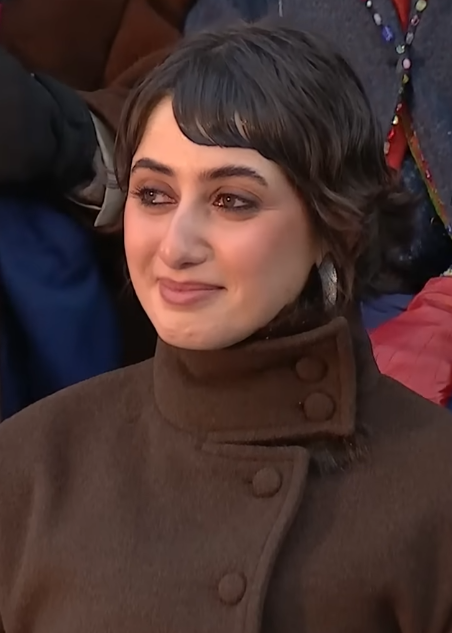
This is the one-hundred and fourth in Arab America’s series on American pathbreakers of Arab descent. The series features personalities from various fields, including entertainment, business, sports, science, the arts, academia, journalism, and politics. Our one-hundred and fourth pathbreaker is Rama Sawaf Duwaji, a Muslim of Syrian origin, an artistic illustrator, and now, the wife of the newly elected first Muslim mayor of New York City. Rama’s art is not just a profession; it is a critical part of her worldview, especially as an expression of her pro-Arab, pro-Palestinian stance.
Rama Sawaf Duwaji, Syrian American wife of New York City’s new Muslim mayor—a force on her own
Rama Sawaf Duwaji was born in Austin, Texas, on June 30, 1997, to Syrian Muslim parents from Damascus. Her parents are professionals in their own right, her father a software developer, and her mother, a pediatrician who has participated in humanitarian missions in warzones with the Syrian American Medical Society. Living in the States for a while, the family moved to Dubai, United Arab Emirates, and Duwaji spent the rest of her childhood in the Arab states of the Persian Gulf.
It is worth noting that in Hinduism, the faith of Mamdani’s mother, the name ‘Rama’ is a god who represents marital devotion. It is perhaps a fitting name, one that underscores the relationship of this couple who have had a transformative effect on New Yorkers and other like-minded people around the world.
Early on, as a child, Rama started drawing to fill her time, often getting “in trouble for doodling in her textbooks and notebooks at school.” Supported by her parents in her love of art, following high school, Rama entered the communication arts program at the Virginia Commonwealth University (VCU) School of the Arts. Attending classes at VCU’s satellite campus in Doha, Qatar, following her freshman year, she transferred to the main campus in Richmond, Virginia. Rama obtained a Bachelor of Fine Arts and graduated ‘cum laude’ in 2019.
Following graduation, Duwaji returned to her family in Dubai. From there, she participated in artist residencies in Beirut and Paris, after which she moved to New York City in 2021 to study illustration as a visual essay at the School of Visual Arts. Rama’s approach to art was to visualize what she saw in real life, then interpret it in the composition of her illustrations. She received her Master of Fine Arts in 2024, based in part on her thesis, which focused on “making and sharing dishes as a communal act.” Subsequently, Rama was selected as one of 24 artists from more than 500 applicants for an artist’s residency program in the Catskill Mountains of upstate New York.
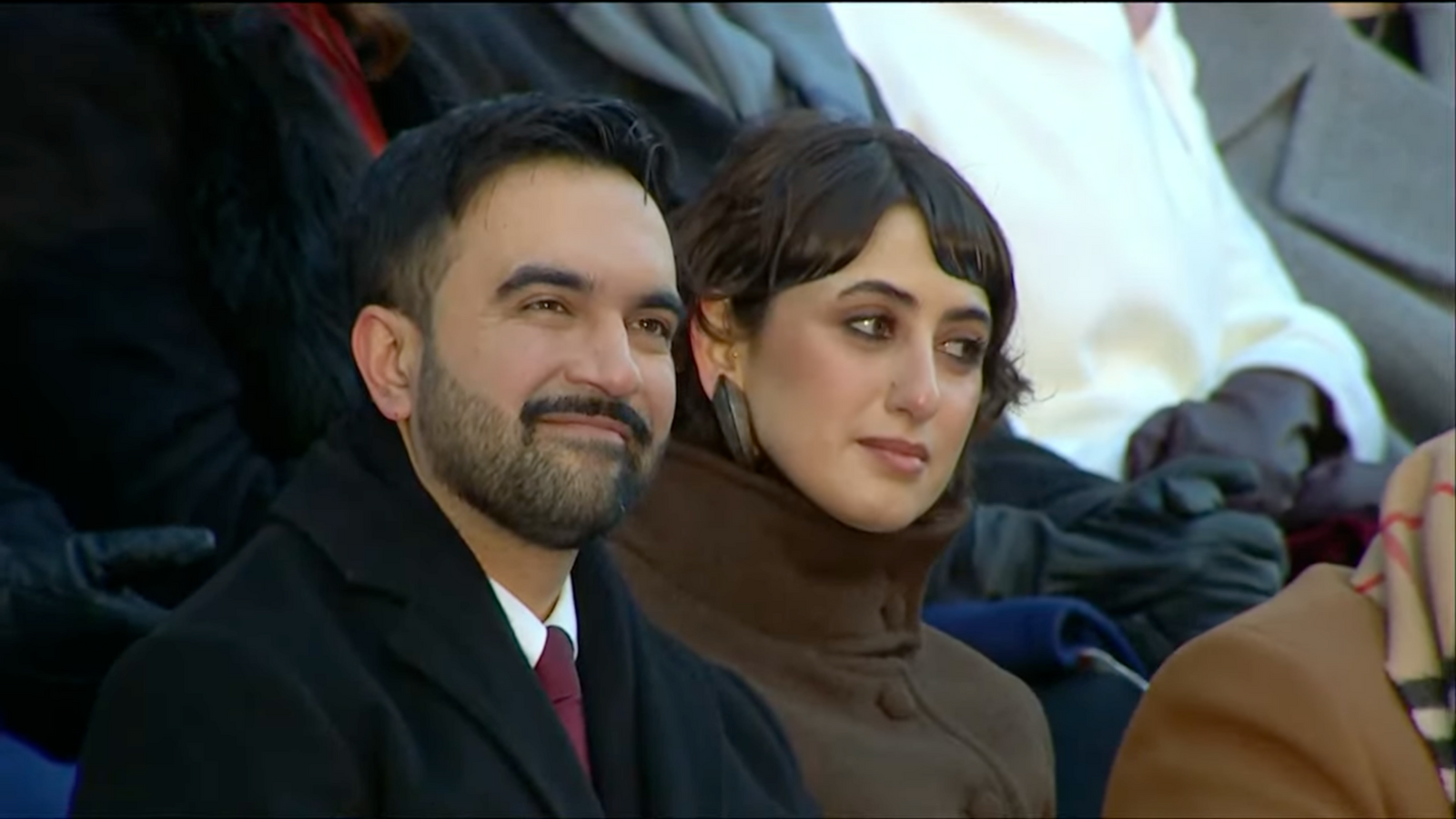
Rama met Zohran Mamdani on the dating app ‘Hinge’ in 2021, when he was a member of the New York State Assembly. After dating for several years, they were engaged in October 2024, then married in a private ‘nikah’ ceremony (Arabic for the sacred Muslim ceremony and legal contract of marriage) two months later in Dubai. This was followed by a civil ceremony in February 2025 at New York City Hall. In honoring Zohran’s father, an Indian Muslim who lived in the East African country of Uganda, where Zohran was born, they also had a ceremony there in July 2025.
A few months after their wedding, encouraged by Duwaji’s passion for politics, Mamdani ran for mayor. Following his victory in the 2025 mayoral election and his subsequent inauguration as mayor, Duwaji became the first lady of New York City on January 1, 2026, making her the first Gen Z-er and the first Muslim to assume that role. In contributing to his victory, Rama contributed to visuals for his campaign. Prior to moving into Gracie Mansion upon taking office ,the couple resided in Mamdani’s legislative district of Astoria, Queens.
A perception during the campaign was that Duwaji was somewhat silent. ‘The New York Times’ claimed she was “absent from the campaign.” The accusation of her silence prompted Mamdani to defend her: “Rama isn’t just my wife, she’s an incredible artist who deserves to be known on her own terms,” he said in a widely cited social media post in May. “You can critique my views, but not my family.”
Art is a critical part of Duwaji’s life, especially as an expression of a pro-Arab, pro-Palestinian stance
Duwaji’s illustrations, according to Wikipedia’s series on Arab Americans, “often explore Arab culture and focus on social justice in the Middle East, particularly women’s rights, but also depict scenes of daily life in those countries.” Her work has been published in ‘The New York Times,’ ‘The New Yorker Magazine,’ and ‘The Washington Post,’ as well as British outlets and venues like the BBC and the Tate Modern museum, and she has collaborated with Spotify and Apple. Since 2023, Duwaji has created numerous depictions of the Gaza genocide and the Israel–Hezbollah conflict, as well as artwork supporting the victims of the Sudanese Civil War.
One of Duwaji’s primary concerns is with Muslim immigrants, who she described in a ‘Forbes Magazine’ article as “petrified by the fear that their opinions on Palestinian rights might land them in prison, or deported from New York.” One project she worked on, dating to 2020, was her illustrations for an animated music video for Egyptian American rapper Felukah’s song “I won’t wait.” Called ‘The 3:18,’ the title refers to the specific duration of Rama’s animated work, which highlights significant social issues in Egyptian and Arab life.
The animation, according to Forbes, “depicts complex personal and legal struggles, including arranged marriage, cousin marriage, and being disowned by family.” Duwaji used pen-and-ink-style digital illustrations and animation to amplify the “flow of these tragedies.” A notable scene in the video features “flower petals transforming into melancholy figures and sweeping up facial fragments, emphasizing the line: she couldn’t believe how one law could serve a man and destroy a woman’s universe”. As Felukah raps in Arabic, “These problems aren’t going to fix themselves miraculously…On certain days, it feels like the world just works against me.”
According to a ‘New York Post’ article, a close look at Duwaji’s illustrations shows she frequently targets “American imperialism” and is sharply critical of the U.S.’s support for Israel.” For example, one of her images, posted in 2024, ‘shows enormous stacks of US bills labeled ‘Israeli war crimes.’” Mamdani himself commented next to the illustration writing, “New York charities send over $60 million every year to fund Israeli war crimes, and that number is only growing.” He urged his followers to contact their elected officials to end the funding.
An animation from May shows a Palestinian girl holding a large empty pot with the words “Not a hunger crisis” written across it, before showing more people holding similarly empty bowls. The accompanying text reads: “It is deliberate starvation.”
While Rama and Zohra share strong political attitudes based on their respective origins and religious backgrounds, for Mamdani’s role as mayor of all New Yorkers, he has made clear that his personal views must take second place to the dire needs of the most vulnerable of his constituents. Rama is at his side in his new role as mayor, and Mamdani credits her with so much: “And to my incredible wife, Rama, hayati,” Mamdani wrote in a social media post in May, using the Arabic word for “my life…There is no one I would rather have by my side in this moment, and in every moment…Rama isn’t just my wife; she’s an incredible artist who deserves to be known on her own terms.”
For samples of her artwork, see her Instagram page here:
Sources:
-“Rama Kuwaji” Wikipedia Series on Arab Americans, 2025”
-“Rama Duwaji, Zohran Mamdani’s Wife, Lets Art Speak For Her,” Forbes, 10/2/2025
-“Zohran Mamdani’s wife Rama Duwaji uses her art to rage against US ‘imperialism’ and ‘Israeli war crimes’,” New York Post, 11/8/2025
John Mason, Ph.D., focuses on Arab culture, society, and history and is the author of LEFT-HANDED IN AN ISLAMIC WORLD: An Anthropologist’s Journey into the Middle East, New Academia Publishing, 2017 and of his new novel, WHISPERS FROM THE DESERT: Zaki, a Little Genie’s Tales of Good and Evil (2025), under his pen name, Yahia Al-Banna. He has taught at the University of Libya in Benghazi, Rensselaer Polytechnic Institute in New York, and the American University in Cairo. John served with the United Nations in Tripoli, Libya, and consulted extensively on socioeconomic and political development for USAID and the World Bank in 65 countries.
The views and opinions expressed in this article are those of the author and do not necessarily reflect the position of Arab America. The reproduction of this article is permissible with proper credit to Arab America and the author.
Want more articles like this? Sign up for our e-newsletter!
Check out our blog here!