
Subscribe
to receive news by email
Poll
Will the Trump Administration Shift U.S. Policy in Favor of Palestine?
- No (87%)
- Yes (13%)
 Loading ...
Copyright © 2026 Arab America
Go topPathbreakers of Arab America—Randa Jarrar

By: John Mason / Arab America Contributing Writer
This is the ninety-second in Arab America’s series on American pathbreakers of Arab descent. The series features personalities from various fields, including entertainment, business, sports, science, the arts, academia, journalism, and politics. Our ninety-second pathbreaker is Randa or Ra Jarrar, a Palestinian Egyptian/Arab American, award-winning novelist, short story writer, essayist, translator, stage performer, and teacher. Depicted as “a fearless voice of dissent who has been called ‘politically incorrect,’“ she was raised for a time in Kuwait and Egypt. A story that captivated her early on was a celebrated Egyptian belly dancer’s journey across the United States in the 1940s.
Randa Jarrar, a fearless voice of dissent, called “politically incorrect,” brings home perceptions from the Arab World into her courageous, riveting writings
Randa Jarrar was born in 1978 in Chicago to an Egyptian mother and a Palestinian father. She grew up in Kuwait and Egypt, and after the Gulf War in 1991, she and her family returned to the United States to live in the New York City area. Jarrar studied creative writing at Sarah Lawrence College, from which she received a B.A. She then earned an M.A. in Middle Eastern Studies from the University of Texas at Austin and an M.F.A. in creative writing from the University of Michigan. She became a creative writing associate professor at California State University, Fresno.
Jarrar was described by the ‘New York Times’ writer, Michelle Goldberg as “a fearless voice of dissent …who is politically incorrect.” She is the author of the memoir ‘Love Is An Ex-Country,’ the novel ‘A Map of Home,’ and the collection of stories ‘Him, Me, Muhammad Ali.’ Randa also performs as an actress, starring recently in ‘Hulu’s RAMY’ (an American comedy-drama television series that premiered on Hulu in 2019, starring Ramy Youssef). Rana’s essays have appeared in ‘The New York Times Magazine,’ ‘Salon,’ ‘Bitch, and ‘Buzzfeed.’ She is a recipient of a Creative Capital Award and an American Book Award, as well as awards and fellowships from Civitella Ranieri, the Lannan Foundation, Hedgebrook, PEN, and others. Randa has participated in writing workshops for 27 years.
Jarrar has written nonfiction and fiction, publishing her first short story in the prestigious ‘Ploughshares’ literary journal in Fall 2004. Her short story, “You Are a 14-Year-Old Arab Chick Who First Moved to Texas,” was the winner of the first Million Writers Award for online fiction.

Randa published her first novel in 2008. ‘A Map of Home,’ which is set in the Palestinian-Israeli conflict during the Gulf War. The story is first set in Kuwait, then Egypt, and ends in Texas, where Randa’s father got his start in the U.S. A ‘Christian Science Monitor’ review described the story as follows: “Randa Jarrar takes all the sappy, beloved clichés about ‘where you hang your hat’ and blows them to smithereens in her energizing, caustically comic debut novel.” It is based in part on her growing up in Kuwait and Egypt. ‘A Map of Home’ was published in six languages and won a Hopwood Award, an Arab-American Book Award, and was named one of the best novels of 2008 by the Barnes & Noble Review. In 2010, the Hay Festival and UNESCO’s Beirut World Book Capital Award named Jarrar one of the most gifted writers of Arab origin under the age of 40.
‘Love in an Ex-Country’ is Randa’s story of how a road trip turned into an occasion for reflections about her identity and past. The story was linked in her mind to a tale of a celebrated Egyptian belly dancer’s journey across the United States in the 1940s. In 2016, Jarrar drove cross-country from California to her parents’ home in Connecticut. Randa’s journey turned into a reflection on issues of race, gender and sexuality, trauma, and female embodiment. The first noteworthy incident took place in Arizona, where, according to a Kirkus Book Review, “Jarrar encountered a White female trucker who likened her fellow Syrian-born drivers to monkeys.”
The confrontation angered Randa for a variety of reasons, “including the fact that it revealed how the woman did not recognize her as Arab; and how being Arab in the U.S. meant being ‘silenced, erased, demonized, vilified, and monstrosized.’” The trip also had its liberating side, “as the author reveled in her freedom and sexuality with Tinder matches and barroom flirtations. But as she celebrated her plus-sized body and the confidence that came from rejecting ‘mainstream beauty standards,’ she also remembered her adolescence, when her body seemed to be ‘punishing me, rebelling against me.’”
Jarrar, self-defined ‘queer,’ a Muslim Arab American woman, using he/him and she/her pronouns, tackles systemic racism, domestic violence, sexuality, trauma, and body image
More recently, Randa has become known for being dragged out of PEN America (a major writers’ union) for protesting. Jarrar protested the special guest and well-known Zionist celebrity, Mayim Bialik, a Gaza ceasefire opponent. Specifically, Jarrar was removed from the event for calling out the names of the 13 authors martyred in Gaza. PEN America is known as an organization “dedicated to championing free speech,” especially in defending at-risk writers and journalists in 100+ countries. One criticism against PEN is that it has failed to acknowledge the killing of over 130 journalists in Gaza since October 7, 2024.
During the PEN ‘Out Loud’ event in Los Angeles, journalist Bialik had already faced intense criticism for her social media post trivializing the war in Gaza. This war had resulted in the killing of more than 27,840 Palestinians (now more than 50,000), with 70 percent being women and children, in addition to 1,139 Israelis. According to ‘The New Arab/Global Voices,’ “PEN America’s decision sparked anger in the literary community and led to two prominent writers severing ties with the organization ahead of the event.” Despite the controversy, PEN proceeded with the event.
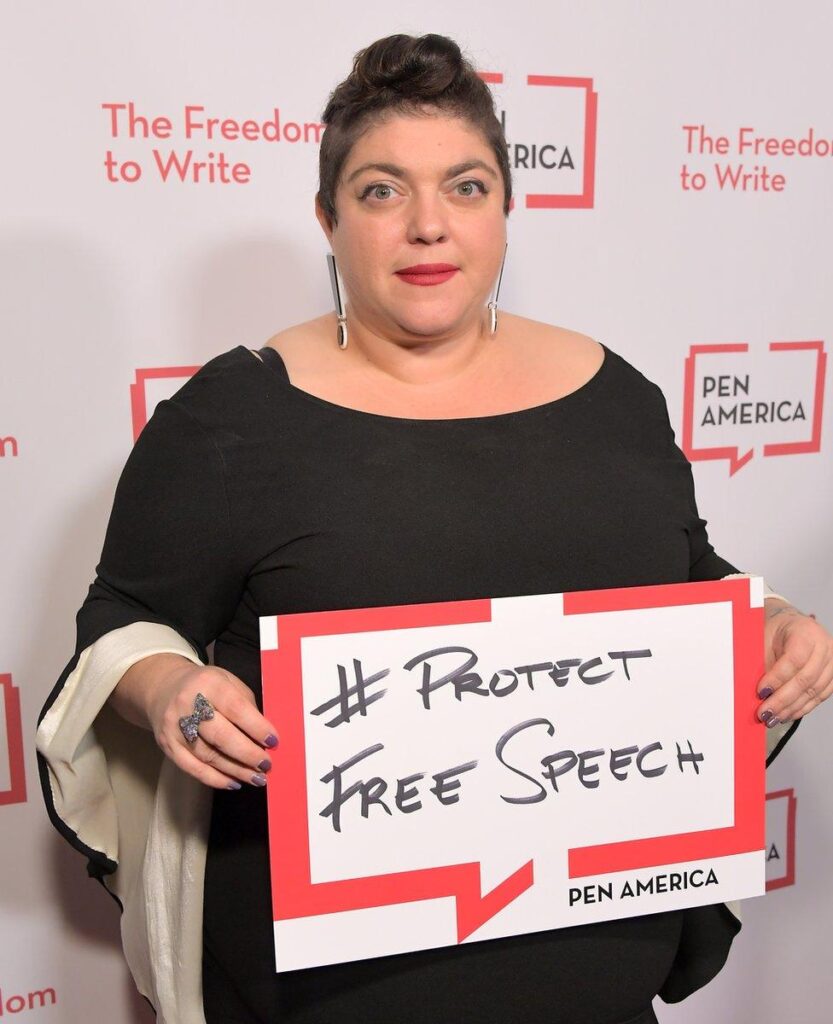
‘The New Arab/Global Voices’ continued its depiction of the dismal event of Rada’s unfortunate “extraction” from the PEN event:
Six writers associated with Writers Against the War on Gaza (WAWOG), including Author Randa Jarrar, attended the PEN Out Loud event. They disrupted the event by playing the names of the 13 writers and poets killed by Israel in Gaza since October 7 using a loudspeaker, while also objecting to Bailik being given a platform.
“The protesters were asked to leave, and, when Jarrar refused, she was dragged out of the event. The incident was captured in video footage that went viral on social media. In the video, Jarrar can be seen being dragged out of the event by force, as she remained seated on her chair.
Following the event, PEN America issued a statement expressing their “regret” for having to remove the protestors for the event to proceed. However, the organization has yet to make a public statement about those 13 writers, as well as the 122 journalists and 100 academics that (as of 2024) have also been killed by Israeli forces since October.”
Given what we have learned about Randa Jarrar, her sense of dignity, fearless voice of dissent, and her capacity for political incorrectness, it is hardly surprising that she would fervently support her fellow Palestinians from attack.
Sources:
-“Randa Jarrar,” Wikipedia Series on Arab Americans, 2025
-‘A Map of Home,’ Randa Jarrar, Christian Science Monitor Book Review 9/25/2008
-‘Love Is an Ex-Country-A Memoir,’ Randa Jarrar, Kirkus Book Review, 2021
-“Palestinian writer Randa Jarrar dragged out of PEN America event for protesting,” The New Arab/Global Voices-MENA, 2/8/2024
John Mason, Ph.D., focuses on Arab culture, society, and history and is the author of LEFT-HANDED IN AN ISLAMIC WORLD: An Anthropologist’s Journey into the Middle East, New Academia Publishing, 2017. He has taught at the University of Libya in Benghazi, Rensselaer Polytechnic Institute in New York, and the American University in Cairo. John served with the United Nations in Tripoli, Libya, and consulted extensively on socioeconomic and political development for USAID and the World Bank in 65 countries.
The views and opinions expressed in this article are those of the author and do not necessarily reflect the position of Arab America. The reproduction of this article is permissible with proper credit to Arab America and the author.
Want more articles like this? Sign up for our e-newsletter!
Check out our blog here!