
Subscribe
to receive news by email

Poll
Will the Trump Administration Shift U.S. Policy in Favor of Palestine?
- No (87%)
- Yes (13%)
 Loading ...
Copyright © 2026 Arab America
Go topPathbreakers of Arab America—Simon Shaheen
By: John Mason / Arab America Contributing Writer
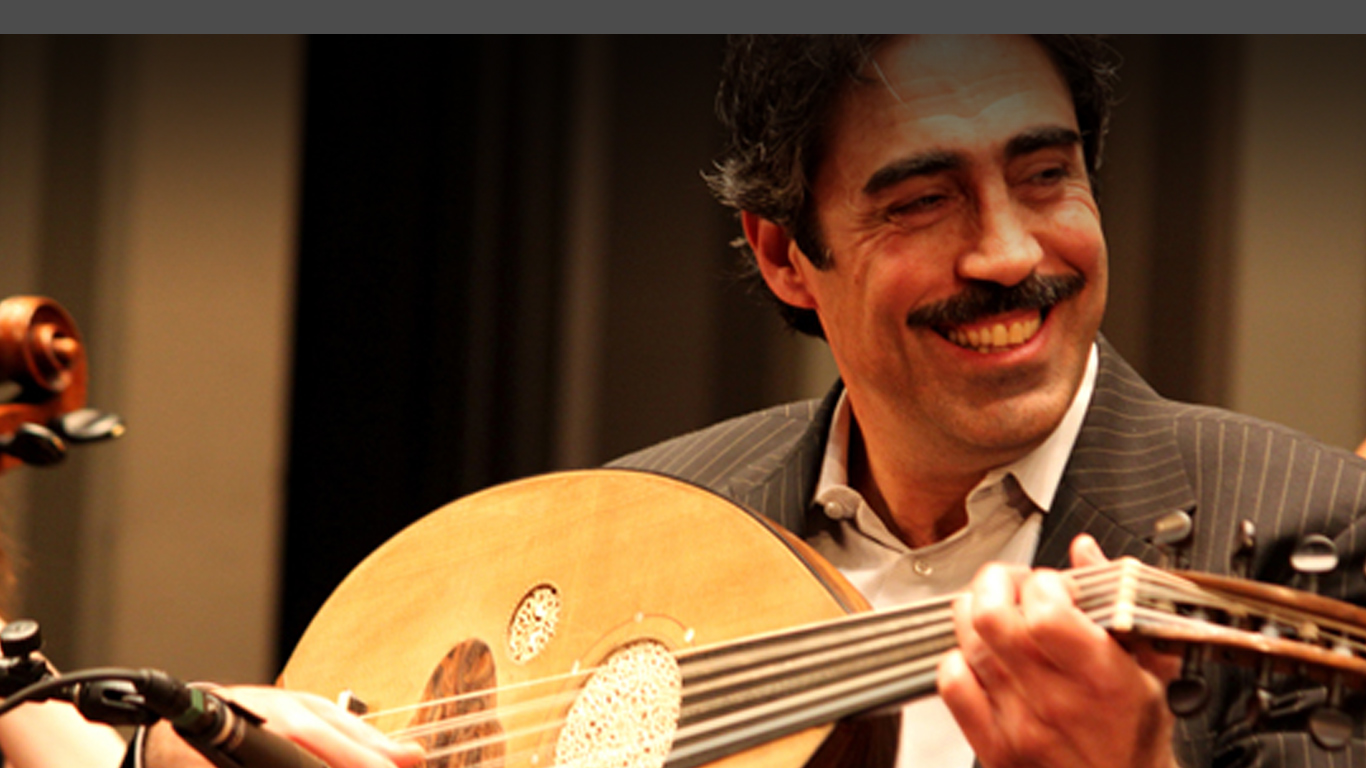
This is the eighty-ninth in Arab America’s series on American pathbreakers of Arab descent. The series features personalities from various fields, including entertainment, business, sports, science, the arts, academia, journalism, and politics. Our eighty-ninth pathbreaker is Simon Shaheen, Palestinian-born virtuoso musician and orchestra leader who has become one of Arabic music’s most prominent ambassadors and most active educators in the United States.
Once-in-a generation master musician, composer, orchestra leader, and oud and violin player, Simon Shaheen has taught several generations of Americans on the joys of Arabic music
Simon Shaheen was born to an Arab Catholic family in Ma’alot-Tarshiha, an Arab village in the Upper Galilee, Israel. The Shaheen family is known for its musicality. His father, Hikmat, was a professor of music and a master oud player, while his brother Najob was an instrument-maker. Another brother, William, was also an oud player and sisters Laura and Rosette were singers.
By the age of 2, Shaheen moved with his family to Haifa, but spent most of his weekends in his birth village. He recalled much later that “Learning to play on the oud from my father was the most powerful influence in my musical life.” He began playing the oud at age five, and studied violin at the Conservatory for Western Classical Music in Jerusalem. Simon recalls, “When I held and played these instruments, they felt like an extension of my arms.”
Shaheen attended Tel Aviv University, earning degrees in Arabic literature and music performance. He later pursued further studies at Hebrew University of Jerusalem and in 1980 he emigrated to the United States to study music at the Manhattan School of Music and Columbia University. He eventually became a U.S. citizen and lives in New York City. There he created the Arabic ensemble, ‘Qantara’ (meaning ‘arch’), which he leads.
In his role as an educator Shaheen founded the Near Eastern Music Ensemble, which performs at arts festivals and retreats. One of his annual retreats, the Arabic Music Retreat, is held at Mt. Holyoke College campus in Massachusetts. There he assembles a large faculty of Arabic music teachers for a week of instruction and concludes with a concert. The event began with 12 students but now sees close to 100. As one praiseworthy source expressed: “For successful young musicians, the retreat is an opportunity to study under one of the most significant musical teachers of a generation whose continuing desire to adapt and change is one of his greatest gifts.”
In 1994 Shaheen received a National Heritage Fellowship from the National Endowment for the Arts. In addition to his work in traditional and classical Arabic music, he has participated in many cross-cultural musical performances, including vocalist Soraya, Henry Threadgill, Vishwa Mohan Bhatt, and with Jewish klezmer musicians The Klezmatics.
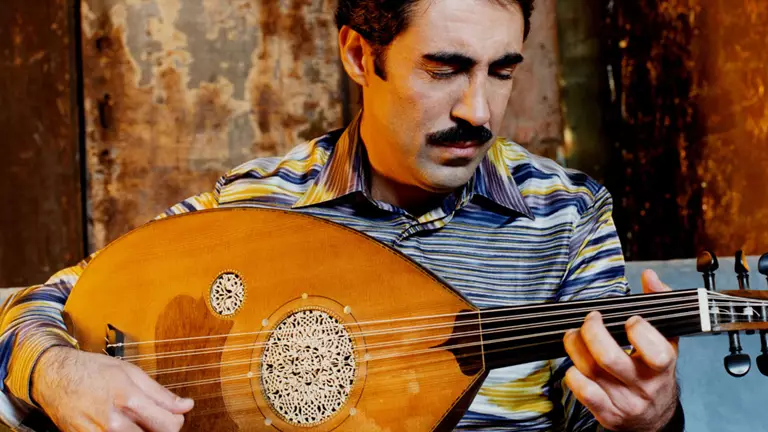
Shaheen, a remarkable ambassador and educator, has given Americans a true understanding of Arabic music
In a Kennedy Center for the Performing Arts program note about Shaheen, it describes the historical linkages between Western and Arabic music. First, “Many of our Western musical instruments are direct descendants of Arabic stringed and reed instruments, as well as the use of complex melodies and improvisation in performance. Master musician and composer Simon Shaheen, along with his ensemble ‘Qantara,’ demonstrates the unique sound and range of several Arabic instruments, while also performing traditional Arabic music that fuses jazz and classical influences.
Shaheen is depicted as a musician who performs and composes music that reflects traditional Arabic culture while embracing modern jazz and classical styles of the Western World. In his journey towards merging the two rather different music orientations, in 1982, Simon formed the Near Eastern Music Ensemble in New York and established a series of Arab music workshops and lectures for schools. With his ‘Qantara’ musical group, he has recorded several albums, several of which fuse Arab, jazz, Western classical, and Latin American music.
As Simon proclaims, “I want to create a world of music exceptionally satisfying to the ear and for the soul,” [which is] “why I selected members for Qantara who all virtuosos in their own musical forms are, and whose expertise and knowledge can raise the music and the group’s performance to spectacular levels.”
Musical instruments of the Arab World comprise another point of interest in the story of fusion between Arabic and Western music. As Europeans began to travel to new lands during the Middle Ages, Arab musical instruments became known to the Western world. In fact, Arab culture is responsible for the introduction of practically the entire drum family to European music.
Shaheen is known for his heroic effort in saving the tradition of the oud, which along with the drums is a key instrument in Arabic music. As he described, in a Boston Globe feature, “the elegant lute with its pear-like shape, fretless neck, and 11 strings – five pairs of two plus a single one at the low end – not only grounds Arabic music, but offers clues to the whole aesthetic of a culture.” The oud, according to Simon, “is the center of the Arabic traditional small ensemble,” He compares it with the piano, which in Western music, “acts like the main instrument in the hands of composers and singers, to accompany themselves or use as a reference when they are composing.”

Shaheen waxes eloquent in describing the oud: “Look at the oud,” he says. “It’s embellished, it has all these beautiful ornaments. And I explain to people that the ornaments are part of our way of living. We ornament our food. Traditional clothing is all embroidered. Arabic writing, you look at calligraphy, it’s all ornamented. So making people understand this concept definitely helps them feel closer and closer to the music.”
In a documentary about Shaheen covered by Al-Jazeera, it goes behind the scenes with this “Palestinian icon and musical virtuoso…one of the most significant and celebrated Arab musicians of his generation.” In revering his father, Simon notes that “He introduced me to the secrets of classical Arab music.” The film depicts Shaheen looking to Palestine and to other parts of the Middle East for the next generation of Arab musical talent. In the film we see a series of Skype auditions with Shaheen in the U.S. and his potential students in Ramallah.
Shaheen’s sourcing of Arabic music is very broad, as expressed in the Al-Jazeera review. He averred, “I like to use the ideas of different music from different countries like Egyptian, Syrian, and Palestinian music, Lebanese, Moroccan, Tunisian and Iraqi music.” While noting the similarities among these different national forms of music, Shaheen said, “For sure, many of these musical styles have a lot in common but there are differences as well.”
A high form of praise of Simon derives from the violinist Layth Sidiq, an educator in his retreats. He noted, “I went deeper into Arabic music with Simon which made me appreciate my musical roots…This encouraged me first to expand my understanding of Arabic music within me before I can share it with others. At the same time I can learn about other music and cultures and if possible merge the two together.”
Simon Shaheen has made us all the more appreciative of not only Arabic music, but with the joy of hearing how that music fuses with the totally different tradition of Western music genres.
Sources:
–“Simon Shaheen,” Wikipedia Series on Arab Americans, 2025
–“Saving an oud tradition: A virtuoso of Arabic music is teaching it to others,” The Boston Globe, 10/10/2008
–“Understanding Arabic Music: Simon Shaheen & Qantara, The Kennedy Center, (recorded in 2009), 1/21/2020
–“Simon Shaheen: A Musical Journey,” Al-Jazeera, 2/5/2020
John Mason, Ph.D., focuses on Arab culture, society, and history and is the author of LEFT-HANDED IN AN ISLAMIC WORLD: An Anthropologist’s Journey into the Middle East, New Academia Publishing, 2017. He has taught at the University of Libya, Benghazi, Rennselaer Polytechnic Institute in New York, and the American University in Cairo; John served with the United Nations in Tripoli, Libya, and consulted extensively on socioeconomic and political development for USAID and the World Bank in 65 countries.
The views and opinions expressed in this article are those of the author and do not necessarily reflect the position of Arab America. The reproduction of this article is permissible with proper credit to Arab America and the author.
Want more articles like this? Sign up for our e-newsletter!
Check out our blog here!