

Subscribe
to receive news by email

Poll
Will the Trump Administration Shift U.S. Policy in Favor of Palestine?
- No (86%)
- Yes (14%)
 Loading ...
Copyright © 2026 Arab America
Go topPioneers and Punitives: What We should Know about the Israeli Settlement on Southern Syria

By Mitzi Tapang / Arab America Contributing Writer
In mid‑April 2026, a coordinated incursion by Israeli settler activists crossed from the Golan Heights into southern Syria. Around 40 activists from the far‑right group Halutzei HaBashan (“Pioneers of Bashan”) entered the Syrian village of Hader (reported as Al‑Hader) in Quneitra governorate, briefly occupied parts of a building, and carried the Israeli flag while calling for new Jewish settlements in southern Syria as part of a “Greater Israel” vision. Israeli forces subsequently apprehended the activists and returned them to Israeli territory for questioning.
This is not the group’s first attempt. On Monday of August 15, 2025, roughly 40 individuals (nine families) breached the border fence near the Bariqa in Quneitra province, about three kilometers from Alonei HaBashan in the Israeli‑occupied Golan Heights. They declared the founding of a new settlement named “Neve HaBashan” and held a ceremonial cornerstone‑laying event that included planting flowers in memory of a fallen IDF soldier. The Israeli army announced that it had foiled the attempt, detaining the activists and preventing the establishment of a permanent outpost on Syrian territory.
Where Bashan fits
The Pioneers of Bashan (Halutzei HaBashan) is a religious‑nationalist settlement organization founded in April 2025, amid the power vacuum that followed the fall of Bashar al‑Assad’s regime in December 2024. The group frames its mission as a “return” to ancestral lands and explicitly seeks to establish Jewish settlements in the biblical Bashan region—modern southwestern Syria and the Golan Heights.
In December 2024, just days after opposition forces took Damascus and Assad fled, the IDF announced it had conducted over 350 strikes across Syria, neutralizing an estimated 70–80% of Syria’s strategic military resources and air‑defense capabilities. A year later, in December 2025, reports indicate Israel attacked Syria more than 600 times over the past year, maintaining air dominance and further degrading Syria’s military capacity. These operations created a security environment in which settler groups believe they can push into Syrian territory with minimal immediate resistance, even as the IDF continues to detain them when they cross the border.
The Land of Fertility
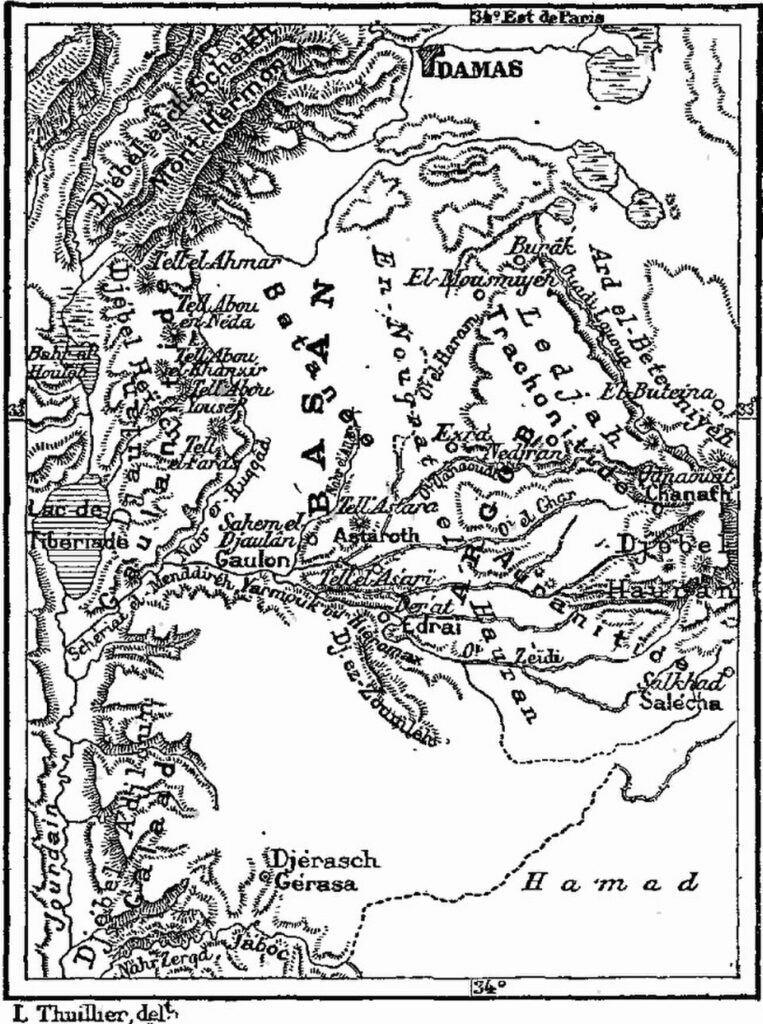
Bashan (Hebrew: הַבָּשָׁן) is the ancient biblical name for the northernmost region of Transjordan during the Iron Age, situated in what is now modern‑day Jordan and Syria, including the fertile plateau east of the Sea of Galilee and parts of southwestern Syria.
The toponym is widely connected by scholars to the proto‑Semantic root meaning “flat ground” or “stoneless, fertile land,” with Bashan’s historical reputation for rich pasture‑lands, livestock, and crops.
Bashan enters the biblical record in Genesis 14:5, where the Rephaim, described as “giants,” are defeated by invading kings in Ashteroth‑karnaim. Deuteronomy 3:11–13 identifies King Og of Bashan as the last of the Rephaim and calls the Argob region within Bashan “the land of the Rephaim,” reinforcing a mythic memory of giants and formidable fortified cities. The Rephaim ruled over 60 fortified cities in Argob, a subregion of Bashan known for its rocky recesses and mountain fastnesses near Hermon.
After the Israelite conquest, Bashan was allotted to the half‑tribe of Manasseh, though some native groups, Geshurites and Maacathites, remained among the Israelites in certain areas.
The Pioneers of Bashan argue that Bashan is historically part of the Land of Israel and that settling there is essential to securing northern Israel and realizing a “Greater Israel.” The’ rhetoric follows the “return” to these empty lands and calls on the Israeli cabinet to remove the enemy from all of HaBashan and allow settlement.
Why does this matter?
The incursions into Syria and the attempt to found Neve HaBashan cannot merely be understood as isolated acts of fringe activism. There is a more pressing shift in the political ecology of the Levant and Israel’s sustained air operations that created a power vacuum to be exploited by settler movements.
And beyond settlerism, it is ultimately a cultural marking intended to signify the greatest possible extent of Israeli territorial claim over Syria’s fertile southwestern lands. Just as border crossings are never only border crossings, the group’s self-identification as Pioneers of Bashan carries the ideological weight of present-day political ambitions.
Want more articles like this? Sign up for our e-newsletter!
Check out our blog here!