Subscribe
to receive news by email

Poll
Will the Trump Administration Shift U.S. Policy in Favor of Palestine?
- No (86%)
- Yes (14%)
 Loading ...
Copyright © 2026 Arab America
Go topJuneteenth: An Enduring Symbol of Unity Among Minorities
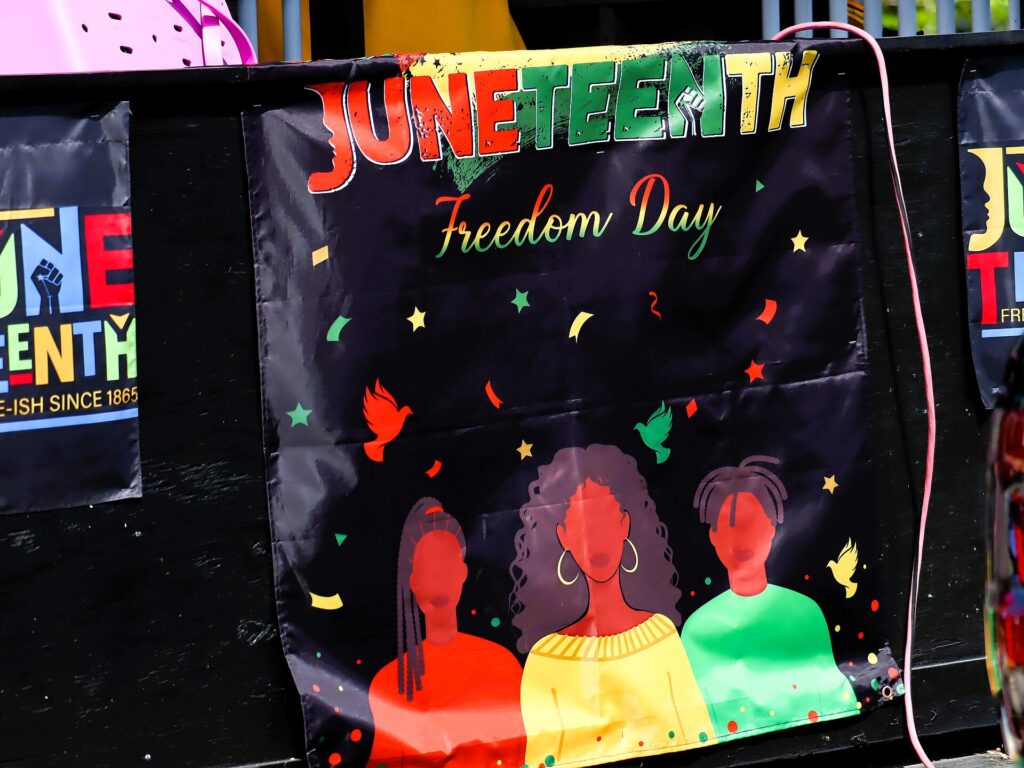
By Jahnvi Chopra/Arab America Contributing Writer
The Legacy of Juneteenth
On June 19, 1865, Union troops arrived in Galveston Bay, Texas, marking the day that all enslaved African Americans in the United States of America would gain their freedom. Though the Emancipation Proclamation was made effective in 1863, the implementation and enforcement of the executive decree wasn’t fully carried out until later.1 This moment in history, remembered as Juneteenth, highlights the importance of never giving up hope through adversity, which is a message that can be applied to all people fighting through struggle.
Arab Americans and Shared Identity with African Muslims
Historical Significance
African Muslims were a foundational part of the creation and development of America. Though the exact numbers are unknown, many documents, legal principles, and traditions reflect their presence and impact. African Muslims were integral to mapping borders, fighting against British rule and the Confederacy, labor, and businesses within White society.2 While it wasn’t their choice, the lasting effects of their contributions have transformed the America we know today.
Intersectionality
Out of approximately 3.7 million Arab Americans in the U.S, around 25 percent of them are Muslim.3 Though this number may be underwhelming to some, Muslims still make up a large part of Arab Americans and heavily influence their identity. Many people exist at the intersection of these identities, which act as a platform to connect both shared histories and current events between them.
Universal Reflection
Countless individuals with African American identity have been celebrating Juneteenth since the time of Emancipation. However, this historic moment and the struggle that it represents shouldn’t be limited to just one group of people. The Islamic Circle of North America encourages non-Black people to treat the holiday as a day of “remembrance and reflection,” pushing all communities to “respectfully commemorate the day.”4
Arab American Solidarity
As recognition of Juneteenth has grown, allies have formed across racial and ethnic differences. The Arab American community in particular has played a massive role in the overall awareness of the event. Additionally, several Arab communities have adopted celebratory practices that highlight the common ground between their identities and those of Black Americans.
ADC
The American-Arab Anti-Discrimination Committee (ADC) educates Americans about upcoming legislative changes, Arab history and culture, and the defense of rights, all related to Arab American identity. While they primarily focus on Arab Americans, they extend their work to serve many groups, even if they aren’t related to Arab identity. The ADC has long been an ally of the Black community, commemorating Juneteenth and standing in solidarity with them to advance equity and social justice efforts.5
The Arab American National Museum
The Arab American National Museum is located in Dearborn, Michigan, in the middle of the largest concentration of Arab Americans in the U.S. It is the first and only museum focused specifically on “sharing Arab American contributions that shaped the economic, political, and cultural landscapes of American life.”6
Like the ADC, the museum is committed to going beyond Arab Americans and to sharing the experiences of immigrants and ethnic groups of all backgrounds. They also aim to cover the pasts of those outside their focus and recognize that histories are often places of shared experience between groups. On June 19, 2021, the museum posted on Instagram to memorialize Juneteenth: “As a museum rooted in community, we recognize and honor the call for active solidarity that Juneteenth reminds us of, as well as the importance of commemorating this day.”7
The University of Utah’s International and Area Studies Program
In partnership with the University of Utah’s International and Area Studies Program, the university’s Middle East Center within the College of Humanities establishes its dedication to Black American allyship. Their statement expresses their ongoing commitment to remembering Juneteenth, not simply as a holiday, but as a day to remember the importance of improvement. They are “reminded of the ongoing need to actively confront racism and oppression and to work toward racial justice on all fronts,” affirming their stance as universal supporters for equal rights and opportunities.8
Looking Ahead
Since Juneteenth was established as a federal holiday by the Biden Administration in 2021, there has been significant controversy over its validity and whether it should be embraced by groups outside the Black community. Even so, most Arab American organizations have recognized the historical and political relevance of the overlap between both identity groups. As a result, they have strengthened their allyship with Black communities across the U.S. and promoted the day of remembrance to people of all backgrounds and identities.
As Juneteenth continues to evolve into a mainstream holiday, it will grow in both popularity and acceptance among the American people. Underneath the festive parades and barbecues lies a universal truth about societal shifts, applicable to everyone, regardless of background, life experience, or identity. It is best put by Barack Obama, “Juneteenth has never been a celebration of victory or an acceptance of the way things are. It’s a celebration of progress. It’s an affirmation that despite the most painful parts of our history, change is possible—and there is still much work to do.”9
Want more articles like this? Sign up for our e-newsletter!
Check out our blog here!
- NMAAHC ↩︎
- NMAAHC ↩︎
- Insight Into Academia ↩︎
- ICNA ↩︎
- ADC ↩︎
- AANM ↩︎
- Instagram ↩︎
- MEC Utah ↩︎
- Obama White House Archives ↩︎