
Subscribe
to receive news by email

Poll
Will the Trump Administration Shift U.S. Policy in Favor of Palestine?
- No (87%)
- Yes (13%)
 Loading ...
Copyright © 2026 Arab America
Go topSilenced but Not Forgotten: Honoring the Journalists Who Risked Everything to Reveal Gaza’s Truth
By: Laila Mamdouh / Arab America Contributing Writer
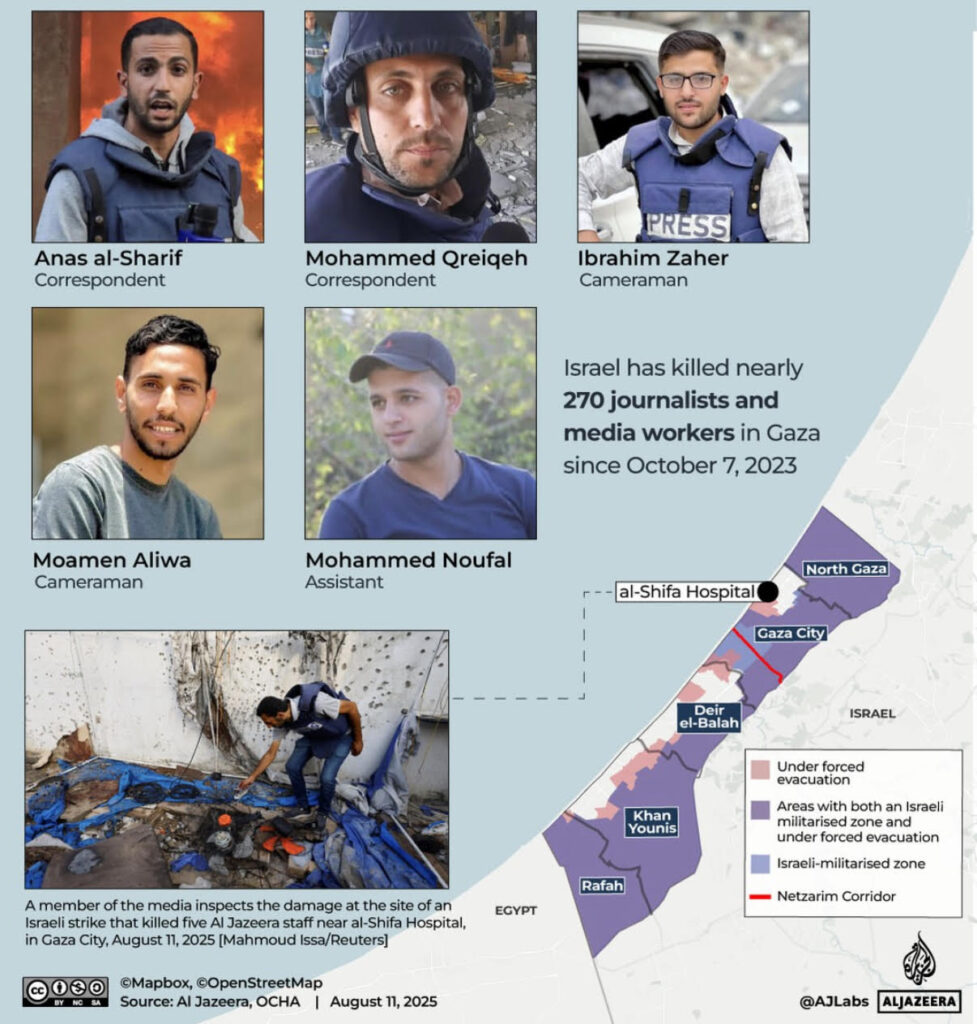
In less than two years, Gaza has seen an unprecedented attack not only on its civilians but also on the journalists who risk everything to document the truth. Media groups report nearly 270 journalists have died in Gaza since October 2023, showing the extreme danger of reporting there.
For the journalism world, August 10, 2025, marked a dark turning point. A deliberate Israeli airstrike in Gaza killed six members of Al Jazeera’s news team in a single strike. An unprecedented loss that sent shockwaves through newsrooms across the globe. The attack heightened fears that forces now deliberately obstruct documenting atrocities in Gaza. As if silencing those behind the cameras could erase the stories they tell.
Yet the truth does not die with the journalists who risk everything to capture it. Each of these men: Anas al-Sharif, Mohammed Qreiqeh, Ibrahim Zaher, Mohammed Noufal, Moamen Aliwa, and Mohammed al-Khaldi, carried with them a lens, a voice, and a determination that reached far beyond Gaza’s borders. Their lives and work illuminate why their loss is not just a tragedy for Palestine, but for the global pursuit of truth. (Al Jazeera).
Remembering the Fallen: Six Voices of Truth in Gaza
Anas al-Sharif (28) was more than a correspondent; he was Gaza’s voice to the world. Known for his fearless live reporting, he often stood in the middle of bombed streets, narrating events as they unfolded behind him. His commitment went beyond professional duty; it was deeply personal (The Guardian). In the weeks before his death, Anas openly spoke about the threats he faced, yet refused to leave his post. Hours before his death, he wrote: “Do not forget Gaza.” That call now echoes both his legacy and his challenge to the world (TIME).
Mohammed Qreiqeh was a veteran reporter whose voice carried the weight of experience. He had documented multiple wars in Gaza, and despite the danger, insisted on covering the human stories. Grandmothers clutching faded photographs, children playing among rubble, families sharing their last loaves of bread. His reports made the world see ‘Gazans’ as people (Al Jazeera).
Ibrahim Zaher (25) was the youngest member of the crew, yet his camera work carried the weight of someone far beyond his years. His lens captured the unfiltered truth of shattered hospitals, street funerals, and moments of rare joy amid destruction with the determination to show not only what war destroys, but also what survives. (Le Monde).
Mohammed Noufal (29) had a gift for finding the small details that told a larger story. These details became powerful symbols of survival. A father of two young children himself, Noufal often said he filmed with them in mind, hoping the world would see Gaza’s children as deserving of the same safety as any other (Al Jazeera). His work was a reminder that even in war, life insists on being lived.
Moamen Aliwa was a freelance camera operator who built his career on courage and adaptability. Without the institutional protection of a major network, Moamen often took assignments others turned down. He ventured into areas under intense bombardment to capture footage the outside world would never otherwise see. His work was frequently picked up by major international outlets, helping bridge the gap between Gaza and audiences abroad (National Union of Journalists).
Mohammed al-Khaldi, a freelance photojournalist, was gravely wounded in the August 10 strike and died the following day. His photography was often quiet but piercing: the profile of a man praying in the ruins of his home, a child’s bare feet in the dust, a line of women waiting for water. Al-Khaldi’s images carried an intimacy that statistics and headlines could never match. Many of his photos remain unpublished. However, those who have seen them say they are among the most haunting and beautiful images to emerge from Gaza’s war (UNESCO).
Each of these six men understood the risks of telling Gaza’s story, yet they chose to keep their cameras rolling. Their lives remind us that journalism is not merely a profession, but rather an act of defiance against erasure. And though their voices have been silenced, their images, words, and courage endure. This only proves that killing the messenger can never truly kill the message.
Al-Jazeera and the International Response
The deliberate killing of six journalists on August 10 struck at the heart of global journalism. Press freedom organizations, including the Committee to Protect Journalists, the International Federation of Journalists, and the United Nations Human Rights Office, joined governments and media outlets worldwide in condemning the attack as a direct assault on the press. They emphasized that international humanitarian law protects journalists. Targeting them undermines not only the right to report, but the very foundation of truth in times of war.
Al-Jazeera Media Network condemned the attack as “yet another blatant and premeditated attack on press freedom” and “a desperate attempt to silence the voices exposing the impending seizure and occupation of Gaza” (Al Jazeera). The network demanded accountability through international institutions, urging that the killing of journalists cannot and should not go unpunished.
Ireland’s deputy prime minister called the strike “the silencing of some of the few journalistic voices left,” a sentiment echoed by protests erupting in cities from Dublin to Sydney. Leaders in France, Italy, Australia, and the UK warned that this brazen act would deepen global instability. They also said it would erode the world’s ability to hold power to account (The Sun).
Can Silencing Journalists Erase the Truth?
As yet another tragedy unfolds, one must confront a chilling question: how long will this continue, and can the systematic killing of journalists erase realities? The answer is clear: No. Even as forces attempt to extinguish the historiographers of suffering, the truth persists through the memories of survivors, through suppressed social media, repeated testimonies, and even through the act of silencing itself.
But this chilling logic remains: without cameras, without witnesses, the world’s windows to the violence close. No camera = reduced visibility. No visibility = unchecked atrocity. Does killing journalists deny the atrocities? It may shelter them temporarily from sight, but not from history or conscience.
Let us honor Anas al-Sharif, Mohammed Qreiqeh, Ibrahim Zaher, Mohammed Noufal, Moamen Aliwa, and Mohammed al-Khaldi, not only in memory but in determined insistence. Their stories must continue. Their last images, their last words, beg us not to look away.
Want more articles like this? Sign up for our e-newsletter!
Check out our blog here!