Subscribe
to receive news by email

Poll
Will the Trump Administration Shift U.S. Policy in Favor of Palestine?
- No (87%)
- Yes (13%)
 Loading ...
Copyright © 2026 Arab America
Go topThe Arab American Politics of Superman 2025
By: Katie Beason / Arab America Contributing Writer
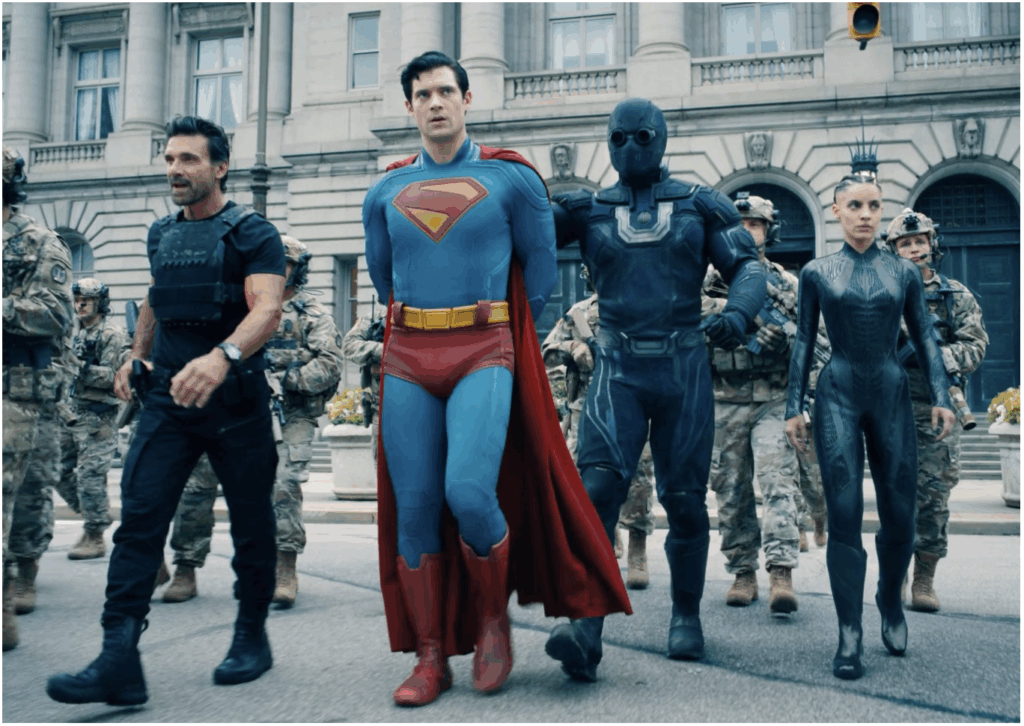
James Gunn’s 2025 Superman is causing quite a stir on the internet, with praise for its timely portrayal of international armed conflict, government overreach, and American exceptionalism, as well as admonishment for perceived anti-Semitism and anti-American attitudes. While other recent superhero movies like Marvel’s Thunderbolts* swing dramatically away from politics and towards the emotional and interpersonal, Gunn renews the long history of comic books interrogating the American identity and our role in international armed conflict.
Note: Spoilers ahead!
Superman in American History
DC Comics introduced Superman in 1938 against the backdrop of World War II as a response to fears of new technologies and as an exploration of new geopolitical realities. Before the attack on Pearl Harbor in 1941, Superman was an avenue through which to explore the new reality that America may have a responsibility to intervene in foreign conflicts. After the attacks, America as a global policeman became less subtext and more overt. The phrase “truth, justice, and the American way” originated in a 1942 radio series called “The Adventures of Superman,” which highlighted Superman’s dedication to American values during the war.
Superman in 2022
After 9/11, the visual aesthetics of superhero movies, especially in the DC universe, skewed distinctly pessimistic and gritty. Compare George Clooney’s Batman with Christian Bale’s or Robert Pattinson’s. James Gunn began writing his Superman debut in 2022 after two decades of noir color grading and civilian crime. His 2025 return to directing would reintroduce Superman with a different cast of actors and set the tone for Superman’s future DCU appearances. While the invasion of Ukraine was present in his writing process, the tone in dialogue and aesthetics skews much brighter and more optimistic.
This was likely a response to the darkness that many Americans feel in the current political landscape. Gunn’s prediction that audiences would respond more positively to an optimistic representation of American values was realized, as Superman 2025 beat nearly all DC movies from the past 5 years and all MCU movies of 2025 at the box office (so far).
Predictions and Allegory in the Superhero Genre
The superhero genre is filled to the brim with predictions. The X-Men franchise has historically represented the LGBTQ+ community and the civil rights movement, while the Fantastic 4 franchise was reflective of pervasive fears of nuclear war. Superman’s traits tend to lend themselves to a vague hopefulness in American exceptionalism and American masculinity. It’s the battles he fights with tend to lean more allegorical.
In Gunn’s Superman, the plot has a veneer of fiction over an incredibly common American occurrence. When there is unjust conflict in the world, how should America intervene? When Boravia, a fictional US ally, invades an oil-rich desert country full of brown people, what is America’s role?
Superman intervenes at the border of Boravia and Jarhanpur to prevent a brutal land invasion against a civilian population, prompting massive retaliation from the American people, including Silicon Valley stand-in Lex Luthor.
The development of this conflict predated the current genocide in Palestine, and Gunn’s statements, that Superman was not inspired by any particular conflict, are most likely true. Instead, the film made a careful analysis of America’s trends in the Middle East and Eastern Europe and created a conflict that was broadly representative of America in the 21st century. In this respect, its unspecified and predictive nature pre-dating Palestine shows how consistent American foreign policy is towards human rights crises against brown people, and the leniency it grants its allies.
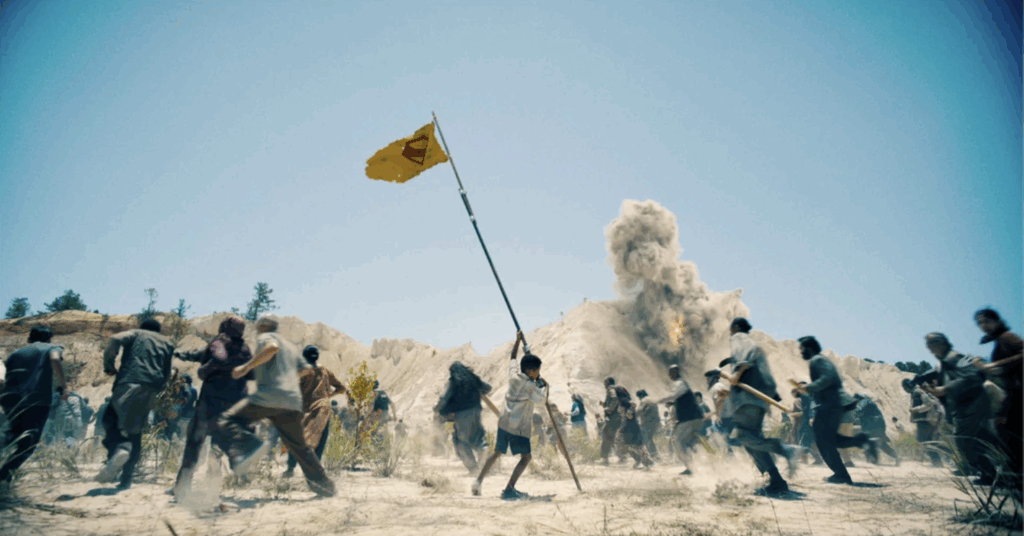
There is an argument to be made that Boravia loosely represents Russia, as Boravian is a vague Slavic-sounding language. This would be reflective of when Gunn began writing, six months after the invasion of Ukraine. However, unlike Russia, the fictional Boravia is a cherished US ally, using American-made weaponry. They are emboldened to commit atrocities because they are allies of the US, not despite potential backlash from an enemy, like Russia and the US. This makes the relationship closer to that of Israel and the US. This, coupled with scenes of brown people wearing headscarves and wielding bricks and rocks against an invading army, is why this movie has become an allegory for Israel-Palestine.
Being Arab in the DCU
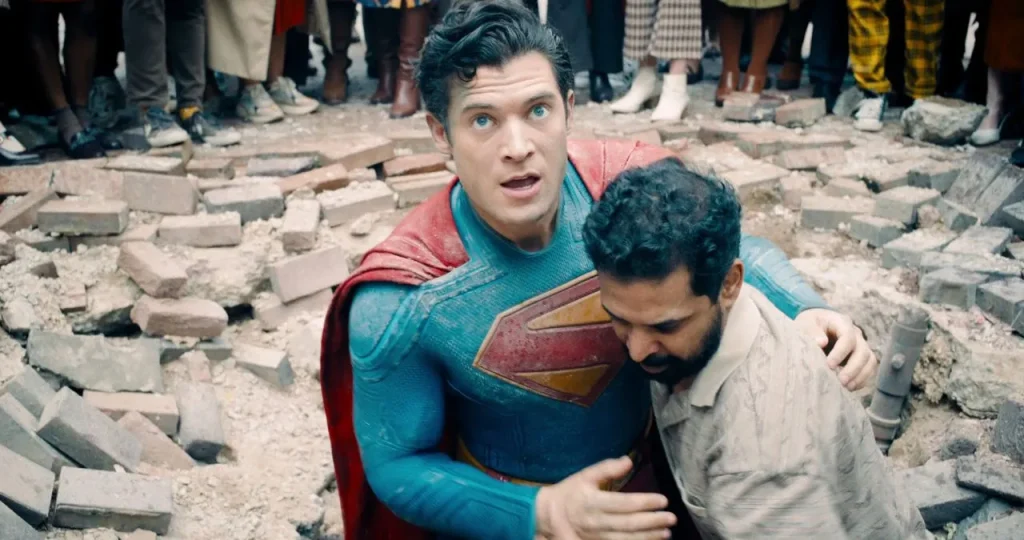
Every superhero movie has a civilian who helps the hero. It humanizes the hero and shows with whom his moral allegiances lie. In Superman, this civilian is Malik, or Mali, who owns a falafel cart. When Superman prevents the invasion of Jarhanpur, his popularity across the US is down, and he loses a fight against Lex Luthor’s Superman clone. Mali runs to help Superman out of the rubble, joking about having offered Superman free falafel. An Arab-coded character being the civilian in the first 10 minutes of a superhero movie is a massive departure from the era of Iron Man in 2008.
Mali’s face is scanned by Lex Luthor, and despite his foreign accent, Luthor identifies him as a “local.” This puts him in contrast with Superman, who is referred to as an alien. In his backstory, Superman is effectively a refugee. His home planet was destroyed, and his parents sent him on a ship to Earth, where he was adopted. The politics of this movie treats Superman like a foreigner on Earth, like immigrants are treated as foreigners in the US.
As an alien, the impact on Superman is obvious. He is denied the right to question American laws and decisions. When his family background is questioned, the American public turns on him completely and absolutely. When arbitrarily arrested, the special forces specifically neglect to read him his Miranda rights, and he is transferred to a black-site prison, no due process, no lawyers, no dignity.
It’s remarkable how closely Superman’s journey through his arrest mirrors those of Mahmoud Khalil and the other brave immigrants who speak out against their mistreatment, as well as against the genocide in Palestine. However, this again is not necessarily because Gunn had the future in Palestine in mind. Rather, he observed America’s history of political detention in the Trump era, of inaction in the face of atrocities, and of the mistreatment of immigrants, and he distilled these trends into a universal story.
It’s no surprise that Ukrainians, Palestinians, and their allies feel such a connection with this movie. By following historic trends, Gunn made a universal allegory for the pain of immigrants in America and the US’s historic inaction in genocides abroad.
The Limits of Superman’s Allegory
While its allegory is shockingly timely, Superman, like all allegories, is simplistic and loses important nuance or criticism. The movie, for example, refuses to completely criticize the American
Superman is not an anti-American movie. Through the power of American journalism, Luthor’s plot to take over a portion of Boravia is exposed and unanimously disavowed, and faith in Superman is unquestionably restored. The Pentagon stops trying to detain Superman, allowing him and the Justice Gang to save Jarhanpur unfettered.
The movie’s vagueness also presents a weakness in its representation of violence done to brown people, especially to kids. It’s a tall order to expect Gunn to have predicted the war in Palestine, the subsequent genocide, and the unprecedented proliferation of photos and videos of starving and dying brown children. Nevertheless, the film’s depictions of six-year-olds from Jarhanpur rallying together in a desert climate to raise the flag of Superman, before being heroically saved from violence at the last minute, have aged poorly in the past three years.
It is hard to believe the stakes when audiences have seen Palestinian children die in the thousands since this movie’s inception. In this respect, the movie reaffirms a degree of American exceptionalism. Rather than Superman and the Justice Gang’s inaction resulting in any meaningful consequences for the people of Jarhanpur, they swoop in at the last minute and save the day. America has 60,000 casualties and is eight decades late.
Want more articles like this?
Sign up for our e-newsletter! Check out our blog here!