
Subscribe
to receive news by email

Poll
Will the Trump Administration Shift U.S. Policy in Favor of Palestine?
- No (87%)
- Yes (13%)
 Loading ...
Copyright © 2026 Arab America
Go topThe Battle for Gaza: Are Economic Protests Really Working?
By: Layla Mahmoud / Arab America Contributing Writer
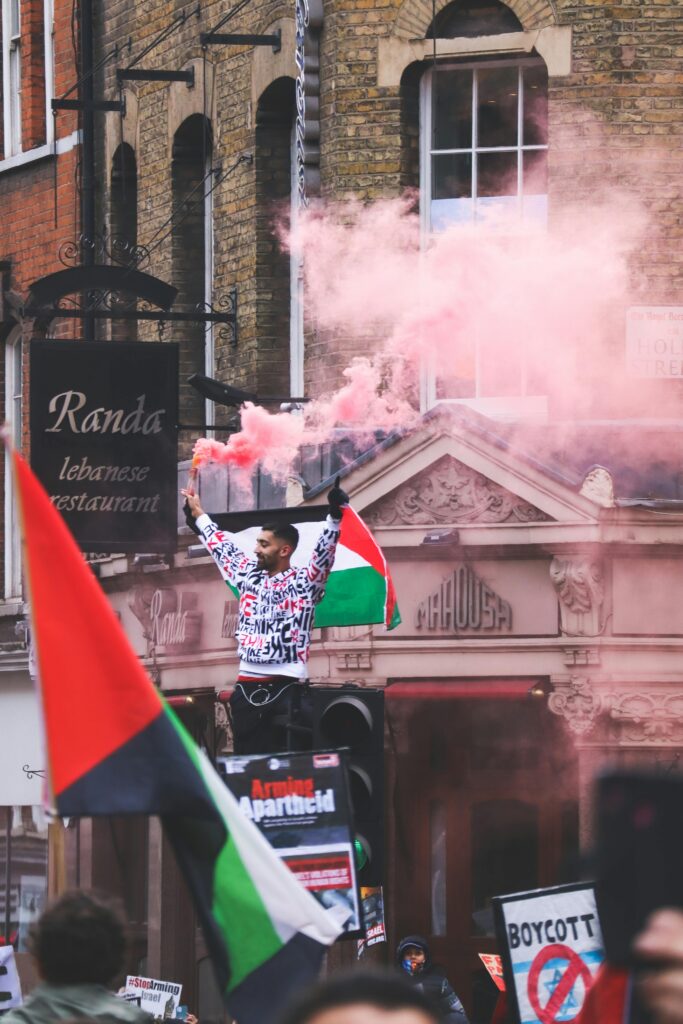
Since the escalation of violence in Gaza, calls to boycott companies linked to Israel have surged across the Arab world and among Arab and Muslim communities in the West. In the U.S., Arab-American organizers have reignited the “BDS” (Boycott, Divestment, Sanctions) movement and urged consumers to use their wallets as tools of resistance.
The Economic Protest Revival
Following the bombardments of Gaza in 2024 and 2025, many Arab and Muslim Americans stopped buying from brands like Starbucks, McDonald’s, and Disney, companies accused of supporting or profiting from Israel’s occupation policies. Social media campaigns, especially on TikTok and X (formerly Twitter), have pushed the message that “no purchase is neutral.” Within weeks, some major corporations faced notable revenue dips in Arab-majority countries, and franchise owners publicly appealed for calm as sales plummeted.
For many, this consumer activism offers an accessible way to participate in political resistance, especially for diaspora communities who can’t physically protest or donate directly. The boycott becomes a moral stance, a public signal of solidarity, and a way to force global attention on an issue long marginalized in mainstream media.
The Question of Impact
But does it work? The answer depends on what kind of “impact” one measures.
Economically, large-scale corporate boycotts rarely dent the profits of multinationals in a lasting way. Starbucks, for example, experienced temporary financial setbacks in Middle Eastern markets but quickly recovered through rebranding and local PR campaigns. However, the symbolic and cultural impact can’t be dismissed. Boycotts shift narratives, force corporate accountability, and pressure institutions to publicly clarify their positions, which was something previously unthinkable in corporate America.
More importantly, these movements create an environment where conversations about Gaza become unavoidable. Even if companies don’t collapse, public discourse changes. Younger generations begin to question complicity, governments are pressed to respond, and media outlets are forced to cover perspectives they once ignored.
A Tool of Awareness, Not a Solution
Most Palestinian advocates acknowledge that boycotts alone cannot liberate Gaza or end the occupation. Instead, they serve as part of a broader moral campaign, one that connects economic pressure with political education. Through boycotts, diaspora communities demonstrate that global solidarity can translate into real-world visibility, even if not into immediate political outcomes.
Critics argue that these efforts oversimplify complex geopolitical realities and unfairly punish workers who depend on boycotted companies. Supporters counter that economic pressure has historically played a role in dismantling systems of injustice, from South African apartheid to U.S. civil rights struggles. In that sense, the boycott becomes a continuation of a long tradition of peaceful resistance, imperfect but essential.
Where the Movement Stands Now
In 2025, economic activism around Palestine has grown more decentralized, digitally organized, and intersectional. Campaigns now merge with climate justice, labor rights, and anti-imperialist movements. Arab-American youth, in particular, have taken the lead in reframing Palestine not as a niche foreign-policy issue but as a global justice cause.
Whether or not boycotts can shift U.S. foreign policy or corporate alignment remains uncertain. But one thing is clear: they’ve already succeeded in transforming silence into engagement. For a generation raised online, the decision of where to buy coffee or stream movies has become inseparable from questions of ethics and human rights.
The power of boycotts, then, may lie not in emptying corporate pockets, but in filling public consciousness by forcing both consumers and companies to confront the cost of complicity.
Want more articles like this? Sign up for our e-newsletter!
Check our blog here!