Subscribe
to receive news by email

Poll
Will the Trump Administration Shift U.S. Policy in Favor of Palestine?
- No (87%)
- Yes (13%)
 Loading ...
Copyright © 2026 Arab America
Go topThe Chapel of Saint Claire & Jacques Liger-Belair
By Ralph I. Hage/ Arab America Contributing Writer
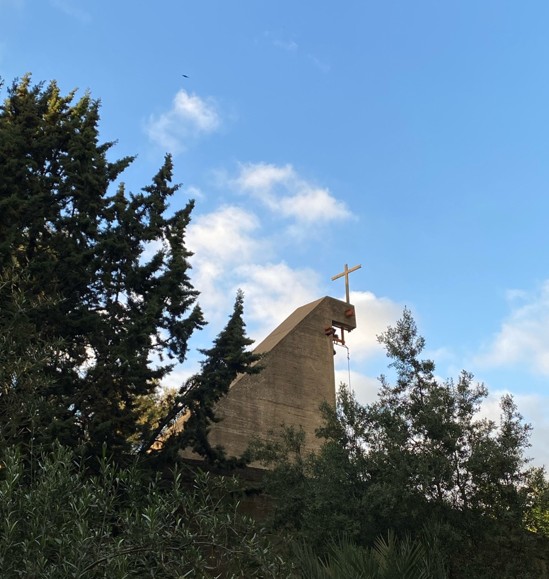
One time, as I drove through the leafy town of Yarzeh in the Baabda district in Lebanon, I decided to park on a quiet side street. I stepped outside my car and saw a statue of Saint Claire. Looking further down the road, I spotted a convent on the left, and on the right, a concrete structure rising through the trees. I walked further out towards it. It was a small chapel characterized by a distinctive architectural style and was known locally as the ‘Clarisses Sisters Unity Chapel.’
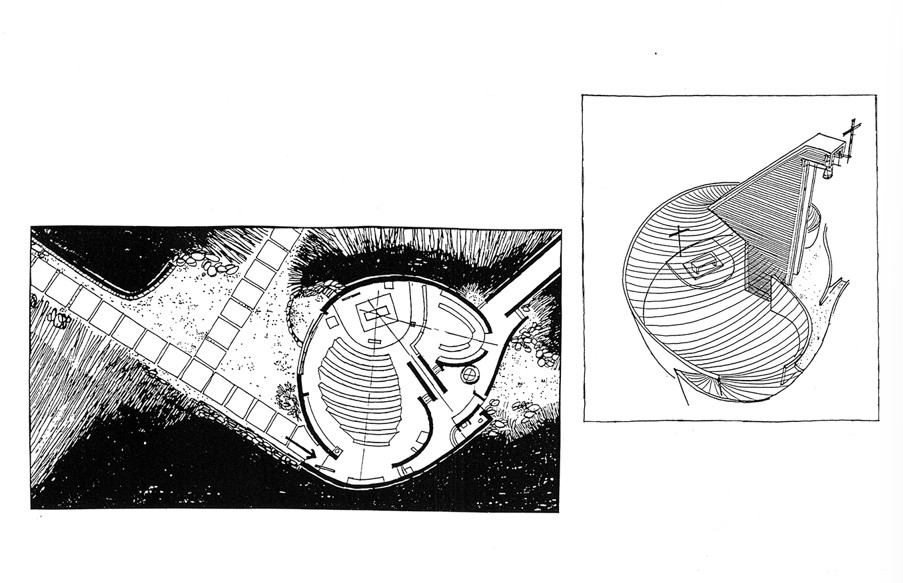
Like the best kind of architecture, it was designed for this specific site. The positioning of the structure, its orientation, and the pathways surrounding it all followed the natural topography and took into consideration the immediate surroundings.
Its circular walls, a hyperbolic paraboloid roof, and a sharply angled bell tower emerging diagonally from the center, gave the building a striking geometric appearance.
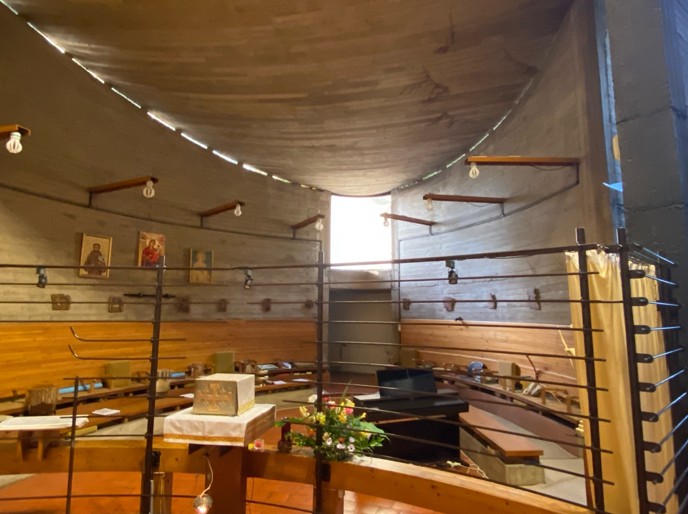
There were two separate entrances – one designated for the sisters of the convent, and another for external visitors.
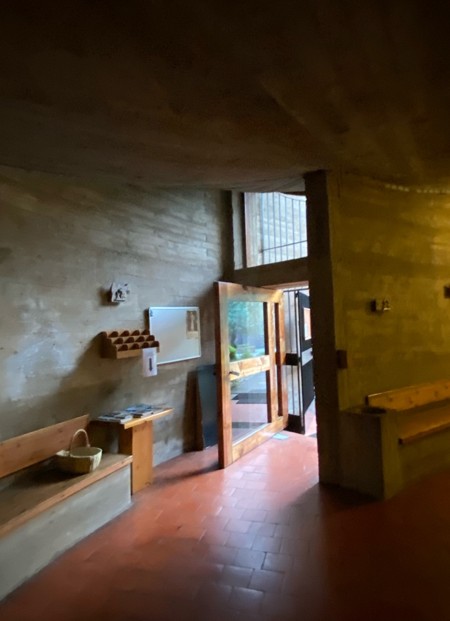
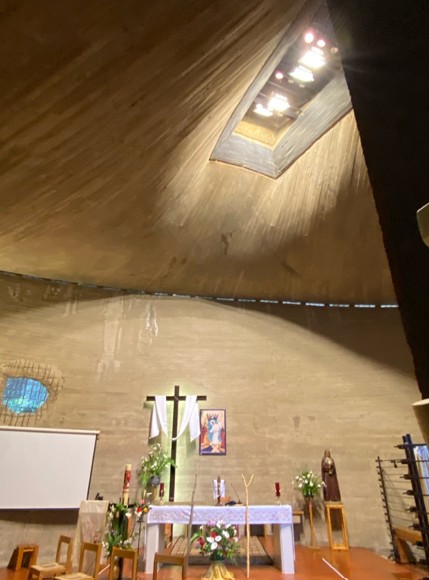
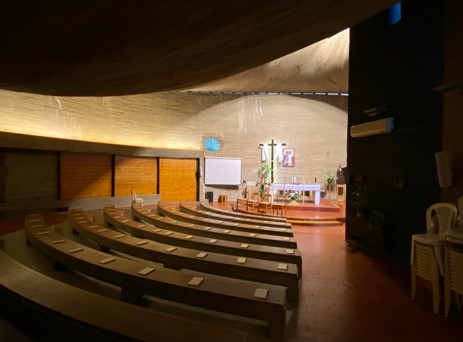
The structure was primarily built with exposed concrete, which created a stark, raw aesthetic. This was softened, however, by the use of warm wooden elements in the pews and doors.
Natural light filtered into the space through narrow gaps between the roof and walls, as well as through openings in the bell tower, casting particular focus on the altar area.
The nearby nature was lush and serene, and the space around it offered a simple and quiet garden to relax in.
The History of the Chapel
I noticed that it had sustained damage from a missile strike near the altar which was simply enclosed in plastic – a memento from the civil war.
I did some research and found that it was built between 1965 and 1967 and was designed by a French-Belgian-Lebanese architect called Jacques Liger-Belair.
In 1955, he received a Diploma in Architecture from the Esa Saint-Luc in Brussels, Belgium where he was a valedictorian, while also obtaining a diploma in urban planning from the ISIUA “Institut Supérieur International D’Urbanisme Appliqué Paris-Bruxelles”.
Between 1958 and 1960, he undertook a study trip to the Middle East and India, with the intention of working on Chandigarh, Le Corbusier’s iconic project, then still under construction in India.
He stopped by Lebanon in this time to earn some money before being able to continue to India. During this stopover, he discovered Lebanon and fell in love – on the Saint-Michel beach – with Jacqueline, the Lebanese woman he would marry a few months later. They spent the rest of their lives together.
In 1961, he settled in Lebanon. In addition to his own Modernist Western architectural culture, he was deeply influenced by the diversity and richness of the heritage of the buildings in the Mediterranean.
Jacques’s Presence in Lebanon
Between 1961 and 1976, he completed numerous projects in Lebanon, such as the Nazareth Kindergarten in Achrafieh and the Franciscan chapel in Badaro.
He was also responsible for two educational building programs for the Ministry of National Education and the religious order of the Sisters of the Holy Hearts. He taught at the National Institute of Fine Arts of the Lebanese University (INBA) and at the Lebanese Academy of Fine Arts (ALBA).
At the request of President Fouad Chehab, he worked on the preservation of the coastline and heritage buildings in Jounieh. At the same time, he worked with ETEC (Beirut), Socetec (France), Albini (Italy), and PHP (Germany), and on several projects in Saudi Arabia.
In 1980, he founded AAA (Atelier des Architectes Associés SARL). In 1990, he was a consultant architect for the Agency for Cultural and Technical Cooperation (ACCT) in Paris. He also worked on urban studies and ZAC developments with the Atelier d’Architecture Paris-Venice. In 1991, he was a consultant to Dar el Handasah for the master plan and reconstruction plan for downtown Beirut.
Belair was granted Lebanese citizenship in 1994, and in 1995, he was awarded the Legion of Honor by the French Government. Throughout his career, he published various books and articles on architecture in Lebanon and the Middle East. He passed away in 2024, but his architectural legacy lives on.
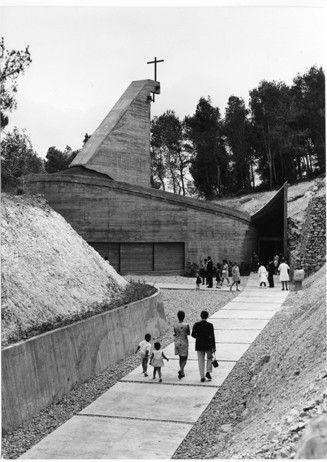
The church remains in use today and stands as a hidden gem of Lebanese architecture.
Ralph Hage is a Lebanese American architect who divides his time between Lebanon and the United States.
Want more articles like this? Sign up for our e-newsletter!
Check out our blog here!