
Subscribe
to receive news by email

Poll
Will the Trump Administration Shift U.S. Policy in Favor of Palestine?
- No (87%)
- Yes (13%)
 Loading ...
Copyright © 2026 Arab America
Go topThe First Arab in Space: Sultan Salman Al-Saud
By: Robert Jackson/Arab America Contributing Writer
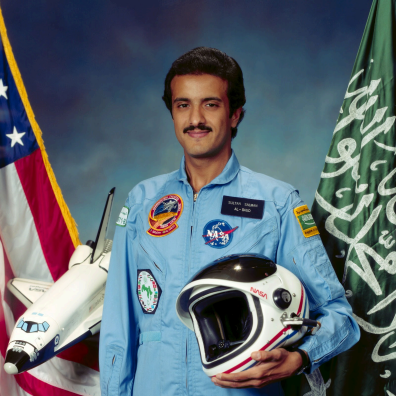
This year, 2025, marks the 40th anniversary of Prince Sultan Salman Al-Saud’s journey into space. He set milestones for being the first Arab, the first Muslim, and the first royal family member to go to space. He is also the youngest to have flown on a space shuttle at 28 years old. His time aboard the Space Shuttle Discovery on mission STS-51-G, gave him a new perspective on life, one of human interconnection. He continues to inspire Arabs to reach for the stars.
Sultan Salman the Aviator
Born in Riyadh in 1956, Sultan Salman Al-Saud grew up in a time of rapid modernization for Saudi Arabia. He showed a passion for flying from an early age which he has carried with him throughout his life. He was deeply inspired at 13, watching the moon landing in 1969. Sultan Salman would go on to become an accomplished pilot in the Saudi Arabian Air Force.
The Mission
STS-51-G appeared to be a run of the mill mission for Discovery, the 5th mission out of 39. However, the mission’s cargo was what made it different and set Sultan Salman on the course to becoming an astronaut. Arabsat, or the Arab Satellite Communications Organization, had been recently established. They had just sent their first satellite into orbit and wanted to send another, Arabsat-1B, on the space shuttle. Major customer nations for the space shuttle services were given seats to send astronauts to space. Sultan Salman was selected and went through a rigorous 10 week training program to become a payload specialist. On June 17th, 1985, STS-51-G launched into space.
During the seven-day flight, Prince Sultan conducted Earth observation experiments, participated in satellite deployment procedures, and served as a cultural and technical liaison between NASA and Arab ground teams. From orbit, he looked down upon the Earth and later described the experience as profoundly humbling.
For the Arab world, this was a landmark achievement, not only was an Arab-built and operated satellite being placed into orbit, but an Arab astronaut was there to witness and support the mission firsthand.
A Symbol Beyond Science
While Sultan Salman’s role aboard Discovery was scientifically and technically meaningful, the symbolic power of his flight may have been even greater. In 1985, the idea of an Arab astronaut was far from common in global imagination. His presence in space challenged stereotypes and expanded perceptions of who could participate in humanity’s most advanced scientific endeavors.
Across the Arab and Muslim worlds, his mission sparked widespread excitement. Schools held special assemblies, newspapers ran front-page stories, and young people began to see space exploration not as a distant Western pursuit, but as a field in which they, too, could one day belong. Prince Sultan himself often emphasized this point, stating that he hoped his journey would inspire Arab youth to pursue science, engineering, and exploration.
Life After Space
Unlike many astronauts whose careers remain centered on space agencies, Sultan Salman returned home to a life of public service. His understanding of aviation and safety later led to his appointment as Chairman of the Saudi Commission for Tourism and National Heritage, a role he held for nearly two decades.
In this position, he became a leading advocate for cultural preservation, environmental protection, and sustainable tourism in Saudi Arabia. He worked to safeguard historical sites, promote domestic tourism, and highlight Saudi Arabia’s rich and diverse heritage to the world. In many ways, this phase of his career echoed the perspective he gained in space: seeing the value of Earth as a shared, fragile home.
In 2018, Prince Sultan was appointed Chairman of the Saudi Space Commission, bringing his story full circle. Decades after becoming the first Arab in space, he was now helping shape the future of Saudi Arabia’s space ambitions, including satellite development, scientific research, and international collaboration.
A Lasting Impact
Prince Sultan Salman Al-Saud’s legacy cannot be measured solely by the number of orbits he completed or the days he spent in space. Its true weight lies in what his journey represented and continues to represent.
He demonstrated that participation in space exploration is not confined by geography, culture, or language. His flight stood as early proof that the Arab world could contribute meaningfully to global science and technology when given opportunity and investment. For Saudi Arabia, his achievement foreshadowed the nation’s growing interest in science, innovation, and space as pillars of future development.
Perhaps most importantly, his story remains a source of inspiration. For students gazing up at the night sky from Cairo, Riyadh, Casablanca, or Amman, Sultan Salman’s journey offered a simple but powerful message: exploration is universal, and the path to the stars is open to all who dare to pursue it.
The View That Changed Everything
Astronauts often speak of the “overview effect,” the cognitive shift that occurs when seeing Earth from space. Prince Sultan experienced it firsthand, and he carried it back with him, translating that perspective into decades of service on the ground. His life illustrates how a single mission can ripple outward, shaping national identity, inspiring generations, and redefining what is possible.
Four decades after Discovery returned safely to Earth, the image of Sultan Salman Al-Saud floating in microgravity remains important. It is not just the image of a man in space, but of a region stepping onto a larger stage, looking outward, dreaming bigger, and claiming its place among the stars.
Want more articles like this? Sign up for our e-newsletter!
Check out our blog here!