Subscribe
to receive news by email

Poll
Will the Trump Administration Shift U.S. Policy in Favor of Palestine?
- No (87%)
- Yes (13%)
 Loading ...
Copyright © 2026 Arab America
Go topThe Global Revival of Arab Symbols, Jewelry & Aesthetics in the Diaspora
By: Laila Ali / Arab America Contributing Writer
For decades, the evil eye, the bead-thin blue eyes watching over children and homes in the Arab world, has been our most visible symbol in the West. But there’s a deeper visual language being revived across the Arab diaspora: Calligraphic pendants. Geometric arabesques. Hamsas and crescents. Kufic calligraphy. Arab symbols are making a comeback in fashion, jewelry, and art, infused with new layers of meaning: Pride. Identity. Belonging.
For Arab Americans, these are symbols of home, reinterpreted to anchor us in the diaspora and help us connect to the Arab world, even when we can’t return there.
A Visual Language of Protection
The Hamsa, or Khamsa, is a hand-shaped amulet said to bless and protect those who wear or display it. It’s believed to have pre-Islamic and pre-Jewish origins (there is a Jewish equivalent called the hamsa hand). Arab diaspora artists are reimagining this centuries-old symbol, whether hung from the neck like a charm or “hidden” as a tattoo.
The crescent moon and star, which has been used across cultures and religions as a symbol of light and guidance, appears in jewelry collections like the crescent pendant from Loulia Jewelry, a gold crescent with a diamond on one side and a moonstone on the other. Called the Hadiyah, it’s a spiritual symbol meaning “guidance” in Arabic, a nod to the lunar month during Ramadan.
The arabesque, a hypnotic geometric pattern with vines, diamonds, or grids, can be seen on modern Arab designers referencing this decorative motif from traditional Islamic art.
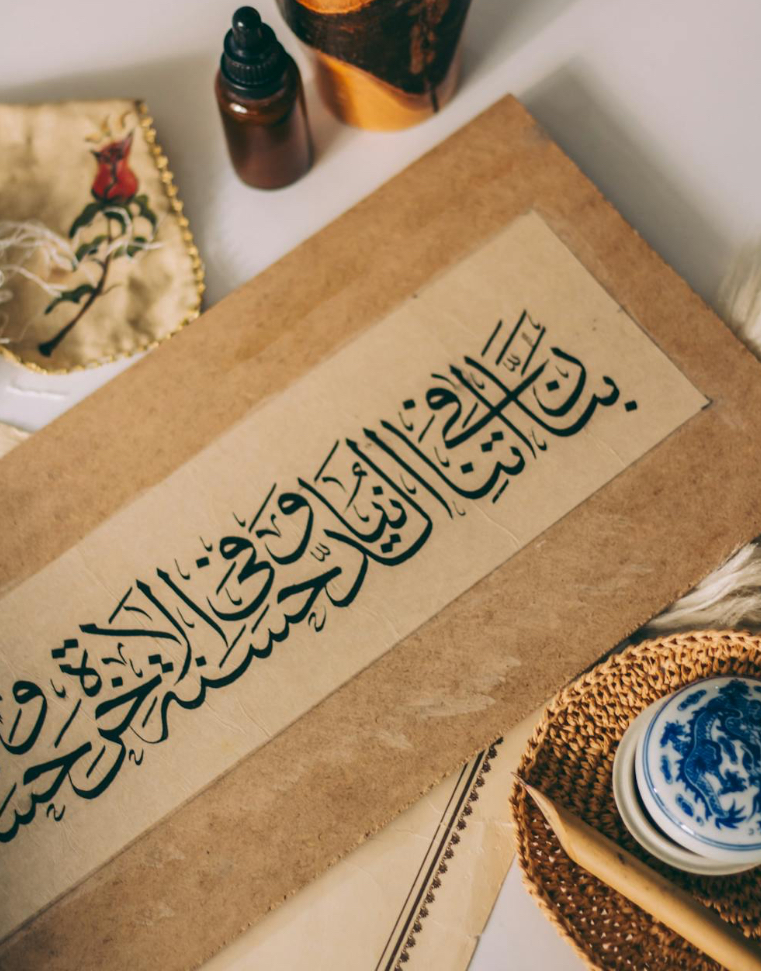
Then there’s Arabic calligraphy: An entire language turned into line. Flowing scripts are an ancient art in the Arab world, but the bold angular letters of Kufic script, once used to decorate early mosques and coinage, are the ones making a comeback on necklaces and other jewelry. Words like حب love or حرية freedom. Lines that literally trace Arabic identity, yet can be understood universally. Each line and loop a dialogue between artistry and identity, permanence and change.
A Revival Rooted in Diaspora
The Arab diaspora, and especially the U.S., is the heart of this movement. For many Arab Americans, growing up meant learning how to hide, deflect, and present culture as “watered-down” for others . Invisibility becomes part of your DNA. Wearing a calligraphy pendant on the street or putting a hamsa over my shoulder is a way to reclaim our culture and language.
Designers like Noor Shamma, Nadine Ghosn, and Ola Shehadeh are bringing traditional Arab motifs into the world of luxury jewelry and international fashion, mixing heritage and contemporary design.
Young Arab-American artists are leading the charge of arabesques in digital art and graphics, graffiti-style calligraphy, and old talismans as new symbols of power. In a moment where representation and visibility are so important, these symbols become a way to tell our own stories, on our own terms.
More Than Ornamentation: What These Symbols Mean
For many who wear them, these symbols aren’t just ornamentation. They’re stories. The Hamsa isn’t just a hand: It’s the hand of my grandmother, her fingers blessed by grandmothers before her, clasped over my own before I leave the house. The crescent moon isn’t just an ornament: It’s my father, telling me the first half of Ramadan is the “dark moon” and the second half the “light.” Calligraphy isn’t just “art”: It’s the living power of language, the written word translated to sacred geometry. There’s layers of meaning in these symbols, each carrying multiple weights:
- Protection and continuity, guarding against bad luck, but also guarding against forgetting.
- Faith and resilience, symbols of belief through migration.
- Identity and pride, subtle ways of claiming your space in a world that often asks you to explain or apologize for being Arab.
In the diaspora, this new visual language can hold all of these meanings, plus more. These are symbols of public reclamation and private memory: Visibility as resistance, as pride, as solidarity. Symbols that help us protect our identity in the diaspora and stay rooted in the culture of home.
Creating Meaningful Modernity
The power of this visual renaissance in the Arab world isn’t just in its aesthetics but also in how Arab-Americans are translating it. This revival isn’t just a museum tour, it’s a translation. A hamsa may take on new forms with clean minimalist lines. Kufic calligraphy now spells out modern phrases and slang. The arabesque may show up on sneakers or custom motorcycle helmets.
But this doesn’t dilute meaning: It proves that Arab art adapts.
Cultural evolution is both good and necessary, but for many of us, this also feels like the work of bridging two worlds that often feel divided. How can I be both Arab and American in my art? How can I make my cultural practice speak to the diaspora? We adapt while honoring our past, adding layers to the visual language of what it means to be Arab and Muslim.
At its best, the revival of Arab symbols in art and design isn’t nostalgia. It’s cultural continuity. The work of each new generation to keep our language, our history, our identity alive, relevant, and translated for the world.
Want more articles like this? Sign up for our e-newsletter!
Check out our blog here!