
Subscribe
to receive news by email

Poll
Will the Trump Administration Shift U.S. Policy in Favor of Palestine?
- No (87%)
- Yes (13%)
 Loading ...
Copyright © 2026 Arab America
Go topThe Libyan Henna You’ve Never Heard Of: Misrata’s “Fish Net” Henna Tradition
By: Nourelhoda Alashlem / Arab America Contributing Writer
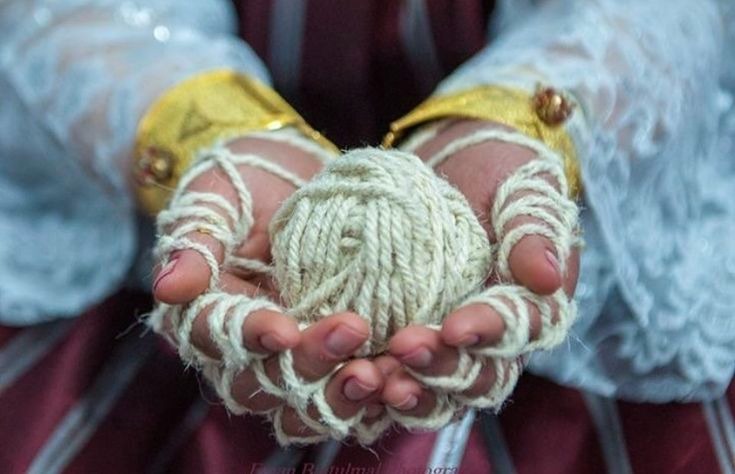
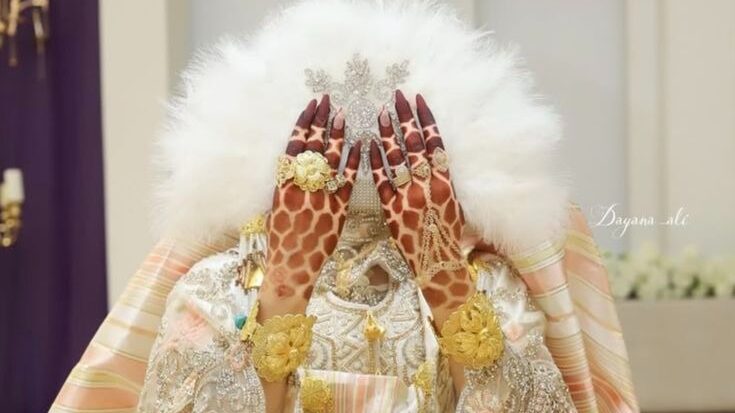
When people think of henna, they imagine floral or cultural designs painted onto hands and sometimes feet. But in Misrata, one of Libya’s most historic coastal cities, henna looks very different. It is not drawn. It is tied.
This tradition, known as Henna al Shbur, exists only in Misrata. The tradition is reserved strictly for brides and takes place on the henna night before the wedding. Women have passed it down orally from one generation to the next rather than documenting it in writing. Many believe women practiced it even before the 7th century.
Misrata sits along Libya’s Mediterranean coast and has long been shaped by trade and maritime life. The city’s name comes from the Misrata tribe, known as the “Misurateens,” part of the Amazigh Hawwara confederation, and historical reports describe the city as a crossroads for convoys and sailors. Some interpretations link the people’s name to sailing. Misrata’s wedding customs amply demonstrate this intimate connection to the sea, which is not only geographical but cultural. The fishnet pattern itself, known as the Shbur, directly reflects Misrati identity and serves as a reminder that marriage, like the sea, requires patience and dependability.
Watch the process of making the Nira below (Timestamp 46:03):
Symbolism of the Rope and Henna
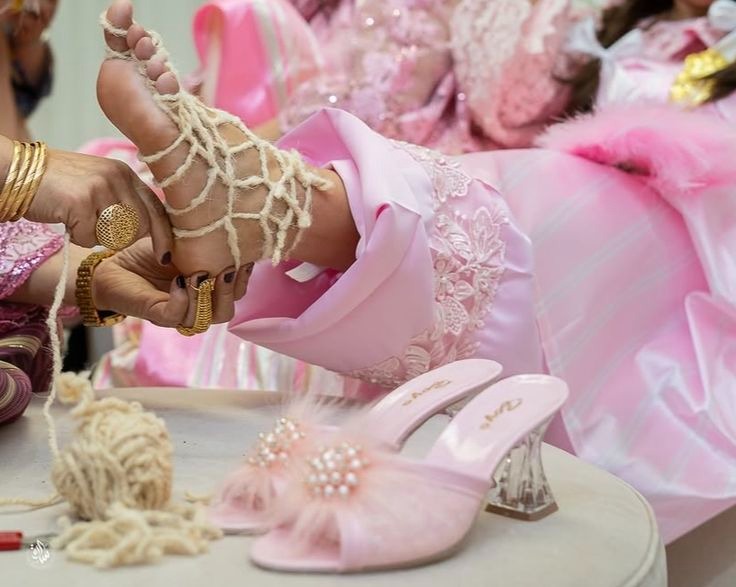
Instead of a traditional henna cone, the Henna al Shbur tradition uses a thin rope made from sheep’s wool called Nira. Wool carries meanings of warmth and protection, values closely tied to marriage and the structure of the home. Women carefully wrap the rope around the bride’s hands and feet in a diagonal fishnet pattern called the Shbur, pulling it tight and repeating it across the skin. The tightness represents marital stability, while the repeated crossings symbolize continuity and fertility. The design itself, however, reflects Misrata’s deep connection to the sea and the belief that marriage, like sailing, requires patience.
This ritual uses henna paste made from dried henna leaves ground into a fine powder and mixed with water and lemon to activate the dye. Also, ground roselle petals are added to deepen the red color of the henna. Henna has long held value not only for its symbolism but also for its function. People traditionally used the plant paste to cool the body and moisturize the skin, offering relief from heat. For thousands of years, people also applied henna to ease headaches, stomach pain, and skin ailments, making it a form of care as much as adornment.
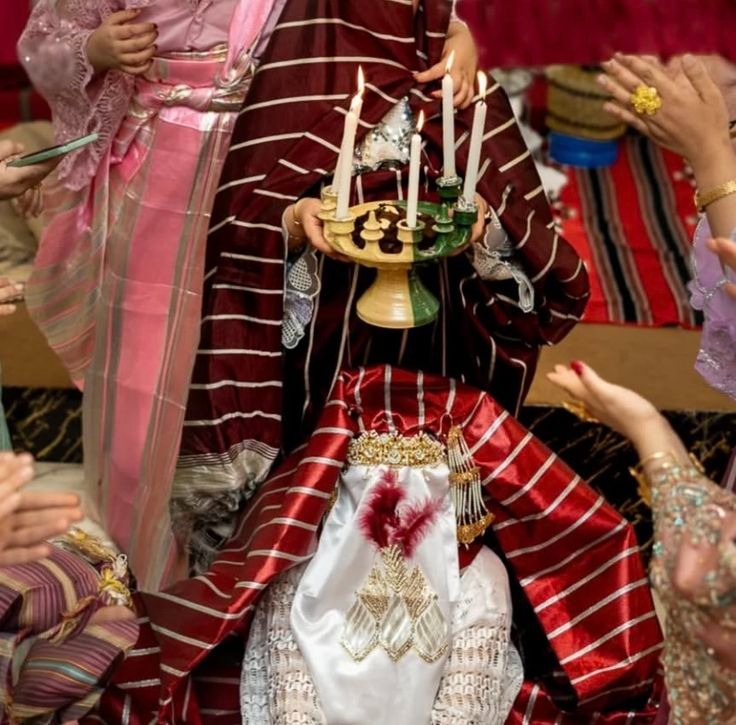
The paste is then placed into a bowl surrounded by five lit candles, representing the Hand of Fatima, also known as the Khamsa, a symbol of protection used across North Africa. In some families, women shape the henna paste into a fish, a Libyan symbol of good luck, abundance, and Misrata’s maritime identity.
A Community Celebration
The Misrata henna ceremony is very communal. Another tradition is placing three to seven eggs on top of the henna bowl. The fish symbolizes purity, fertility, and the promise of a bright future for the bride. Bridesmaids and guests then take a small dot of henna and place it in the center of their palm and light a candle on top of it, seeking barakah for themselves as well. Through this practice, the ritual extends beyond the bride and becomes a shared moment for everyone in this celebration.
Bridal Dress and Ritual Practice
During the henna night, the Misrati bride wears one of the city’s most recognizable traditional outfits, reserved specifically for this ceremony. The attire consists of a red tunic known as the qmeja, paired with a striped houli called bukhatayn, meaning “of two lines.” In some families, the bride may wear a pink houli known as bodry. The attire combines luxurious silk, lightweight cotton, and wool, accented with gold or silver threads.
Traditionally, the bride wears her hair in one or two long braids. The braids symbolize continuity, patience, and the intertwining of two lives into one. Like the rope used in the henna itself, the braids also involve a ribbon intertwined in them. Jewelry is kept simple and traditional, often including nabila bracelets, rings, and khikhal, anklets worn around the feet.
During the ceremony, the bride’s face remains covered. A close female relative, often someone she deeply trusts, holds the henna bowl above her head for the entire ritual. This act represents emotional guidance and reassurance. In some families, relatives gift the woman holding the bowl a gold necklace, and she holds it in her mouth throughout the ceremony as a symbol of endurance and patience for the bride.
Ritual Completion and Shared Blessings
Once the woman ties the nira rope and applies the henna, she leaves it on the bride’s hands and feet overnight. The following morning, she gently removes it with olive oil before washing it away with water. In Libya, olive oil represents a deeply rooted cultural, economic, and religious staple associated with health, sustenance, and prosperity. According to local tradition, people believe it holds strong medicinal value and can cure most ailments. Its use in this moment reflects a connection to the land and to generations who relied on it for nourishment and healing. This symbolism is powerful in Misrata, where olive oil production has existed for thousands of years, dating back to ancient civilizations that established large production centers in the region.
On the day of henna, it is tradition to eat Couscous from the bride’s lap. Many believe the couscous served during this ceremony tastes better than any other, especially because people share it in such a meaningful setting.
The significance of the Shbur
Henna al Shbur is deeply tied to Misrata’s relationship with the sea. The fishnet (Shbur) pattern, the tight weaving of the rope, and the importance of patience all reflect a coastal way of life shaped by sailing and the Mediterranean Sea itself. In Misrata, the sea represents discipline and trust, values that define how marriage is understood and ritualized.
Like many traditional North African practices, Henna al Shbur has not been formally documented. Libya, despite its long history, has much of its cultural knowledge preserved through oral tradition rather than written records. Women, in particular, have been the primary carriers of this knowledge, passing it down through practice and storytelling. As a result, traditions like this often remain invisible outside their local context, even though they have existed for centuries.
This lack of documentation does not reflect a lack of history, but rather the opposite. Libya’s history spans Amazigh, Phoenician, Roman, Arab, Italian, and Ottoman periods, yet much of its cultural heritage remains underrepresented.
Henna al Shbur is one example of how deeply rooted and specific Libyan traditions can be. This tradition continues not through documentation or popularity but through the community that actively practices and protects it today. In that way, the ritual itself becomes a form of living history, one that connects Misrata’s past to its present through the hands of its women.
Want more articles like this? Sign up for our e-newsletter!
Check out our blog here!