

Subscribe
to receive news by email

Poll
Will the Trump Administration Shift U.S. Policy in Favor of Palestine?
- No (87%)
- Yes (13%)
 Loading ...
Copyright © 2026 Arab America
Go topThe Past and Future of Morocco’s Argan Tree
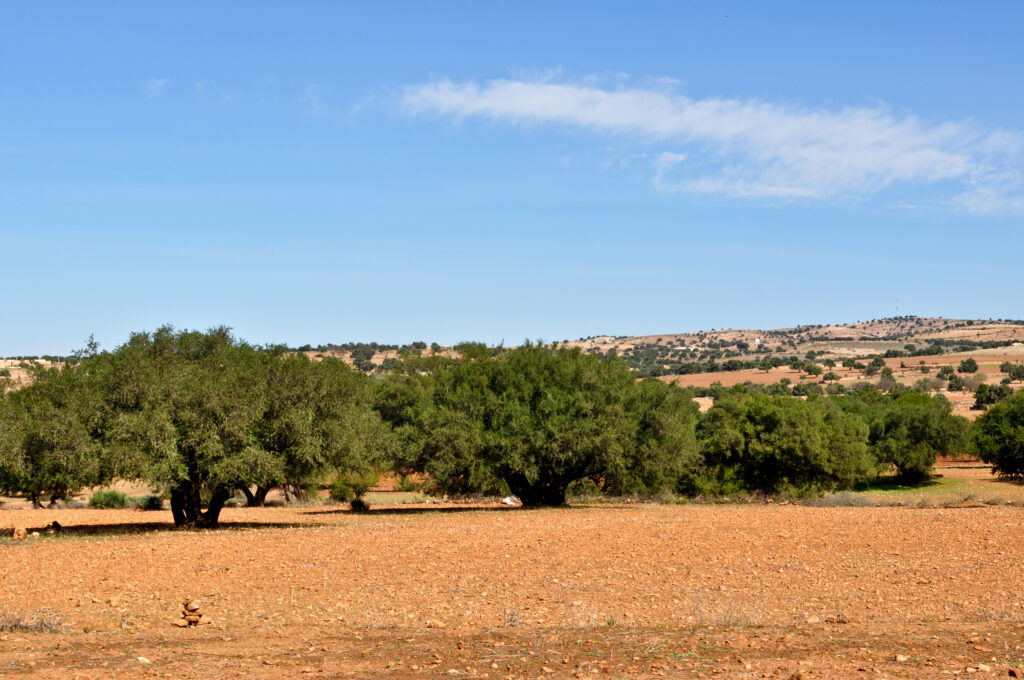
Photo by Elena Tatiana Chis, CC BY 4.0 via Wikimedia Commons
By: Diksha Tyagi/Arab America Contributing Writer
The argan tree has long shaped life in Morocco. Argan oil is derived from its fruits, which has been used for centuries in cooking and medicine. The tree also plays a significant role for agriculture in general in the region, helping to mitigate effects of climate change. However, natural argan populations have declined over the years. A recent scientific breakthrough may help this valuable resource continue to flourish, with researchers creating an almost complete genome of the tree. The value of the argan tree for both Morocco and the international community may lead this development to have numerous effects.
The Importance of the Argan Tree
The argan tree, scientifically Argania spinosa, has been an essential part of Moroccan life for centuries. It grows primarily in the southwest of Morocco and is endemic to the country. The regions where it grows are particularly home to Amazigh communities, who developed many of the tree’s traditional uses.
Local people learned that oil could be extracted from the kernels of the argan fruit. The process is very labor-intensive. It requires fruits to be dried, pulps to be removed, and roasting and grinding the inner kernels. From there, oil can finally be pressed out.
Argan oil plays numerous roles in Moroccan life. In cuisine, it is commonly eaten with bread and incorporated into traditional dishes. It also has been used for cosmetic and medicinal purposes, applied to moisturize skin, strengthen hair, and even treat small wounds. Yet, the tree itself is also a crucial part of the Moroccan ecosystem. Its roots help to stabilize soil and prevent erosion, therefore slowing desertification in this critical area.
Recently, argan oil has also gained global attention in cosmetics, cuisine, and skincare. This has made the oil a large export product, creating job opportunities for those who work in oil cultivation.
A Declining Population
However, the argan tree has experienced a significant decline over this last century. At a time, it covered a larger area of North Africa. Now, it is mainly in southwestern Morocco. This, coupled with greater global demand, has led to lots of stress on the region.
These forests have declined due to several factors. Firstly, population growth has led to the clearing of land that was once home to trees. In the place of argan trees, infrastructure and other agriculture has taken over. Additionally, climate change has made agriculture in these regions harder. With less predictable rainfall, maintaining argan forests is difficult. This also leads to a cycle where less argan trees take away from their beneficial effects on desertification, making the situation even worse.
Numerous rural communities rely on argan oil production. The tree provides one of few stable sources of income and has sustained economies. Additionally, many women work in cooperatives where they work in argan production, helping women step outside the household and gain greater independence. The decline of these trees can lead to immense consequences environmentally and economically, for both individuals, rural groups, and international communities.
Genomic Mapping
In 2026, a team of Moroccan and international researchers made a major scientific breakthrough involving the argan tree. They have produced an almost complete genome map of the tree, which is done by identifying and sequencing the DNA of an organism. This information can help scientists understand how a species grows, how it responds to environmental stress, and how its oils are made.
Through their map, these scientists were able to find thousands of genes that influence the tree’s development. This could have great implications for argan conservation and agriculture. Researchers can then identify traits associated with drought resistance, disease, and oil yield, and develop strategies to protect argan forests while helping sustain cultivation.
Morocco’s “Generation Green 2020-2030” aims to double argan oil production by 2030. This study can help to do so, directly supporting “long-term conservation of the species”. It also adds to Morocco’s position, placing it at the head of this scientific endeavor. Overall, this development can play a crucial role in numerous spheres of Moroccan life to come.
Want more articles like this? Sign up for our e-newsletter!
Check out our blog here!