

Subscribe
to receive news by email

Poll
Will the Trump Administration Shift U.S. Policy in Favor of Palestine?
- No (87%)
- Yes (13%)
 Loading ...
Copyright © 2026 Arab America
Go topThe Traditional Architecture of Morocco
By Ralph I. Hage/ Arab America Contributing Writer
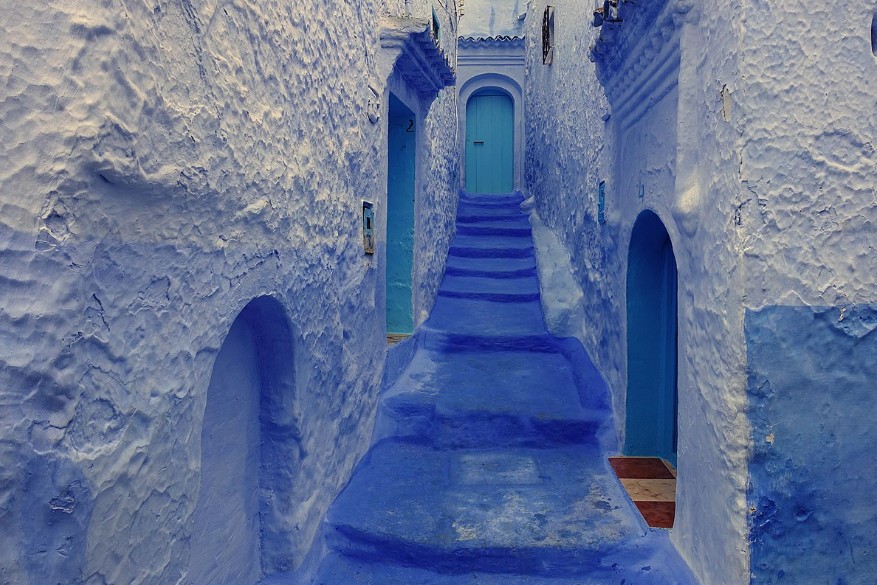
From the narrow alleyways of Fez to the sun-drenched kasbahs of the High Atlas Mountains, Moroccan traditional architecture tells a story of cultural fusion, spiritual symbolism, and unparalleled craftsmanship. Rooted in centuries of Arab, Berber, Andalusian, and Islamic influence, Morocco’s built environment is more than mere shelter; it’s a living expression of identity, artistry, and communal life.
Historical Foundations
Moroccan architecture, like the country itself, is the product of a rich tapestry of civilizations. Indigenous Amazigh (Berber) communities constructed fortified dwellings and desert kasbahs long before Arab-Muslim conquests arrived in the 7th century CE. As Islam spread across North Africa, it brought new aesthetic principles, such as symmetry, geometry, and calligraphy – hallmarks of Islamic architecture seen throughout Morocco today.
The Andalusian refugees, fleeing the fall of Islamic Spain in the 15th century, added their own artistic legacy – ornate stucco, lush gardens, and elegant arches – especially visible in cities like Fez and Tétouan. The result is a hybrid style that is deeply rooted in religious tradition while celebrating local materials and regional identity.
The Medina-Heart of Urban Tradition
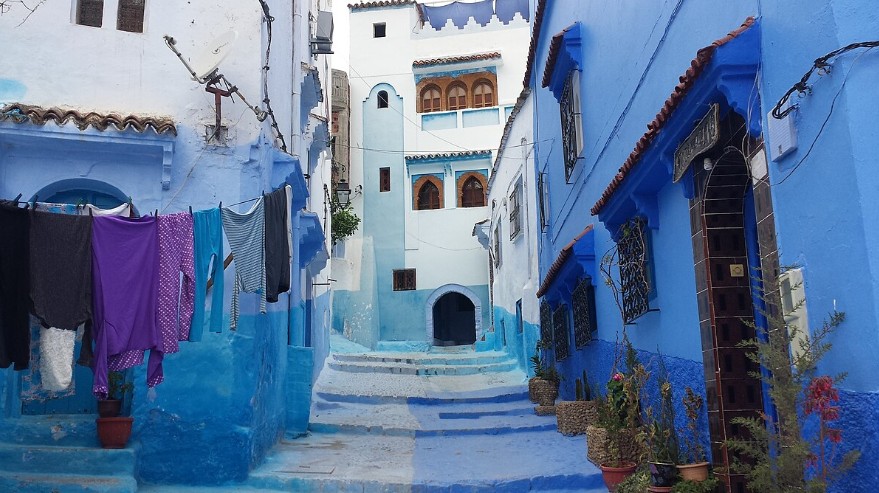
At the core of every traditional Moroccan city lies the medina, a historic walled city filled with labyrinthine streets, bustling souks, mosques, madrasas, hammams, and homes with minimal exterior expression. Medinas in Fez, Marrakesh, and Chefchaouen are UNESCO World Heritage sites, recognized for their architectural integrity and cultural significance.
In these spaces, the layout itself reflects Islamic ideals. Privacy and community coexist – houses are built inward-facing, centered around a riad, a courtyard garden that symbolizes paradise in Islamic cosmology. Exteriors are often plain, while interiors burst with intricate tilework (zellij), carved plaster (gebs), and painted wood (zouak), representing a world hidden from public view but rich in detail and meaning.
One exemplary site is the Al-Qarawiyyin Mosque and University in Fez, founded in 859 CE by Fatima al-Fihri, a woman of Arab heritage. The institution stands as the world’s oldest continuously operating university and a prime example of Moroccan-Islamic architecture with its horseshoe arches, courtyards, and detailed tile mosaics.
The Riad-A Spiritual and Aesthetic Ideal
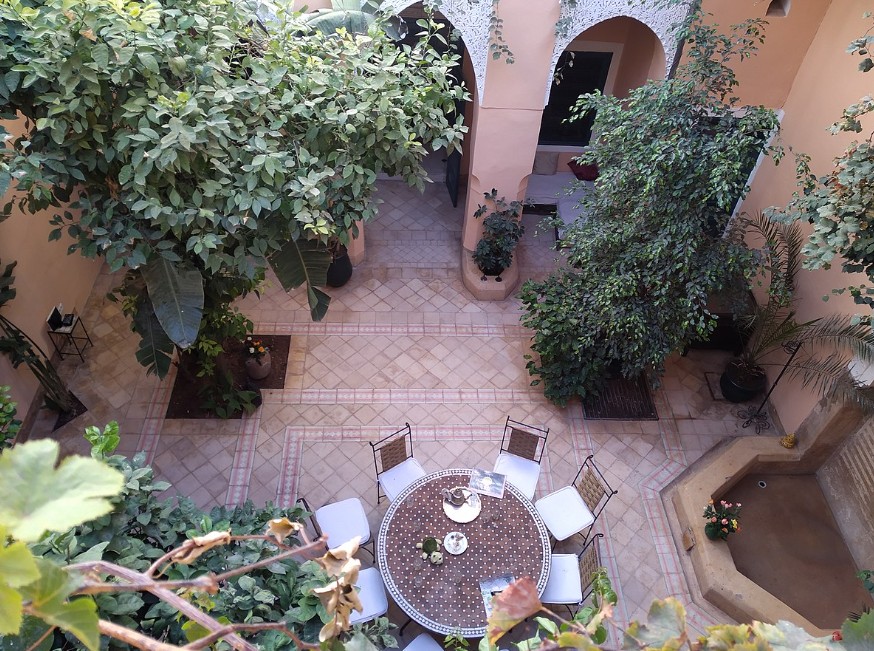
The riad – a type of traditional Moroccan home – is perhaps the most iconic architectural form in the country. Derived from the Arabic word riyad, meaning “garden,” this inward-looking house revolves around a central courtyard, often with a fountain and lush plants. Inspired by Qur’anic descriptions of paradise, the riad integrates the four classical elements – earth, air, water, and fire – into a harmonious domestic environment.
Riads exemplify Morocco’s deep commitment to craftsmanship and symbolism. In cities like Marrakech, now a hub of restored riads turned into guesthouses, travelers are often struck by the layers of geometry and color: blue and green zellij tiles symbolizing water and growth, cedarwood carved with arabesques, and ceilings painted in dazzling patterns.
Kasbahs and Ksour-Desert Fortresses
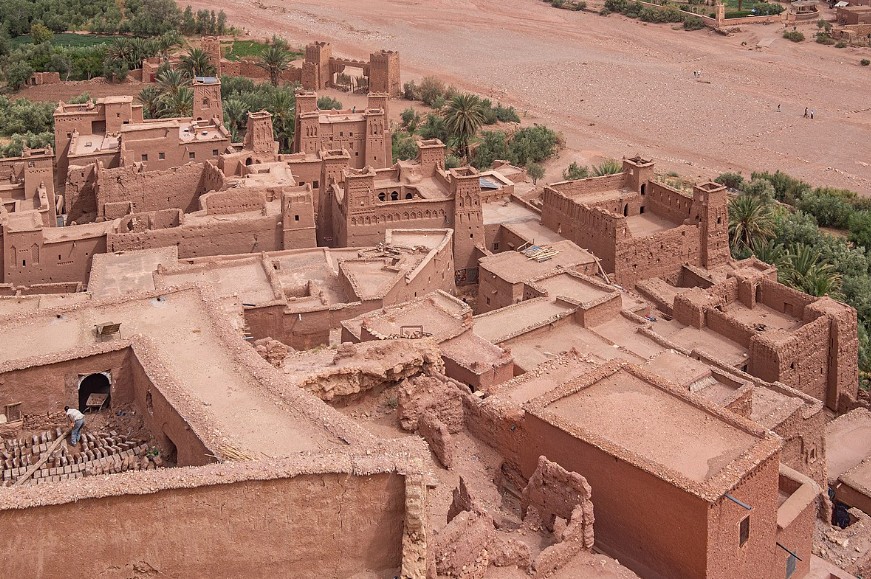
Moving away from the cities, the southern regions of Morocco are dotted with kasbahs and ksour, particularly in the pre-Saharan valleys and oases. Built from rammed earth, these structures blend seamlessly with the ochre tones of the surrounding landscape. Their thick walls protect against the heat by day and the cold by night, while their elevated towers and crenellated walls evoke both defense and grandeur.
The Kasbah of Ait Benhaddou, a UNESCO site near Ouarzazate, is among the most famous examples. It has appeared in numerous films and series, yet remains a quintessential representation of Amazigh vernacular architecture. These earthen structures, though fragile, demonstrate a deep knowledge of environmental adaptation and community-based construction.
Mosques and Madrasas-Sacred Geometry
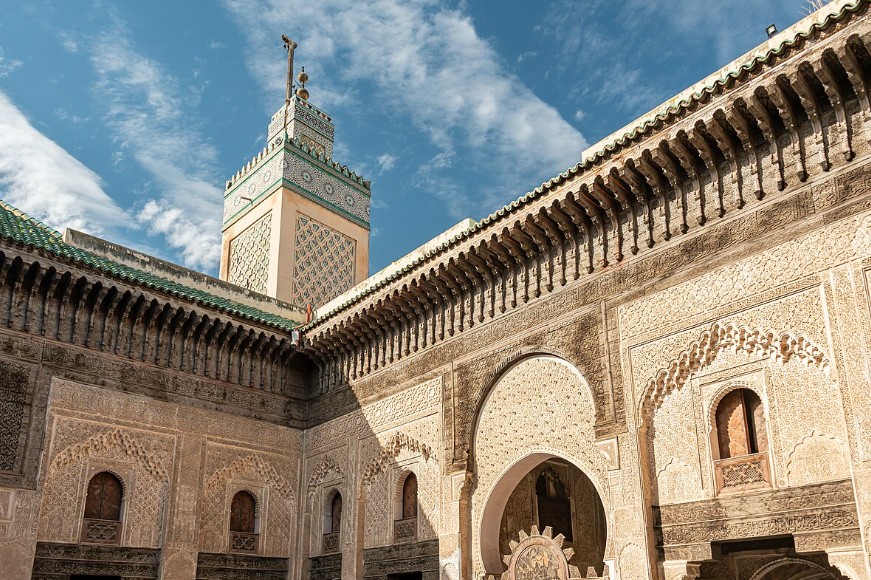
Moroccan religious architecture showcases the profound relationship between form and faith. The layout of mosques adheres to spiritual principles: a mihrab points to Mecca, a minaret calls the faithful to prayer, and ablution fountainspurify the body. The Koutoubia Mosque in Marrakesh, built in the 12th century, is a striking example of Almohad architecture – characterized by its austere lines, symmetry, and monumental scale.
Similarly, madrasas, or Islamic schools, are architectural gems. The Bou Inania Madrasa in Fez, established in the 14th century by the Marinid dynasty, combines function and beauty: classrooms and dormitories surround a richly decorated courtyard, with zellij mosaics, cedar latticework, and Kufic inscriptions that blend education with sacred expression.
Decorative Arts and Materials
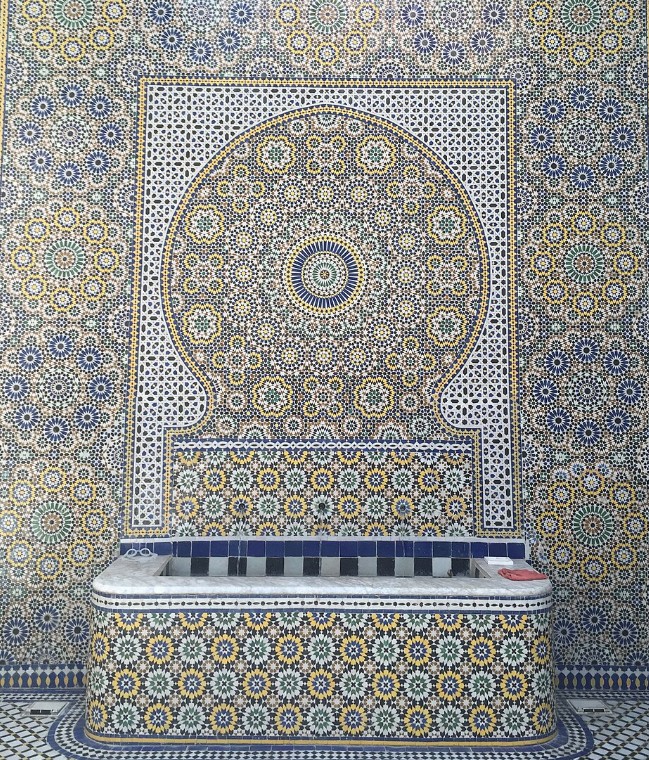
The beauty of Moroccan architecture lies in its details. Artisans, known as ma’alems, pass down traditional crafts through generations, each specializing in a distinct medium. Some key decorative elements include:
- Zellij: Complex mosaic tilework using hand-cut glazed tiles, often forming stars and polygons.
- Carved Plaster (Gabs): Found in arches, ceilings, and walls, often inscribed with Arabic calligraphy or floral motifs.
- Woodwork (Zouak): Painted and carved cedar or thuya wood, used in doors, ceilings, and panels.
- Tadelakt: A polished lime plaster finish used in bathrooms and hammams, both water-resistant and visually soft.
These features are not merely decorative but serve a spiritual purpose, reflecting the Islamic aversion to idolatry through abstract design and the pursuit of divine perfection through geometry and symmetry.
Modern Reverberations and Preservation
While contemporary Morocco continues to urbanize, traditional architecture remains a source of national pride and identity. Architects and preservationists are increasingly committed to adaptive reuse and restoration, ensuring that historic medinas and kasbahs are maintained for future generations.
Institutions such as the Royal Institute of the Amazigh Culture (IRCAM) and the Moroccan Ministry of Culture have supported efforts to preserve vernacular structures and promote local crafts. Meanwhile, eco-tourism and cultural heritage tourism are helping to fund the revitalization of medinas and the reoccupation of riads and ksour.
A Living Tradition
Traditional Moroccan architecture is more than an aesthetic legacy – it’s a living tradition that weaves together environmental wisdom, spiritual symbolism, and multicultural exchange. For Arab Americans seeking to reconnect with their heritage or understand the broader Arab-Islamic artistic continuum, Morocco offers a vivid case study of how architecture can be both deeply local and universally resonant.
Ralph Hage is a Lebanese American architect who divides his time between Lebanon and the United States.
Want more articles like this? Sign up for our e-newsletter!
Check out our blog here!





_-_Chaouen.jpg)
.jpg)


.jpg)
