
Subscribe
to receive news by email

Poll
Will the Trump Administration Shift U.S. Policy in Favor of Palestine?
- No (87%)
- Yes (13%)
 Loading ...
Copyright © 2026 Arab America
Go topThreads of Resistance: The Keffiyeh & Dabke
By: Laila Ali / Arab America Contributing Author
In response to the attacks, Arab American culture has persisted and resisted. Symbols like the keffiyeh and practices like dabke have been turned into living, breathing public demonstrations against anti-Arab racism. From protest chants to dance moves to restaurant decor to virtual gatherings, Arab Americans push back on efforts to silence, erase, and marginalize them, finding beauty and power in their culture.
The Keffiyeh: A Woven Declaration
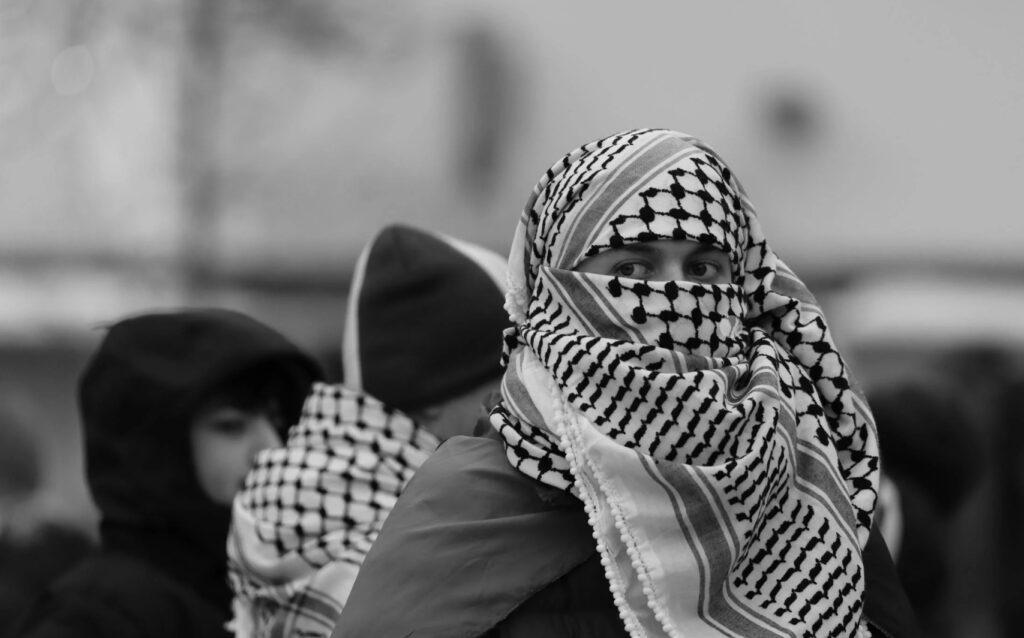
For centuries, Arab men have worn keffiyehs—square scarves with black-and-white checkered patterns—to shield their necks and heads from the desert sun and dust. But in recent decades, keffiyehs have also been one of the most visible symbols of Palestinian resistance and Arab solidarity. In U.S. cities, young Arab Americans wear them over their shoulders at protests, tucked around their necks at vigils, or bandana-style in social media posts that push back on orientalist stereotypes.
At Gaza solidarity rallies in 2024—in cities such as Chicago, New York, and Dearborn—protesters, many of them young Arab Americans, marched wearing keffiyehs passed down from their parents or purchased with intention. The crowd reflected the diversity of the community—Muslim and Christian, young and old—united not just by the cause, but by a shared cultural thread.
To Arab Americans, the keffiyeh is a way to push back on representations of Arabs as faceless, foreign, and disempowered. It’s worn to town halls, to prom, in photos after graduation, on stage at poetry slams. It demands to be seen. However, the keffiyeh’s global popularity and brand-icon status mean that it has also been co-opted in ways that strip it of its political meaning and instead use it as an aesthetic accessory. This makes it even more critical for Arab Americans to reclaim the keffiyeh, give it context, and wear it with pride.
Dabke: Dancing into the Streets
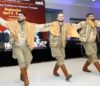
If the keffiyeh is the cloth of resistance, dabke is its pulse. A folk dance with origins in the Levant, dabke is performed in a line at celebrations but also at protests. The dance is celebratory, but with an edge. A crowd of dancers stomps in synchronized, high-energy movements, their arms linked, feet keeping time to the beat of drums and songs. The dance tells stories of resistance, joy, land, and memory.
This Instagram video captures the Boise to Palestine movement, which started in May 2021 in Boise, Idaho. This grassroots community-driven movement organized protests and events to raise awareness about the ongoing colonial oppression and violence faced by Palestinians. At one point in the protest, a group of young people suddenly broke into dabke in the middle of the march. A portable speaker blared, and soon dozens of protesters were dancing in the street, their footsteps rattling the pavement. For the protestors, Dabke was their way of wanting people to truly see them, not just as angry or mourning, but as alive, proud, and unbreakable. Dabke was their way of saying, “We’re still here.”
Spontaneous dabke performances have since become a fixture of protest culture in diaspora communities. Arab American dabke troupes perform at cultural events and at street demonstrations. At Arab American Heritage festivals in Michigan and California, you can often find children as young as four learning dabke on one stage, while their older siblings and cousins are chanting in another corner of the park. In both cases, the message is the same: resistance can be a joyous experience. Culture is not just about remembering the past—it’s about embodying it, loudly, publicly, together.
Culture as Public Resistance
As a protest, culture is especially powerful for Arab Americans, for whom public expressions of their heritage and identity are often markers of difference in a society that has often demanded their assimilation or has tried to paint Arabs and Arab Americans as a monolith. Wearing a keffiyeh or dancing dabke in the street are ways of saying “We are individuals. Our culture isn’t a threat- it is what makes us powerful.” The keffiyeh and dabke are not just cultural traditions; they are tools that can be used to interrupt and subvert dominant narratives, to build community, and to mobilize solidarity.
Arab American organizers also use dabke as a pedagogical tool. Schools and dabke workshops are one way to teach about geography, occupation, migration, and identity. It is embodied education, showing rather than telling. The keffiyeh adorns not just clothing but protest signs, graduation stoles, and murals. It’s on T-shirts and stickers with messages like “Exist. Resist. Return.” At the core of both keffiyehs and dabke is a simple yet powerful message: we will not be erased. Whether through the knot of a scarf or the stomps of a dance, Arab Americans are reminding the world that they are part of the fabric of the American story—and they are weaving it into something new and more just.
Want more articles like this? Sign up for our e-newsletter!
Check out our blog here!