
Subscribe
to receive news by email

Poll
Will the Trump Administration Shift U.S. Policy in Favor of Palestine?
- No (87%)
- Yes (13%)
 Loading ...
Copyright © 2026 Arab America
Go topTintin and Orientalism in Children’s Media
By: Robert Jackson / Arab America Contributing Writer
The Adventures of Tintin comic series is still considered by many to be a classic children’s book series. They follow a fictional boy reporter named Tintin all across the world, and even to space. Despite their age, these colorful stories are widely available and popular. However, they perpetuate many stereotypes about Arabs. The inclusion of colonialist narratives, as well as what Edward Said would identify as Orientalism, should be scrutinized more, as it influences young readers at a developmental age.
What is Orientalism?
Edward Said’s concept of Orientalism is the continued characterization by western authors and artists of the East as exotic, weak, and primitive. Through art and narratives, Orientalism promotes the idea of Western superiority over other cultures.
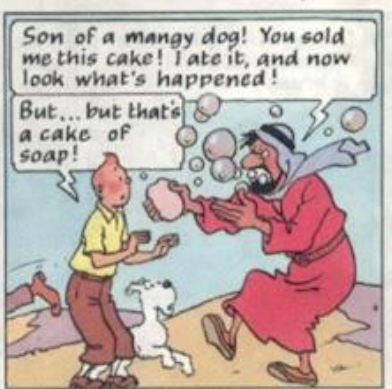
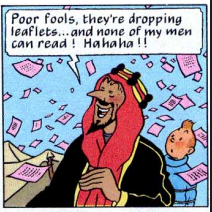
In Tintin, the blatant portrayal of Arabs as “primitive” is obvious in contrast with the “civilized” Europeans and aligns with Said’s writings. The above panel from the 1934 book, Cigars of the Pharaoh, shows Arabs as violent and backward. This sort of narrative fits the definition of paternalistic colonialism, which was still common in the 1930s. Over the course of a single page, Hergé changes between enchantment and disdain for other cultures. With such transparent visuals, Hergé’s work is easy to link to Orientalism.
Wider Influence
Next, we should look at the influence of Tintin in a wider context through the lens of its audience. That audience primarily being children around the age of ten or so, and more specifically, boys. Though the series and the author himself have faced much controversy, the books remain popular. It is because of this audience that Cigars of the Pharaoh and Tintin stories in general have continued to stay relevant. At this point, generations of kids have grown up with Tintin and have passed their love of the series down to their kids. Unlike other similarly controversial works for young readers like Adventures of Huckleberry Finn, Tintin books are easier to read, more subtle in their messages, and have colorful illustrations. Despite their age, their stories of exploration and adventure continue to have a mass appeal. These factors have made the comics quite successful even in the modern day, bringing Orientalism with them.
Critical Context
The Tintin series is still considered a classic of children’s literature. It has been translated into over 70 languages, adapted into plays, TV shows, movies, and its books and merchandise are still selling today. But why, despite its obvious racist and colonialist messaging, does this series endure or perhaps even thrive in the modern day? What is Tintin? To answer the question, we must look at the author himself, Hergé.
As a child, Hergé was a boy scout, encouraging his fascination with adventure. Tintin, a Belgian like Hergé, was designed to be a role model for young boys. He was brave, clever, honest, and independent. In the early 1930’s, when Cigars of the Pharaoh was being published as a comic strip in newspapers, colonialism was at its peak throughout Africa and Asia. Especially in his early work, Hergé was a Belgian nationalist. The catholic conservative newspaper he worked for pushed him further into nationalist storylines. His early work has been considered especially controversial, so much so that Hergé said he regretted it and even went to the trouble of changing some of his earlier work later in life. For example, he began editing out some of the depictions of animal cruelty or alcohol abuse present in his books. In his later work, he would research more into the cultures and places he was writing about, which brought the books further away from their roots as colonialist propaganda. It is this change over time that has softened Hergé’s image over the decades and made his work more palatable to readers.
Tintin Shouldn’t be Pulled off Shelves
The Tintin series is a work of Orientalism. The legacy of this series is filled with controversy and that’s what makes it a valuable. It has sparked the interests of millions of people in other cultures from a young age. With the right guidance, kids can be teleported into another world while being taught to recognize colonialist narratives when they see them. Land of Black Gold was originally set in the British Mandate of Palestine before Hergé changed it to the fictional country of Khemed. This sort of real-world connection with history can ignite more complex understanding of the legacy of Orientalism and help kids understand the world more clearly.
Tintin has enforced the othering of cultures in the minds of generations of kids who were too young to understand its meaning. I myself had positive memories of reading the book series and was shocked at some of the content when revisiting Cigars of the Pharaoh and Land of Black Gold. However, it would be wrong to shun this work. It can be a tool to foster a better understanding of history while continuing to reach new generations of readers. Said’s theory is far from dead as Orientalist works like Tintin shape the way its readers think about the world, even from a young age. Yet, these works can also be used to teach children why these harmful stereotypes are wrong.
Want more articles like this? Sign up for our e-newsletter!
Check out our blog here!