

Subscribe
to receive news by email

Poll
Will the Trump Administration Shift U.S. Policy in Favor of Palestine?
- No (87%)
- Yes (13%)
 Loading ...
Copyright © 2026 Arab America
Go topTrump’s Gaza Plan: All Infrastructure, No Political Framework
By: Ghassan Rubeiz / Arab America Contributing Writer
Without vision, reconstruction is pointless. Gaza remains in agony despite the emergence of Trump’s pacification programs. The very forces that destroyed Gaza now plan to rebuild it. With no lessons learned from the war, the outcome promises more of the same: messing around with the Middle East.
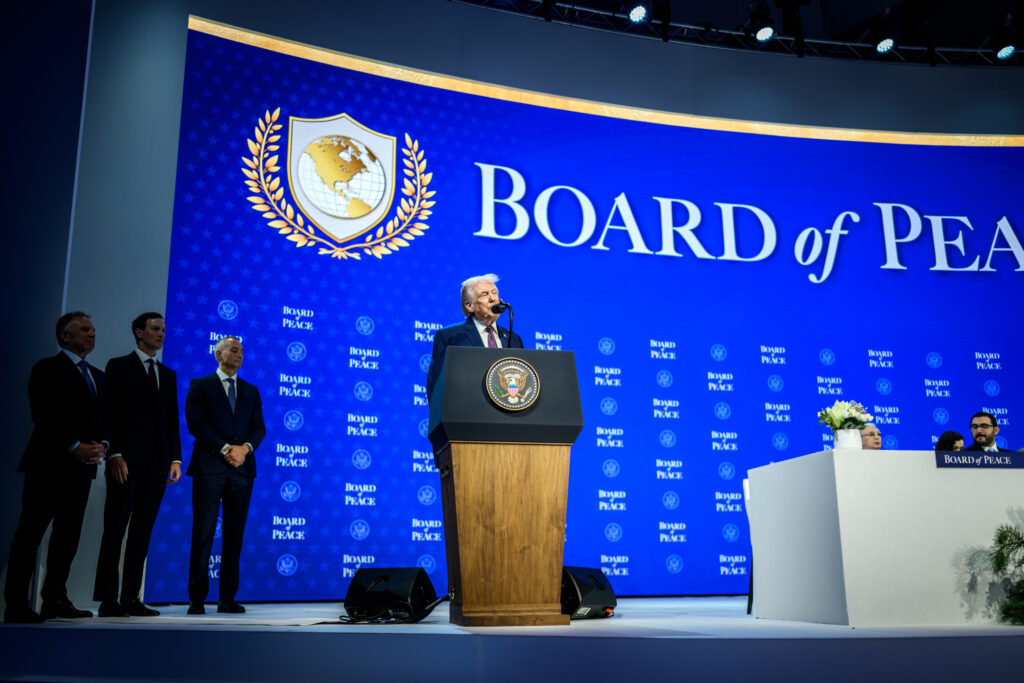
At the World Economic Forum in Davos, President Trump unveiled a master diplomatic plan. He has formed a Board of Peace to resolve conflicts anywhere in the world, not only in Gaza. Is this an effort to marginalize the United Nations Security Council? Tellingly, mostly autocratic leaders joined Trump in this unusual adventure.
Ironically, even as Washington builds this Board of Peace, Israel reportedly prepares for a possible coordinated US – Israeli attack on Iran, raising new questions about the credibility of Trump’s planning.
Under the Trump plan, Gaza would theoretically be transformed from its current wasteland into a luxury coastal metropolis featuring skyscraper beachfront hotels, data centers, resorts, high-end residential areas, and modern transport hubs.
Such a vision is completely disconnected from the reality of a devastated Palestinian population living under occupation on one side and ruled by Hamas on the other.
The US does not plan to fund this project; Arab countries are expected to foot the bill while Israel expands its foothold in Gaza, the West Bank, Lebanon, and Syria.
Palestinian exclusion from the Peace Plan’s design raises fundamental questions about self-determination, culture, and political context. Trump’s plan lacks clarity on the critical political framework necessary for reconstruction, rehabilitation, and healing. While it promises physical rebuilding, it ignores the underlying Israeli-Palestinian conflict, the status of the West Bank, as well as the political rights and future governance of Palestinians.
Process is critical. Gaza should not be rebuilt as a real estate venture. Rebuilding Gaza must be grounded in democracy, reconciliation and community empowerment. To rebuild this community, one must first construct a peace framework that includes a viable future for the West Bank, possibly through a future binational state – with shared borders and mutual responsibility for security and wellbeing. This sounds like a dream, but in a nightmare situation, imagination is normal.
A confederation serving 14 million future citizens, both Palestinian and Israeli, first requires agreement on a framework guaranteeing equality for all Palestinians and Israelis, with commitment over implementation within a foreseeable timeframe.
A binational state cannot emerge without a fundamental shift in attitudes. Both Palestinians and Israelis must move from exclusive land claims to shared ownership. This perspective can only be built on shared security and responsibility, growing through experiences that replace fear with confidence in a common future.
The system of education, rooted in human rights and human development, must be transformed. From preschool onward, children would learn respect for others regardless of religion, ethnicity, or class, with curricula encouraging intellectual curiosity and critical thinking.
The envisaged confederation will face regional pressure from regimes viewing it as a threat to traditional culture and authority. Such an exemplary state could join regional economic and political ventures, moving incrementally toward regional unity.
New leadership with vision for empowered democracy will be essential – a democracy transcending simple majoritarianism.
A new constitution would mandate strict limits on money in politics and the separation of religion and state. Defense budgets would be capped, placing the military under civilian authority. Women would be actively encouraged to pursue leadership across all societal sectors.
This is the framework—not skyscrapers and investment portfolios—that genuine reconstruction requires. Without human investment, any rebuilding effort would leave the fundamental injustices that created this catastrophe intact. Rebuilding Gaza requires vision, not just concrete.
Ghassan Rubeiz is the former Middle East Secretary of the World Council of Churches. Earlier, he taught psychology and social work in his country of birth, Lebanon, and later in the United States, where he currently lives. He has contributed to political commentary for the past twenty years and has delivered occasional public talks on peace, justice, and interfaith topics. You can reach him at rubeizg@gmail.com
The views and opinions expressed in this article are those of the author and do not necessarily reflect the position of Arab America. The reproduction of this article is permissible with proper credit to Arab America and the author.
Want more articles like this? Sign up for our e-newsletter!
Check our blog here!