
Subscribe
to receive news by email

Poll
Will the Trump Administration Shift U.S. Policy in Favor of Palestine?
- No (87%)
- Yes (13%)
 Loading ...
Copyright © 2026 Arab America
Go topTurmoil in Iran and Venezuela Evolve and Impact Neighbors
By: Ghassan Rubeiz / Arab America Contributing Writer
In responding to overseas suffering, the Western powers must listen carefully to the people being helped in order to avoid doing harm as they intervene.
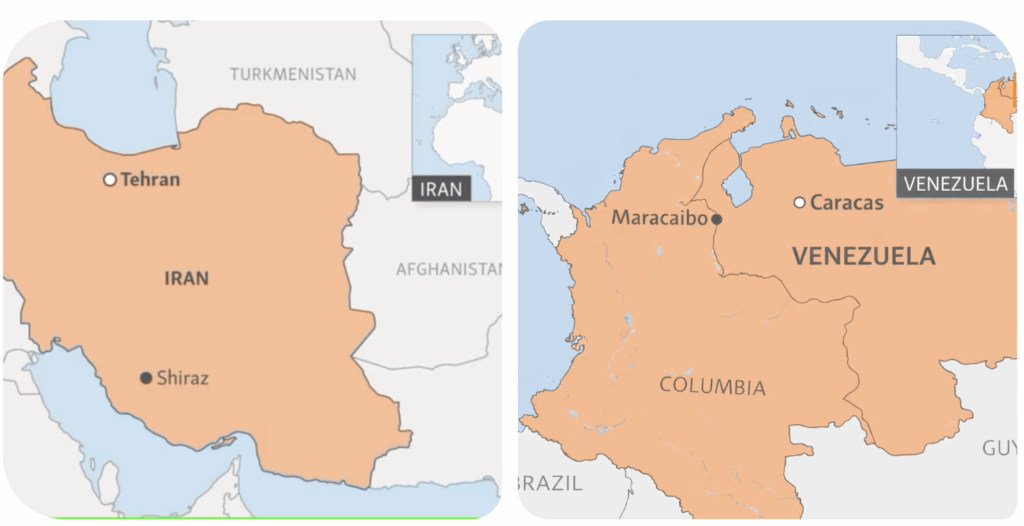
Two dramatic upheavals unfold simultaneously: one in Iran, the other in Venezuela. Though occurring in vastly different contexts, both nations share some noteworthy parallels: oil-rich, deeply autocratic, anti-Western, economically spiraling down, governed by entrenched regimes facing US sanctions and domestic unpopularity.
Yet their triggers differ significantly. Iran’s uprising is internal, driven by homegrown resistance despite external factors like military losses to US-backed Israel. Venezuela’s transition was externally imposed: the Trump administration removed Nicolás Maduro, however, unlawfully, while the state apparatus continues under Vice President Delcy Rodríguez.
The political readiness of the two cases contrasts sharply. Venezuela has a unified democratic alternative in María Corina Machado, opposition leader and recent Nobel laureate. Iran, despite the nationwide uprising and strong moral force, lacks an organized front capable of peacefully assuming power after the regime collapses. The exiled son of the deposed Shah represents one alternative, but his legitimacy remains contested – living abroad in isolation, being artificially allied to Israel, and suddenly emerging to revive a tarnished dynastic legacy.
The road to democracy will be arduous for both.
Washington appears willing to cooperate with Venezuela’s existing regime (minus Maduro) rather than supporting Machado. This transactional approach purportedly ensures “stability” while allowing US oil conglomerates to “regain control” of resources and “restore prosperity” to the impoverished country.
Oddly, Machado plans to visit Washington this week, even proposing to transfer her Nobel Prize to Trump – an amusing gesture raising questions about her judgment, especially since the Nobel Committee has declared that the Prize is non-transferable. After all, democracy is hardly Trump’s passion.
Iran’s regime has never been weaker and appears destined to fall, yet the entrenched Revolutionary Guard Corps (IRGC) could make regime change brutally difficult. If the Islamic Republic collapses, the aftermath may transform symbolically, not substantively: autocratic generals replacing fundamentalist ayatollahs. A military regime might allow women to forgo headscarves and reduce support for revolutionary forces in the Arab world, but most likely try to preserve absolute power, economic control, and restrictions on freedoms. The uprising needs sustained courage and external moral and technical support, but not military intervention.
Venezuela’s short-term prospects may be brighter – the regime’s head is gone, and a clear alternative stands ready to take over.
Yet predicting revolutionary outcomes remains perilous. The very forces inducing change may divert the transition. When the Trump administration prioritizes oil revenues, supporting grassroots liberation seems unlikely.
Iran’s prospects are murkier, given its unique state structure – a theocracy, a regional strategic position, and wide exposure to external threats – particularly, Israel and the US.
If Washington and Tel Aviv would avoid military intervention in Tehran they would be doing the Iranian people a great favor. Democracy must be achieved by Iranians themselves. Left alone, they will ultimately succeed.
Aggressive intervention in Iran may redirect Iranian attention from domestic oppression to imperial aggression. Similarly, Trump imposing his will on Venezuela risks delaying transformational change not only in Caracas but across South America.
A coercively stabilized Iran, without attention to injustice in the region, could actually negatively impact the entire Middle East – Arab and non-Arab alike. Such a narrow approach could lead to the formation of a network of client-states to Washington.
Those expecting that by simply incapacitating Iran they would easily eliminate Hamas and Hezbollah, and free the region from violence, may be dreaming. As long as injustice spreads, resistance will emerge in one form or another. Regrettably, the world assigns to the powerful nations the subjective role of defining and enforcing justice.
How turmoil in Iran and Venezuela evolves depends to some extent on whether outside powers can resist the temptation to control what must ultimately be homegrown revolutions. There is no shortcut to genuine, bottom-up political transformation. Now and later, Trump could offer much help to Venezuela and Iran but without the use of force and with focused attention to the genuine needs of the people helped.
Ghassan Rubeiz is the former Middle East Secretary of the World Council of Churches. Earlier, he taught psychology and social work in his country of birth, Lebanon, and later in the United States, where he currently lives. He has contributed to political commentary for the past twenty years and has delivered occasional public talks on peace, justice, and interfaith topics. You can reach him at rubeizg@gmail.com
The views and opinions expressed in this article are those of the author and do not necessarily reflect the position of Arab America. The reproduction of this article is permissible with proper credit to Arab America and the author.
Want more articles like this? Sign up for our e-newsletter!
Check our blog here!