

Subscribe
to receive news by email

Poll
Will the Trump Administration Shift U.S. Policy in Favor of Palestine?
- No (87%)
- Yes (13%)
 Loading ...
Copyright © 2026 Arab America
Go topTurning Tides in the Student Movement
By: Ramsey Zeidan / Arab America Contributing Writer
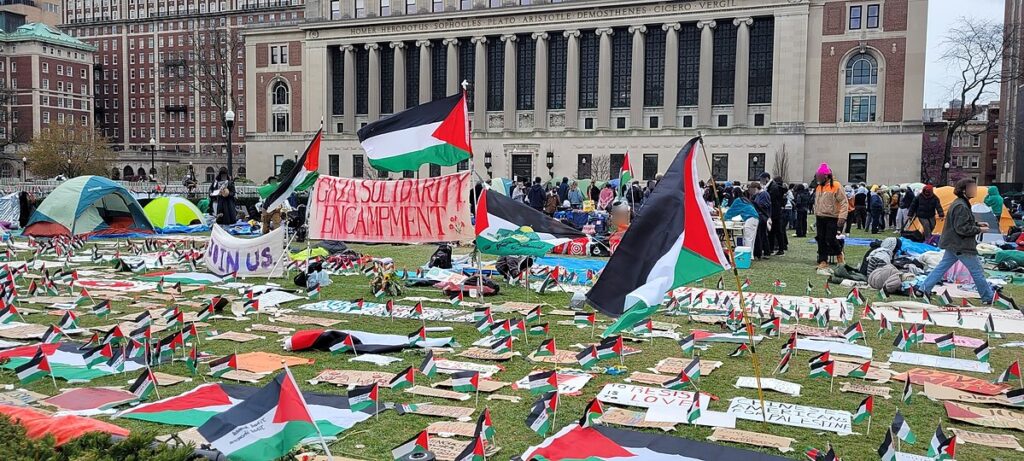
Anyone who has been keeping up with the American news cycle understands the role of students in Palestine’s liberation. College students across the country participated in what some call the “Student Intifada”, a movement showing solidarity for Gaza. Student protests first gained national attention at Columbia in 2024, after which encampments spread like wildfire across American campuses. The encampments focused on occupying university spaces to bring attention to Gaza. Additionally, students present universities with a list of demands, including divestment from Zionist firms and disclosure of foreign investments.
National organizations like Students for Justice in Palestine (SJP) are working in this vein to put pressure on universities. SJP has chapters at over 100 universities in the U.S. and is largely responsible for the wave of encampments. The Student Intifada has had mixed results throughout the country. Some universities came to agreements with students, while others employed heavy-handed suppression. However, recent news has proven vital to renewing the student movement. Now more than ever is the time to pay attention to the Student Intifada; but why?
Legal Wins and Progress
As students return to campus for the Fall semester, student groups have begun seeing the fruits of their labor. The University of Missouri (Mizzou) recently lost in federal court, and must allow pro-Palestinian students to attend university festivities. Last month, the SJP chapter at the University of Pittsburgh was granted an injunction from a judge, allowing them to resume on-campus activities. The judge declared that UPitt was too harsh in its suppression, and argued that SJP suffered “irreparable harm”.
The Council on American-Islamic Relations (CAIR) has made leaps and bounds in the legal battlefield. CAIR is responsible for winning the aforementioned Mizzou case, as well as a landmark $100,000 settlement between the University of Maryland and their SJP chapter. Also at the forefront of the legal battle is the American Civil Liberties Union (ACLU), which has supported SJP chapters in court. The ACLU famously represented political prisoner Mahmoud Khalil, fighting against his unlawful detention.
Unfortunately, this massive progress hasn’t reached everywhere yet. Universities are still unjustly suppressing pro-Palestine expression, drawing domestic and international condemnation. In 2024, UN human rights chief Volker Turk said last month he was “troubled” by the heavy-handed tactics of law enforcement and security on U.S. campuses in response to the protests. Speech suppression is only ramping up, and students must look to protect themselves from political persecution. With protests taking place at dozens of universities, it’s important to discuss ways to keep student groups safe.
Protecting Students: What Now?
First, students need to know their rights. Infringements on privacy and free speech in most circumstances can be escalated to a successful lawsuit. However, practical action in the heat of the moment is vital to immediate safety. The National Lawyers Guild has an extensive guide on how to handle law enforcement encounters, available in 3 different languages. Protesters should know local and state laws on organizing and ensure they are abiding by them. If one adheres to the rules, they can stand firm when confronted by law enforcement. Protesters should not say anything to police and only comply with demands unless absolutely necessary.
Next, on-campus surveillance and “doxxing” is a real concern. Doxxing is a form of harassment which targets activists by publicizing personal information, with the goal of destroying their reputation and endangering their careers. It aims to have them dismissed from their teaching posts or workplaces and invites further online harassment. Students afraid of being doxxed or blacklisted should wear a face covering to protests. Also, here is a useful guide to prevent doxxing and be safe in online spaces. Securing the online sphere is especially important now that the Department of Homeland Security has begun tracking social media activity. Moreover, avoid planning activities on workplace or school networks, and remove contact information for club leaders on social media.
Finally, both student and non-student protesters alike should consult resources before taking action. Palestine Legal, a non-profit dedicated to bolstering the Palestine solidarity movement, has amazing resources for activists. The Center for Constitutional Rights published a brief protest planner to help organizers anticipate anything and everything. Also available for free is the ACLU’s “Know Your Rights” guide for protesters exercising their First Amendment rights.
The Fight Won’t Stop
With encampments cleared out, police crackdowns, and threats from the federal government, showing solidarity with Palestine has become dangerous. However, as history has shown us, that has never deterred activists. Thanks to legal wins and mounting pressure, the tides are officially turning in the student movement.
For those who can, here is a link to donate to the Palestine Children’s Relief Fund.
Want more articles like this? Sign up for our e-newsletter!
Check out our blog here!