Subscribe
to receive news by email

Poll
Will the Trump Administration Shift U.S. Policy in Favor of Palestine?
- No (87%)
- Yes (13%)
 Loading ...
Copyright © 2026 Arab America
Go topTwo Rooms, One Cause: How AUC Students Reimagined Resistance
By: Laila Mamdouh / Arab America Contributing Writer
Last week, the American University in Cairo’s (AUC) School of Global Affairs and Public Policy (GAPP) found itself at the center of a campus-wide storm after hosting Ambassador Daniel Kurtzer, the former U.S. ambassador to both Egypt and Israel, for a discussion with students.
The event, meant to foster academic dialogue, quickly became a campus-wide controversy. Many students condemned the university’s decision, seeing Kurtzer’s past diplomatic role as incompatible with AUC’s values and the Arab world’s solidarity with Palestine.
This was not Kurtzer’s first controversial visit. When he came to AUC in 2019, similar backlash erupted, though on a smaller scale. This time, the context amplified the outrage. U.S. President Donald Trump was in Sharm El-Sheikh the same week for regional peace discussions. At the same time, Israel’s military campaign in Gaza intensified, which much of the international community and nearly all Arab youth have condemned as genocide.
Against this backdrop, many saw the ambassador’s visit as tone-deaf, if not provocative.
Social Media Storm: Outrage and Misinformation
In the days before the event, WhatsApp groups and social media were filled with posts denouncing GAPP’s decision. Rumors spread quickly, labeling Kurtzer a Zionist and accusing AUC of normalizing relations with figures complicit in Palestinian suffering.
The digital outrage, rooted in anger and empathy, was fueled by misinformation and sensationalist reporting. Several viral posts highlighted Kurtzer’s use of the phrase “Palestinian terrorists” in a past context, circulating it without nuance or explanation. For many, that phrase became proof that the ambassador’s presence was unacceptable.
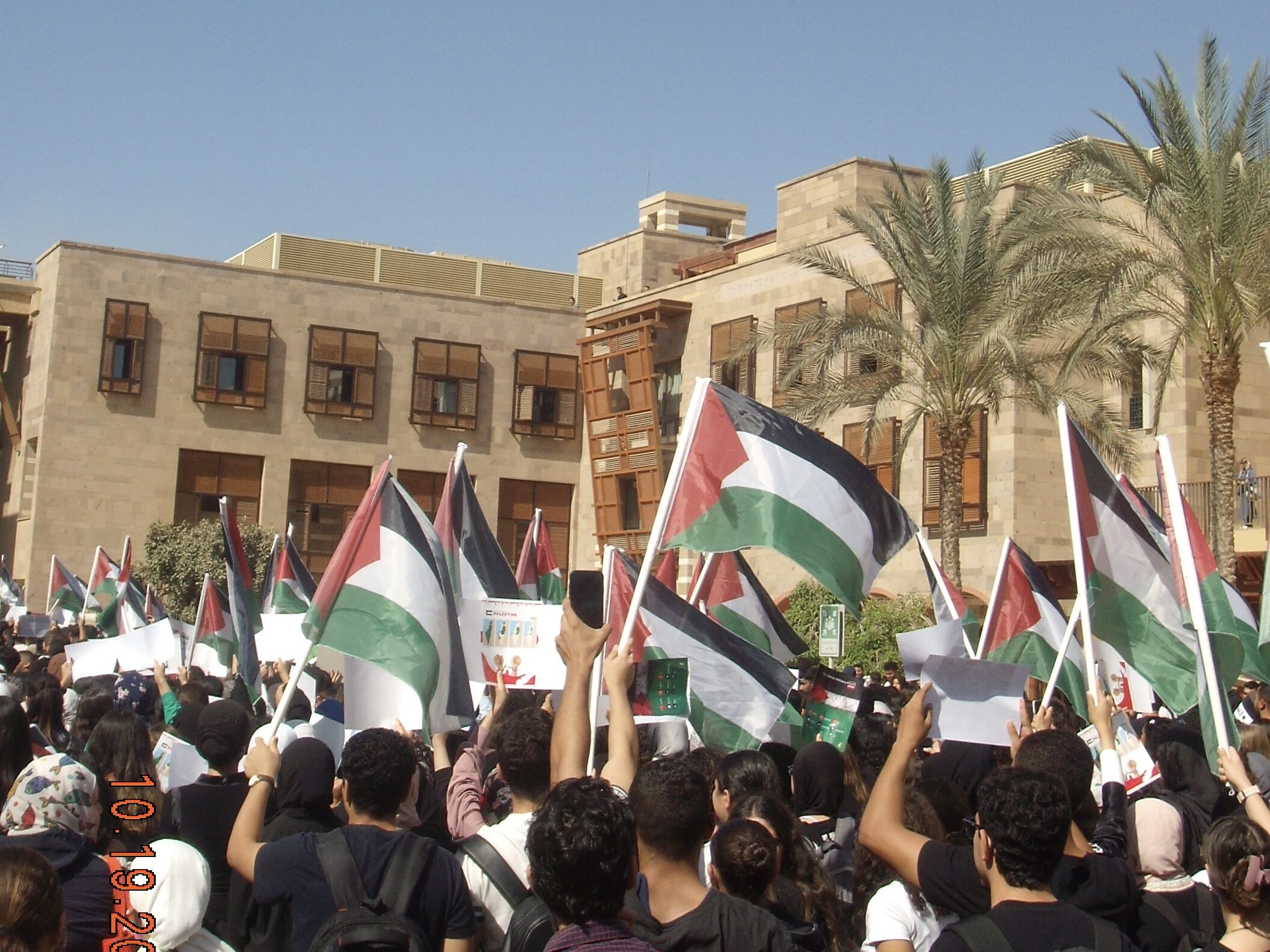
By the day of the event, protests were organized across campus. Students marched with their Kuffeyas and Palestinian flags, held up signs demanding justice, and filled the hallways outside the discussion venue with chants of defiance. Their message was clear: Palestine remains at the heart of Arab consciousness, and normalization with its oppressors, symbolic or otherwise, will not be tolerated.
Inside the Room: Dialogue as a Different Form of Resistance
While protests gained momentum outside, inside the GAPP room, another kind of engagement was unfolding. A smaller group of students chose to attend the event, not to endorse Kurtzer’s views but to confront them directly.
For these students, dialogue was not a sign of compromise. It was a strategy. They believed that understanding the logic, rhetoric, and diplomacy of those who shape Western policy toward the Middle East was essential for crafting stronger counterarguments. Listening did not mean accepting; it meant learning how to dismantle.
In their eyes, protest and dialogue were not opposing forces but two tools serving the same purpose. Both were driven by solidarity, born from frustration, and animated by the same question: How can we, as Arab youth, make our voices matter?
Two Sides of the Same Movement: Passion and Strategy in Tandem
The divide between those who protested and those who attended is easy to mistake for disagreement, but in truth, it revealed something deeper: a generational evolution in how resistance is expressed.
The students outside represented the heartbeat of Arab conscience. Their chants echoed decades of collective struggle, mourning, and steadfastness. They embodied the emotional truth of the Palestinian cause: the refusal to normalize, the refusal to forget. Their protest was not just against one ambassador but against an entire legacy of oppression and Western complicity.
Meanwhile, the students inside reflected a different but equally important current within the same movement. They did not see conversation as capitulation, but as confrontation of a different kind: an intellectual one. For them, “fighting Western logic with Western logic” meant using the tools of debate, diplomacy, and reason to expose hypocrisy and reclaim narrative control.
This emerging approach is controversial among many Arab youth because it risks appearing detached from emotion. Yet, its existence signals a significant shift in how young Arabs are thinking about advocacy. They are realizing that resistance can live both in the streets and in the seminar rooms, and that the fight for Palestine requires both the moral clarity of protest and the strategic patience of dialogue.
One student who attended the event described it this way:
“We weren’t there to agree with him. We were there to understand how people like him think. If we want to challenge the system, we have to understand its language.”
Another protester outside shared a parallel belief:
“I didn’t go in because his words don’t deserve to be heard on our campus. But I respect those who went in. In the end, we’re fighting the same fight, just in different ways.”
Both perspectives are valid and deeply intertwined. The protests outside gave emotional power to the moment, reminding everyone of the raw pain that fuels the cause. The dialogue inside gave intellectual depth, showing that resistance can adapt and expand without losing its moral compass.
Together, these two actions created a balance; a living demonstration that Arab youth can be both impassioned and strategic, both indignant and analytical. This duality is not division; it is the mark of a maturing movement.
A Moment of Reflection: Unity in Difference
In hindsight, coordination between the two groups might have strengthened the impact. A united front os students chanting outside and questioning inside could have amplified the message that resistance is not one-dimensional. But even without that alignment, both sides delivered their message loud and clear.
Kurtzer’s visit did not go unnoticed, nor did it go unchallenged. The protests made sure of that. But the dialogue ensured that the challenge took multiple forms: moral, intellectual, and political.
The strength of this moment lies in its diversity. It showed that Arab youth are capable of holding two truths at once: the pain of their people and the pragmatism required to engage a world shaped by power and discourse.
A New Chapter in Arab Youth Activism
The events at AUC were more than a fleeting controversy; they were a snapshot of a new era in Arab student activism.
Across campuses in the region, young Arabs are redefining what it means to stand for Palestine. For some, that means taking to the streets with flags and chants. For others, it means stepping into rooms with those who represent systems of power and using their words against them.
Both paths are necessary. Both are powerful. Together, they form the modern face of Arab resistance, a movement that is emotional yet strategic, uncompromising yet adaptive.
In the end, AUC’s divided campus was not a sign of weakness but of awakening. It reflected a generation that refused to choose between the heart and the mind, one that understood that true justice requires both.
“We know who you are, we know what you’ve done, but we also know what we must learn to change it.”
That, perhaps, is the message the AUC students sent last week. It might just be the message that defines the next chapter of Arab youth activism.
Want more articles like this? Sign up for our e-newsletter!
Check out our blog here!