
Subscribe
to receive news by email

Poll
Will the Trump Administration Shift U.S. Policy in Favor of Palestine?
- No (87%)
- Yes (13%)
 Loading ...
Copyright © 2026 Arab America
Go topUnderground Art Spaces in Kuwait
By Londyn Sewell / Arab America Contributing Writer
Often, when hearing the phrase “underground,” someone thinks about hidden staircases, dark basements, or places tucked underneath the city. However, in Kuwait, underground means something different.
It does not refer to a physical location below the surface. Rather, it’s a space that exists outside of mainstream attention. Beyond the luxury museums, tourism, etc, these places are shaped by artists rather than trends. They are not always as accessible. Thriving off word of mouth and smaller creative communities. Exclusivity is essentially a part of its power.
Kuwait’s underground art scene is quiet, intentional, and extremely personal to those who choose to share their art.
Mirror House
If there is a symbol of unconventionality, it would be the Mirror House. On the outside, it appears to be an ordinary residential building along the streets of Kuwait City. However, the home was transformed over decades by an Italian-Kuwaiti artist, Lidia Qattan, and her late husband, Khalifa Qattan, one of Kuwait’s pioneers of modern painting.
In the 1960s, Khalifa gave Lidia a house as a wedding gift. Over time, she began decorating the walls with small, handcut mirror pieces around 1972. What started as a decorative hobby slowly became something far more than that. Room by room the house transformed into a full artistic environment. With its completion in 2006.
From the ceiling down to the floors, each room carries a theme: “Planet Earth’ Hall, “Zodiac” Hall, “Universe” Hall, “Knowledge” Hall, “My World” Hall, “Corridor of the Nations”, “Shark Basin”, “Sea World” Hall, and “Stairs to Inspiration”. With so many other themes to explore. Shifting the mirror into different patterns makes visitors feel as though they are walking through someone’s creative imagination.
With the Mirror house not being a conventional museum. The Mirror House is not a conventional museum. Tours are offered by appointment and can only be personally guided through the home, hearing the amazing and personal stories. This is a form of personal intimacy when experiencing art that you don’t normally get when walking through your average museum. Built for devotion and intimacy, not mass audiences.
Contemporary Art Platform (CAP)
While Mirror House represents a good representation of personal underground art, there are spaces like Contemporary Art Platform (CAP) showing a broader cultural shift.
Founded in 2011, CAP came to the forefront at a time when Kuwaiti artists were searching for an environment to create and experiment in. Moving itself away from commercial gallery culture., CAP became known for experimental and contemporary work, performance art, installations, etc. It offered a platform for artists who did not fit within the “traditional” expectations of art, CAP hosts discussions and even cross cultural collaborations between artists.
CAP may not necessarily be “hidden”, but it does operate outside the mainstream museum world, making conversation a priority over spectacle and the process over presentation. In doing so, it has begun to carve out space for artists to explore identity and abstraction.
The freedom of expression and conversation places the CAP within Kuwait’s underground ecosystem.
Sultan Gallery
Way before places like CAP were created, Sultan Gallery was the foundation for modern art in Kuwait. Established in 1969, the Sultan Gallery is one of the oldest galleries in the Gulf. It began as a framing shop run by two sisters, Ghazi and Najat Sultan, before it evolved into a serious contemporary gallery space. At one time, there were places that supported modern and contemporary Arab artists.
Its warehouse-like setting adds to its understated character. Over time, it has consistently highlighted bold and innovative voices, with artists that are willing to question and push norms and explore the complex and political themes of today’s world.
Although it now holds international recognition, it was built from necessity rather than prestige.
Why are these spaces important?
Kuwait’s underground art scene isn’t loud, nor is it heavily promoted in the art world; nor relying on grandiosity.
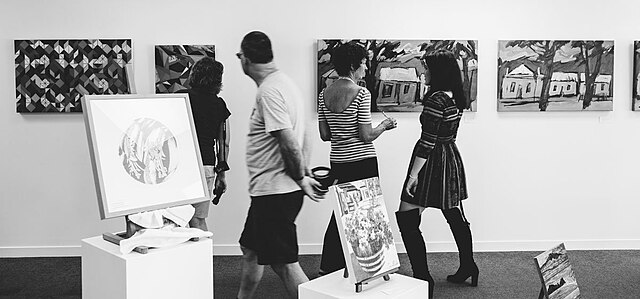
Instead it creates room for risk, vulnerability, and ideas that may not sit comfortably inside polished museum walls. In an area known for large cultural projects and rapid development, these smaller spaces offer something completely different. Moving at a slower pace, artists can experiment without the ever-growing expectations and approval from society.
Mirror House shows how art can be personal rather than formal. Even reflecting that one family’s lifelong dedication to creativity is something that cannot be mass produced.
Independent platforms like CAP give artists room to explore identity, politics, and memory in ways that may feel too bold for mainstream venues. In today’s world, spaces like these matter, and these conversations need to be had.
Spaces like sultan gallery are important because they supported artists before the bigger art market existed, helping build the modern art scene from the ground up.
These underground spaces create community, but also shared curiosity. Visitors are able to engage more deeply. Conversations even begin to feel more open. The line between artist and audience becomes thinner.
Most importantly, these spaces protect creative freedom. Without pressure from trends or outside influence, art can stay local, experimental, and personal. This is not built for everyone, but only for those willing to look closer.
Want more articles like this? Sign up for our e-newsletter!
Check our blog here!