Subscribe
to receive news by email

Poll
Will the Trump Administration Shift U.S. Policy in Favor of Palestine?
- No (86%)
- Yes (14%)
 Loading ...
Copyright © 2026 Arab America
Go topWhen Security Becomes Occupation: Rethinking America’s Role in the Middle East
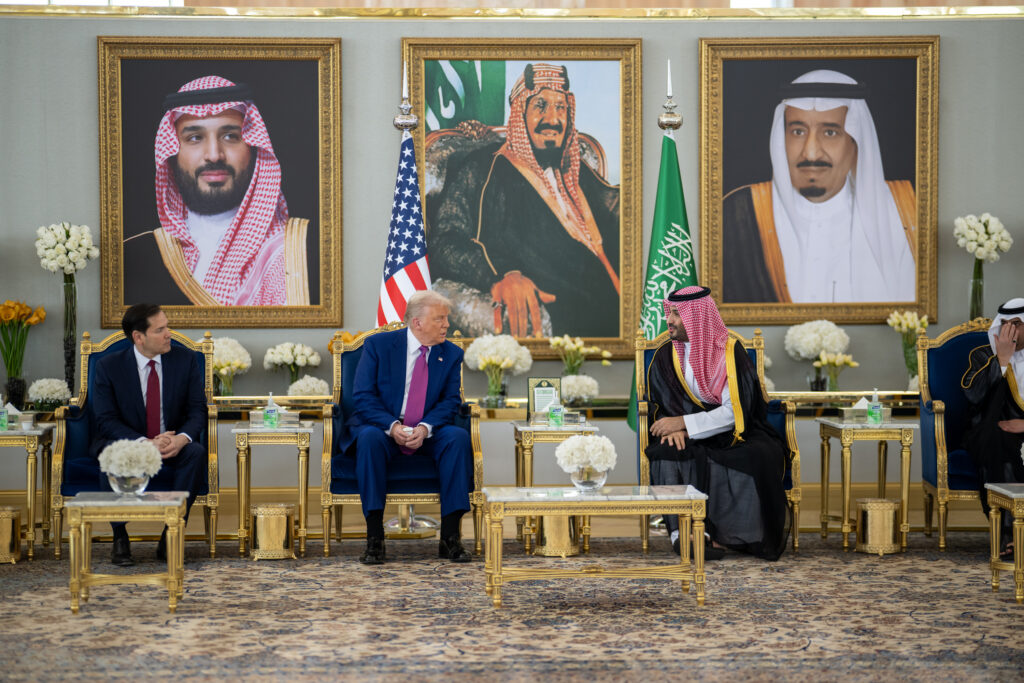
By: Ghassan Rubeiz / Arab America Contributing Writer
For more than a century, American engagement in the Middle East centered on schools, hospitals, and humanitarian missions inspired by the biblical motto “that they may have life, and have it abundantly.” In recent decades, however, the most consequential U.S. presence has shifted from human empowerment to political and military intervention—an evolution that has constrained life rather than enriched it.
A central question has become unavoidable: Does the U.S. military presence in the region, particularly the Arab Gulf, still serve peace, or has it become a source of deeper insecurity? Washington today maintains an extraordinary network of military bases—Al Udeid Air Base in Qatar, the Fifth Fleet in Bahrain, major installations in Kuwait, and training missions in Saudi Arabia, Oman, and Jordan. No region outside Europe hosts a denser concentration of American military power.
This presence is not organic to the region. It is rooted in oil wealth, chronic Gulf insecurity, and Israel’s close ties to Washington. American forces settled in the Gulf as guardians, but instead of protecting the region, they have drawn it deeper into rivalries.
Jonathan Hoffman writes in Foreign Policy that Washington’s policies have made the Gulf “more vulnerable to the fallout of U.S. and Israeli decisions.” By embedding Gulf states in the U.S.–Iran and Israel–Iran confrontations, American forces have turned them into potential targets. Hoffman identifies immediate risks, but there are deeper structural problems: U.S. presence in the Middle East functions as a political occupation.
The modern Middle East lives under five overlapping forms of occupation. The first is territorial occupation—the conventional control of land by outside powers. The second is ruler occupation— authoritarian governments that suppress political participation and accountability. The third is militia occupation—armed non‑state actors filling the vacuum left by weak or collapsing states. The fourth is occupation of the mind—patriarchal, sectarian, and non‑pluralistic social systems that stifle reform and critical thinking. The fifth is foreign superpower intervention—most prominently the United States, shaping regional choices from the outside.
These forms of occupation reinforce one another: dysfunctional political systems invite territorial encroachment; insecure rulers welcome foreign military protection; militias thrive as states weaken; and superpower dominance discourages the development of local institutions capable of governing effectively.
The U.S. presence has taught the region the wrong lessons. It has equated security with advanced weapons and foreign troops, sidelining the fundamentals of real stability: rule of law, accountable governance, economic equity, and freedom of thought. Washington’s preference for rapid modernization—gleaming infrastructure without democratic foundations—has produced wealthy states that remain politically brittle.
American interventionism has also encouraged regional actors to mimic its behavior or to ignore past acts of hegemony. Saudi Arabia and the UAE have projected power into Yemen, Libya, and Sudan; Egypt has intervened in Libya and Gaza. Israel has gone much farther in hegemony. It has habitually crossed borders and occupied land in Syria, Lebanon, and the Palestinian territories.
Unaware of the weight of its presence, Washington has recently acted as the master of regional diplomacy. The U.S.-supported Abraham Accords normalized relations between Israel and several Arab states without addressing the region’s central Palestinian question. This pattern—pursuing political deals without resolving underlying conflicts—has now reached Lebanon.
Last Friday, Lebanon signed a surprising “framework of intentions” with Israel. The agreement pledges a phased Israeli withdrawal from Lebanese territory in exchange for a Lebanese commitment to pursue the disarmament of Hezbollah. Hezbollah immediately denounced the move as “seditious,” warning it could ignite internal conflict. The framework’s fate will depend largely on U.S.–Iran dialogue, without which no Lebanese–Israeli understanding can endure.
Lebanon’s experience offers a stark warning: premature, externally driven deals can destabilize fragile states rather than strengthen them. Pushing Beirut toward an arrangement it cannot sustain risks deepening internal divisions and reviving old fault lines. Critics argue that Washington is trying to fold Lebanon into the Abraham Accords before the country has the political capacity to absorb such a shift. The unavoidable question remains: Can Hezbollah be disarmed without imposing a stress test Lebanon might not survive?
Foreign armies can freeze conflict, but they cannot build peace. The Middle East cannot secure its future through foreign troops, imported weapons, unfulfilled promises, or divisive alliances. The region must find common ground. A new path could begin with a Gulf‑led security dialogue that includes Iran.
The question is no longer whether the U.S. military presence serves peace. It is whether the region is ready to imagine peace without it—peace rooted in state‑building, regional cooperation, and collective security.
Author’s Note: A future column may explore how “non‑state occupation” is conventionally labeled as terrorism, while the other four forms of occupation continue to dominate decision‑making about the region’s search for peace.
Ghassan Rubeiz is the former Middle East Secretary of the World Council of Churches. Earlier, he taught psychology and social work in his country of birth, Lebanon, and later in the United States, where he currently lives. He has contributed to political commentary for the past twenty years and has delivered occasional public talks on peace, justice, and interfaith topics. You can reach him at rubeizg@gmail.com
The views and opinions expressed in this article are those of the author and do not necessarily reflect the position of Arab America. The reproduction of this article is permissible with proper credit to Arab America and the author.
Want more articles like this? Sign up for our e-newsletter!
Check our blog here!