Subscribe
to receive news by email

Poll
Will the Trump Administration Shift U.S. Policy in Favor of Palestine?
- No (87%)
- Yes (13%)
 Loading ...
Copyright © 2026 Arab America
Go topWho Controls the Nile? The GERD and the Rewriting of the Nile’s Future
By: Laila Mamdouh / Arab America Contributing Writer
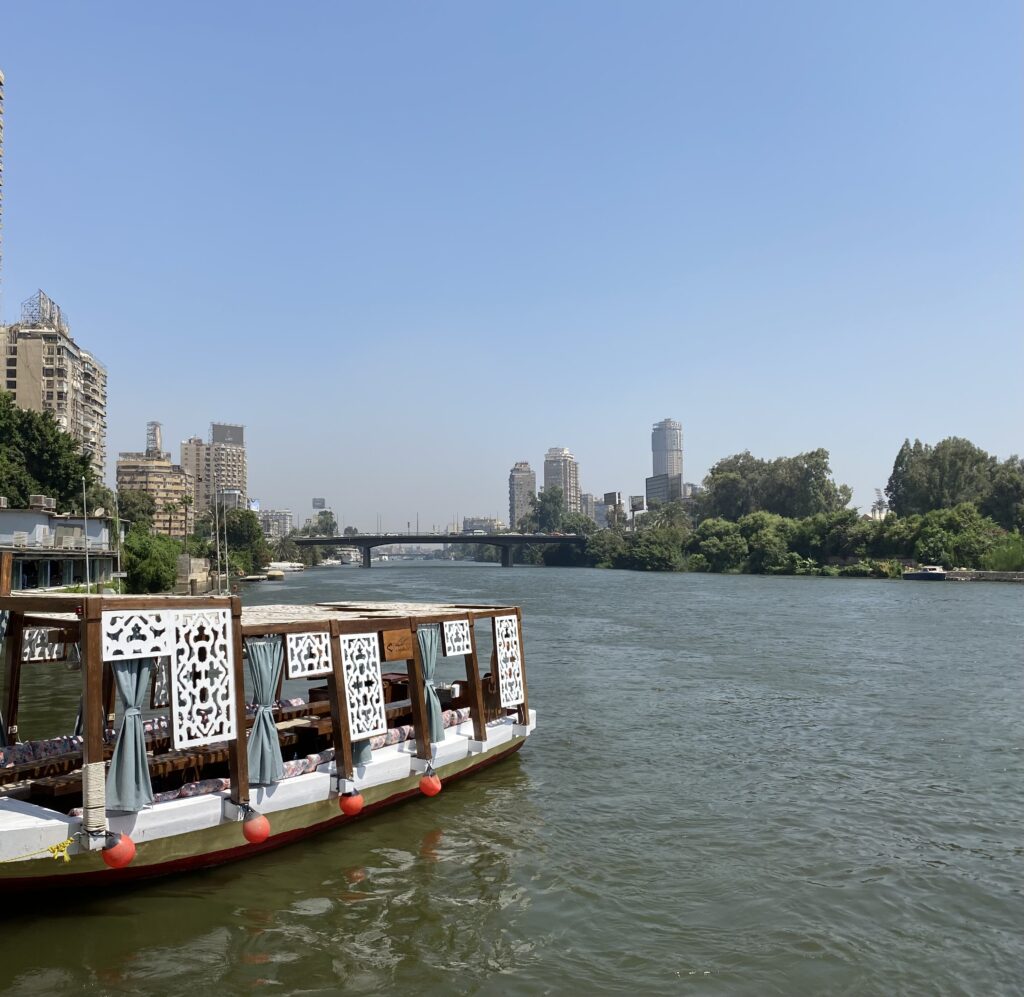
The Nile River has long been more than just a geographic landmark; it is the lifeline of northeastern Africa. Flowing through eleven countries, its waters are most vital to Egypt, Sudan, and Ethiopia, three nations now locked in a bitter political and existential struggle over its control. At the center of this modern-day water war is the Grand Ethiopian Renaissance Dam (GERD), a massive hydroelectric project that Ethiopia initiated in 2011 on the Blue Nile, the Nile’s primary tributary. Celebrated by Ethiopia as a national triumph and viewed by Egypt and Sudan as a national threat, GERD has become a symbol of the fraught balance between national development and regional survival.
Geography, Dependency, and the Dam
The Nile River is the longest in the world, stretching over 4,100 miles. But its real significance lies not in its length, but in its life-giving power. Egypt receives over 90% of its freshwater from the Nile, and its ancient civilization, indeed, its very existence, has depended on the river’s consistent flow for thousands of years. Sudan, too, relies on the Nile for irrigation and electricity; at the same time, Ethiopia, the source of roughly 85% of the Nile’s water via the Blue Nile, has historically received little benefit from its flow.
This asymmetry has long been a point of friction. The 1929 and 1959 Nile Water Agreements, signed without Ethiopia’s participation, allocated the vast majority of Nile water to Egypt and Sudan, effectively excluding Ethiopia from equitable use. For decades, this imbalance persisted. But the construction of the GERD has dramatically shifted the landscape, both literally and geopolitically.
Egypt’s Revolution, Ethiopia’s Opportunity
In 2011, as Egyptians flooded Tahrir Square demanding the downfall of Hosni Mubarak’s regime, Ethiopia quietly seized an opportunity. With Egypt’s political institutions in instability and its foreign policy apparatus in disarray, Ethiopia laid the foundation stone for the GERD. For this was more than a dam; it was a declaration of sovereignty and a long-overdue reclamation of water rights.
For Egypt, however, the construction represented a betrayal and a threat. Built without prior agreement from downstream nations, GERD could directly affect the operation of Egypt’s Aswan High Dam, a project synonymous with modern Egyptian nation-building. Any upstream interference could disrupt the delicate balance Egypt has maintained for decades to manage its agriculture, urban water supply, and power generation.
The GERD: A National Dream and a Regional Nightmare
Ethiopia sees GERD as a keystone for its development. As Al Jazeera mentioned, it is capable of producing over 6,000 megawatts of electricity; it is Africa’s largest hydroelectric dam, and promises to electrify millions of Ethiopian homes, stimulate industry, and bolster national pride. For a country where more than half the population lacks reliable electricity, GERD is nothing short of transformative.
Yet this transformation comes at a cost.
Egypt fears that during drought years or aggressive reservoir filling, the dam will significantly reduce water flow, threatening its food security and livelihoods. The Nile irrigates over 3 million hectares of Egyptian farmland. A sharp reduction in water could turn fertile fields into dust. Sudan faces its own risks: uncontrolled releases or poor coordination could cause catastrophic flooding, especially given its reliance on aging infrastructure and its precarious political climate.
Can vs. Should: The Ethics of the Nile
The central question raised by GERD is not only who can control the Nile, but who should, and under what ethical and legal frameworks. Ethiopia can build a dam because the Blue Nile originates on its soil. But should that give it unilateral rights over a resource that sustains millions beyond its borders?
As per the United Nations Watercourses Convention (1997), International law favors equitable and reasonable utilization of transboundary water, which implies cooperation, not coercion. But in practice, upstream countries like Ethiopia have the geographic advantage, while downstream nations like Egypt and Sudan hold historical and legal claims. GERD exposes the tension between these paradigms.
Israel’s Role and Egypt’s Political Shackles
Further complicating matters is Israel’s reported support for GERD, through both technical assistance and diplomatic backing. As Reuters said, analysts argue that Israeli involvement reflects a broader geopolitical strategy to dilute Egyptian influence in East Africa and the Nile Basin. By helping Ethiopia assert control over the river, Israel indirectly undermines Egypt’s regional leverage.
This intervention comes at a time when Egypt is already politically shackled. Domestic economic crises, authoritarian consolidation, and shifting global alliances have left Cairo with limited mobility in foreign affairs. It is, in effect, chained to the wall, able to protest GERD’s dangers but incapable of halting or reshaping it.
A Crisis Without Resolution
Years of African Union–brokered negotiations have yielded little progress. According to the International Crisis Group, Egypt demands a legally binding agreement that guarantees minimum water flows. Ethiopia insists on its right to develop without external interference. Sudan, caught in the middle, fears both water scarcity and the consequences of a poorly managed dam. All three have traded diplomacy for rhetoric, and trust is in short supply.
Meanwhile, GERD has begun generating electricity. Its turbines spin as water builds behind its walls. For Ethiopians, this is long-awaited justice. For Egyptians and Sudanese, it is an existential gamble (BBC).
The Overarching Question
The GERD has become more than a dam. It is a mirror reflecting the deeper questions of post-colonial resource rights, regional power dynamics, and the thin line between self-interest and shared destiny. If Ethiopia’s gains mean Egypt’s drought and Sudan’s floods, who bears responsibility? And what does justice look like in the distribution of nature’s gifts?
As the waters rise behind the GERD, so too do the stakes for the Nile Basin. The overarching question remains: who should control the Nile? And can a project that brings light to some justify plunging others into darkness?
Want more articles like this? Sign up for our e-newsletter!
Check out our blog here!