
Subscribe
to receive news by email

Poll
Will the Trump Administration Shift U.S. Policy in Favor of Palestine?
- No (87%)
- Yes (13%)
 Loading ...
Copyright © 2026 Arab America
Go topA New Generation of Arab-American Politicians: Abdul El-Sayed
By: Robert Jackson / Arab America Contributing Writer
Across the country, a new wave of Arab-American leaders is rising. This series explores their stories, motivations, and the futures they are working to build.
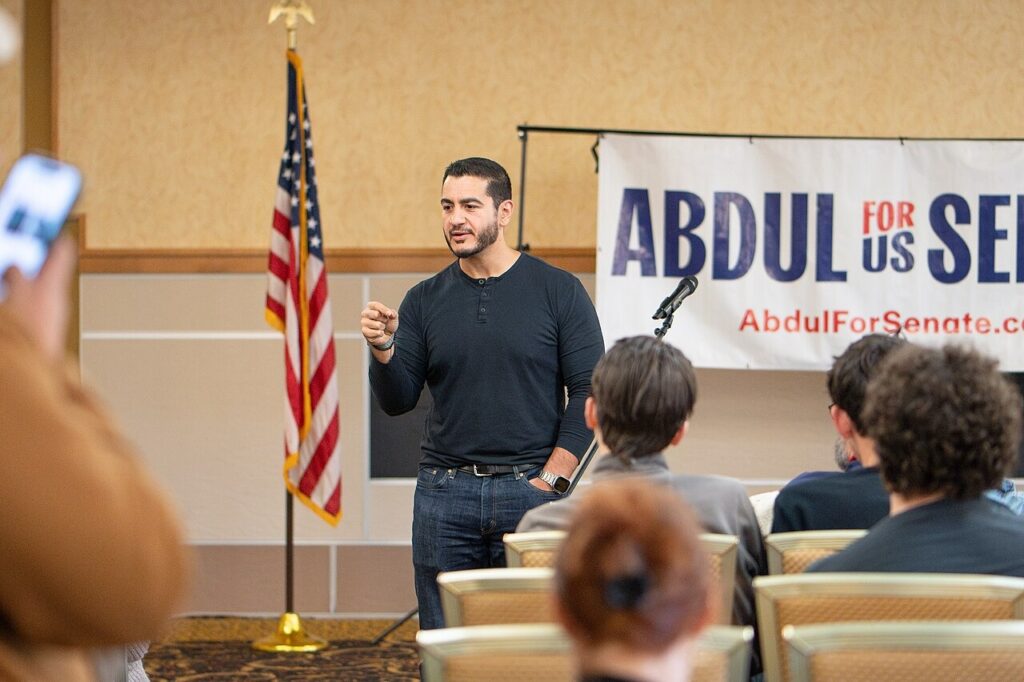
Dr. Abdul El-Sayed is one of the new voices in politics calling for progressive change. With doctorates in Public Health and Medicine, this former public health official is running for U.S. Senate in Michigan, bringing with him a health-centric agenda. As the second part of this series, Arab America spoke with Abdul about his entry into politics, his policies, and his Egyptian heritage.
An All-American Story
Abdul’s father emigrated to America in 1978, but his mother’s family has been American since the Revolutionary War. His parents taught him that courage was standing up to the powerful for the powerless, a lesson he has taken to heart. In school, he played sports and studied hard. He went to the University of Michigan, earned a Rhodes Scholarship to Oxford, and received his MD from Columbia. Abdul often jokes that he’s got a name built for politics, but his story is certainly all-American, even if he loves Egyptian om ali.
From Health to Politics
Throughout his education, Abdul learned about connection between life expectancy and policy, which motivated him to get into politics. After a short time as an assistant professor, he became Director of Detroit’s Health Department from 2015 to 2017. During this time, he heavily reformed the department and partnered with the Vision To Learn program to provide thousands of students with glasses. He resigned to run for Governor of Michigan but didn’t win the primary.
Abdul said that his 2018 campaign taught him two things: that Michiganders wanted to know what you are about and didn’t care as much about the things we’re told divide us, and that corporate money corrupts our politics. After the election, he was appointed the Director of Human and Veteran Services for Wayne County in 2023, a role in which he distinguished himself. He is most proud of the work he and his team did to eliminate the medical debt of over 300,000 people.
Health Politics
Abdul has made it clear that if elected, he would continue to fight for a healthier Michigan. He has called for Medicare for all and even co-authored a book entitled Medicare for All: A Citizen’s Guide. A big part of his campaign is about reminding people that “every dollar we spend abroad, in the 22 billion we’ve sent to Israel or the 185 billion that we’re sending to ICE, is a dollar we’re not spending on your healthcare.”
When I asked him about TrumpRx, the administration’s negotiations with pharmaceutical companies to lower drug prices, he was dismissive.
“It’s a gimmick”…“I don’t make much of it because he’s [Trump] not serious.”
Union Candidate
Abdul has deep ties with organized labour movements and his father was an inspiration to him. As a professor, Abdul’s father led a strike that gained worker rights for professors at Eastern Michigan University. Abdul himself was arrested for protesting for a $15 minimum wage in 2018. During the interview, Abdul reaffirmed his belief in unions as a critical part of creating a more affordable America.
“Unions are critical if you’re going to build a more just society.”
Abdul Himself
This interview revealed that Abdul has a taste for action. He played football and lacrosse as a student. He spends a lot of time at the gym keeping himself fit. Going out and trying to make change is the way he is. No matter the result of the election, no doubt Abdul will keep fighting for change for his community. To him, the hardest part of running for Congress isn’t the long hours or finding donors, it’s fighting against the cynicism people in politics.
“I don’t think of our politics on a left-right spectrum, I think about it rather as people who have been left out and the people who are locking them out…I side with the people who are being locked out.”
Want more articles like this? Sign up for our e-newsletter!
Check out our blog here!