

Subscribe
to receive news by email

Poll
Will the Trump Administration Shift U.S. Policy in Favor of Palestine?
- No (86%)
- Yes (14%)
 Loading ...
Copyright © 2026 Arab America
Go topFranco and Street Arabic: How Arab Speakers Have Reclaimed Their Language in English Domination
By: Shayla Frank/ Arab America Contributing Writer
Scroll through a group chat between two Arab 20 year olds anywhere from Amman to Anaheim, and the language on the screen won’t match anything in a dictionary. Numbers sit inside words like extra letters, standing in for sounds English never had to develop. Out of context, it can look like Arabic quietly losing ground to English, one more language dissolving into whatever runs on a keyboard. It isn’t that. It’s Arabic speakers refusing to let a technical limit decide what language they got to keep.
The Bottleneck Generation
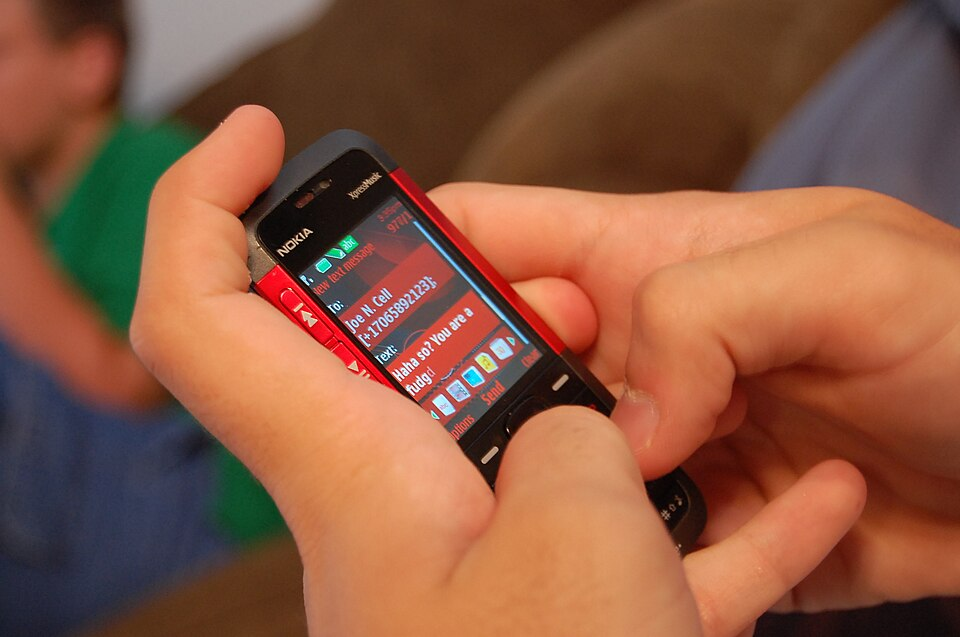
The system has several names. Arabizi. Franco. Arabish. All of them point back to the same problem, which was never Arabic itself. Through the last years of the twentieth century, mobile texting, early chatrooms, bulletin boards, and instant messaging spread across the Arab world running on keyboards that supported Latin script only. Arabic wasn’t on the menu, so people did what anyone who needs to talk to each other always does. They built a workaround out of what they had.
The fix wasn’t random. The number 3 stands for ع because, flipped around, it traces the shape of the letter. The 7 carries ح, a breathy sound with nothing close to it in English. Every substitution followed that same logic: a number chosen because it looked like the letter it replaced, not because it sounded like anything in English. It was a script built by an online community of speakers, the work of whoever happened to be logged into a chatroom or holding a pager at the right moment in the 1990s.
This is usually where the story flattens into “young people invented internet slang,” but the demographics matter more than that. The community that assembled the system did so by improvising early text messages, and weren’t the very-online, very-young Gen Z that tends to get credit for it now. Most were teenagers and young adults living through the internet’s first arrival in the region, which puts most of them closer to Gen X and the oldest millennials. In short, Gen Z didn’t invent Franco. They were born into a language their older siblings, cousins, and parents had already put together.
Inheritance or Survival?
By the time smartphones spread across the Arab world and its diaspora, the constraint that created Franco no longer existed. Phones now ship with a full Arabic keyboard. Thus, typing ع or ح in actual Arabic script takes one extra tap, not an improvised workaround. The bottleneck closed, and realistically, Franco should have closed along with it.
It didn’t. If anything, it got more elaborate. Researchers keep landing on the same finding: Arabizi now functions less as a technical patch and more as a marker of who belongs. Studies comparing users just a few years apart in age found the youngest texters layering in more apostrophes and more complex number combinations than slightly older users, who tend to keep to a simpler, more basic version. Rather than a system running out of steam, this is one being actively developed by people who no longer need it and are choosing to keep building it anyway.
Nowhere is that choice more loaded than in the diaspora, where a different kind of gap opens up. A lot of second-generation and later Arab American kids grow up hearing Arabic at home, absorbing a dialect from their parents and grandparents, without ever being taught to read or write the script itself. Linguists call this a heritage speaker, someone with real, lived fluency in the spoken language and a blank space where literacy should be. For that reader, Franco isn’t one option among several, but the only script available to put Arabic sounds on a page. From a distance, a kid in Dearborn, Bay Ridge, or Aurora texting his teta isn’t choosing Franco over Arabic script the way a Cairo teenager with two working keyboards might be. He’s using the only alphabet he was ever taught, English, to keep a language alive that the classroom never touched.
Critics, usually a generation up, have called all of this lazy, a symptom of kids losing touch with the language of the Quran and their grandparents who still speak it. That critique assumes the alternative was full literacy in the first place, but for a lot of the people doing the texting, it wasn’t. The choice was never between Franco and formal Arabic, but between Franco and silence.
Taking the Chatrooms to Coachella
Franco started as a way to make texting easier. However, it stopped being about that a long time ago, and this generation didn’t just inherit the script and keep it alive. They built on top of it, layer by layer, until it became the foundation for a culture they pioneered on their own terms creating new music, platforms, and a way of telling their own stories instead of translating anyone else’s.
Bayou has said the shift blends where his generation grew up looking up to American acts like the Weeknd for lack of any other option and kids can now look up to Saint Levant, Elyanna, Zeyne, or Bayou himself, artists who sound like them from the start. Which is the difference between borrowing a culture and building a stage of their own.
When Bayou, born in Egypt and based in Los Angeles, shared a Coachella stage with Palestinian artist Saint Levant, it wasn’t a novelty crossover. Bayou’s single carries the title “Bansa 7aly,” Franco sitting right there in a released song instead of a private text thread. Grammy.com’s Arab American Heritage Month spotlight reads like a group chat come to life, naming Lana Lubany, Felukah, Bayou, and Sahera alongside Saint Levant as the artists carrying it forward.
Moreover, TikTok and Instagram deserve credit for keeping the language alive as well. They function not as neutral pipes the culture happened to flow through, but as the actual stage this generation built for itself. Before these two apps, there was no dedicated venue for a sketch about asking an immigrant parent to read out a verification code, or a bit about bringing home a report card. Subhi Taha has built a following by working through exactly that territory, what it means to grow up Muslim American, sketch by sketch. The Canadian comic behind the account Jaurjicomedy, of Egyptian and Iraqi descent, has pulled a combined audience of well over a million across the same two apps, out of comparable immigrant-household material.
None of it had anywhere to live before platforms built for short, personal, language-blended storytelling existed. Franco didn’t just find a home on TikTok and Instagram, but allowed a generation that made it, to build an entire community on these platforms that wasn’t there before.
That same language shows up at a smaller scale too, in the text underneath the videos. Linguists who study Arabizi now list captions and comments on social media as one of its main habitats, right alongside the group chat it started in. A typical example pulled from that research is, “Ma 3am efham chu 3am te7ke,” Lebanese Franco for “I don’t understand what you’re saying.” It’s an unremarkable sentence, and that’s the point. And this same style exists under a TikTok video or buried in an Instagram comment thread constantly, but with different words attached.
This doesn’t run through the old channels, either. Suhel Nafar, a member of the pioneering group DAM turned music industry executive, points to Instagram pages like MENA Heat as infrastructure now, not a side effect, the kind of place where he personally discovered a teenage Gaza rapper who goes by MC Abdul and Palestinian-Jordanian singer Issam Alnajjar. He calls the meme pages built around Franco the hub of a third culture, not fully one thing or the other, made by kids who grew up straddling both. The texting habit came first, and the memes, the sketches, the talent scouting, and the songs all followed the same route the texts already knew, handing a generation the room to tell its own stories instead of waiting for someone else to tell them first.
Michael Hakim, another artist working the same blend of R&B and Arabic sound, has been direct about the stakes. When he is writing across both languages, numbers included, is how he holds onto an identity under active pressure to disappear. That’s the same instinct that opened this piece in a group chat, just amplified onto a stage and a streaming platform.
The Future of Franco
Not everyone studying this agrees on where it goes next. Researchers comparing millennial and Gen Z users abroad found genuine disagreement even among the users themselves, some treating Franco as a permanent fixture of how they’ll always write Arabic, others describing it as a phase that will fade once technology finishes catching up. Both camps are looking at the same evidence and drawing different conclusions, which is usually a sign that the story isn’t finished yet.
Although, the technology argument cuts in an interesting direction. The original relationship, where machines forced the workaround, has started to run the other way. Linguists have taken Franco seriously enough to build entire research datasets out of it, pulling posts from forums and group chats to teach software how this generation writes. AI translation tools are now working to catch up to Franco itself, training on that harvested text to understand a system nobody standardized and nobody asked permission to invent.
The spelling still isn’t settled, since the same word can be spelled half a dozen defensible ways depending on dialect and personal habit, which keeps tripping up even well-funded systems. In one recent trial testing several major AI models against real Franco, one model kept sliding into Cyrillic and Chinese characters mid-sentence when it lost the thread, and another started inventing anger in messages that were perfectly calm. Software is chasing a language people built by hand, not the other way around.
Whether Franco is still around in another twenty years might end up mattering less than what it already proved. A generation kept a workaround long after they needed it, then turned it into songs, slang, and whole online communities. This isn’t a language dying out quietly so much as a generation deciding, out loud and in public, what it means to hold onto Arabic while living somewhere English runs the keyboard.
Franco is a community that got told its language was disappearing and answered back with a script of its own making and a refusal to go quiet.
Want more articles like this? Sign up for our e-newsletter!
Check out our blog here!