
 Loading ...
Writer explores Arab culture through food
By Donna Olmstead
Albuquerque Journal
Food and language were writer Zora O’Neill’s tickets to the Arab world.
O’Neill, who first studied Arabic in college in the 1990s, decided it was time to put her language skills to the test in a tour through the Middle East and wrote a book about her experiences, “All Strangers Are Kin: Adventures in Arabic and the Arab World,” (June 2016, Houghton Mifflin, $25).
The New Mexico native, who grew up in the East Mountains, will read from her book at 6 p.m. at Bookworks on Rio Grande NW.
“When I first started to think about this book in 2009, I knew I wanted to write about people’s everyday lives to show a side of these places that never makes it into the news. Conveniently, those topics – jobs, boyfriends and girlfriends, what people had for lunch – are just about my skill level in Arabic,” she says. “I absolutely love food and it’s an easy way to connect with people. In any language I always learn the food words first. Although I didn’t focus on food in this book, the subject certainly crept in a lot, as it’s a natural topic of conversation for me.”
O’Neill has written and published more than a dozen books, including the 2009 cookbook, “Forking Fantastic: Put the Party Back in Dinner Party,” a book she wrote with Tamara Reynolds.
She says she chose countries to visit to represent different Arabic dialects and cultures: “People talk about the Arab world as if it is one place, but it’s a quilt of cultures and traditions, sewn together with a (kind of ) common language.”
Because she traveled alone, she also picked countries for personal and practical reasons – Egypt, because she went to graduate school there. The United Arab Emirates because she could not travel alone in Saudi Arabia. She went to Lebanon, because Syria was already getting too dangerous for extended travel and she wanted to see “the new, cool Beirut.”
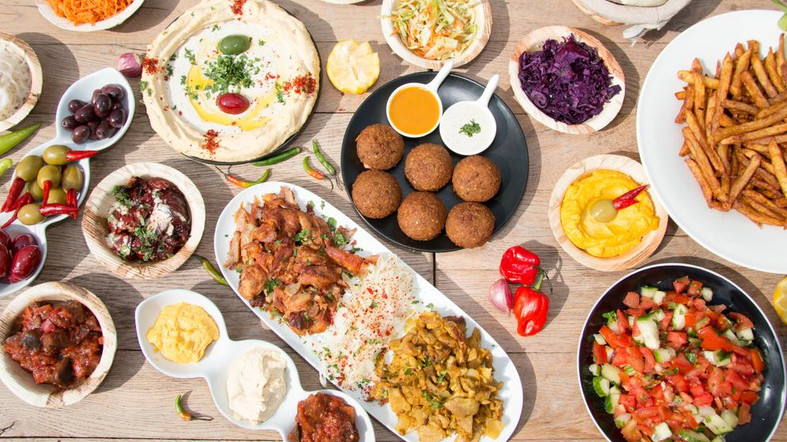
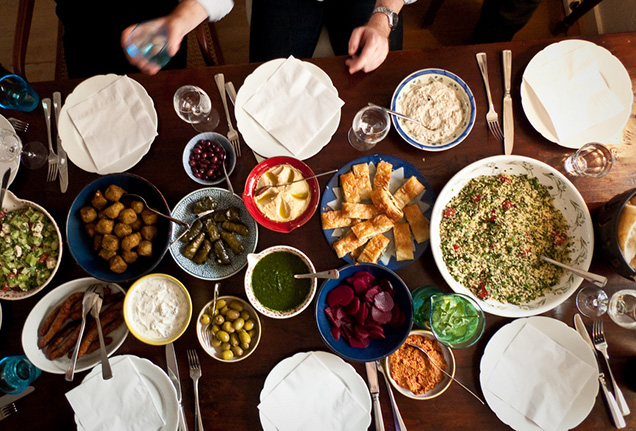
She says she could eat breakfast all day in Lebanon and Syria. She recalls manousheh, a round, chewy bread, sprinkled with zaatar (oregano-sesame spice), oil and cheese. A dessert, knafeh, crispy semolina and cheese can become breakfast when it’s encased in pita and dolloped with apricot jam. She thinks foodies of the world are ready for labneh, thicker and more sour than the popular Greek yogurt.
She says she’s sorry she couldn’t spend more time in Syria as a casual tourist, because the food culture there is unrivaled. She remembers a 2007 trip. “You could not have imagined a less terrorizing country. A lot of the feeling I got there had to do with the food and the people who prepared it. It is some of the most refined in the Arab world, especially in Aleppo. People are extremely particular about ingredients and preparation and won’t eat food out of season. There are a lot of sweet and sour combinations.”
She especially favors muhammara, an intense red pepper paste, walnuts, pomegranate molasses and hot chile.
“Having some language skills gave me the confidence to take these trips in the first place,” says O’Neill, who now calls Queens, New York, home. “Traveling as a middle-aged, white American woman is one of the more fortunate positions to be in across the globe. In the Middle East, it gave me special perks. I was often welcome in traditional men’s zones, just because I was such a novelty. Because people there rarely do anything solo, I think some people just felt a little sorry for me sometimes and treated me extra well.”
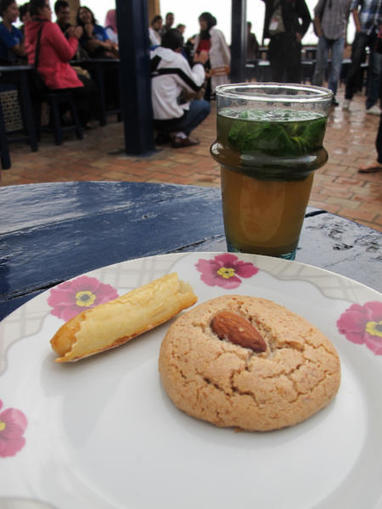
She ended her journey in Morocco because of her parents’ travels there in the 1960s. She credits them and their adventures for her love of Arabic culture. Her name, Zora, honored a Moroccan woman her mother admired for her independence.
“Our house was filled with lots of little things from their trips, including clothing and dishes from Morocco, and a cassette of Arabic music that I listened to over and over when I was really little. All the Morocco stuff sort of primed me to think of Arabic as not that foreign. Just that little exposure to Arab culture as a kid had given me a way in.”
During her five years researching and writing the book, she often found herself invited into the homes of new acquaintances and their extended family, “who invite you in as if you’re an old friend and cook you enough delicious food to put you in a coma. Overall this is a book about everything but politics. I went back to study Arabic again precisely to reconnect with the culture I remembered before. Even if there is some political unrest in a country, daily life goes on. As I learned in Cairo, trouble is extremely localized. Just look at a map and remember that the human ability to maintain normalcy is very strong.”
MUHAMMARA (SYRIAN RED-PEPPER-AND-WALNUT DIP)
This is short work if you have a food processor. Many Syrian cooks would use a mortar and pestle. The average Syrian home cook also uses prepared red pepper paste (Turkish brands are imported to the U.S.; look for those that contain only salt and peppers). It is more convenient than roasting fresh peppers, and more intensely flavored.
Serves 6-8 as an appetizer
2 red bell peppers
1 red jalapeño
ADVERTISEMENT
¾ cup shelled walnuts, chopped fine
½ cup fresh bread crumbs
1 clove garlic, coarsely chopped
1 tablespoon pomegranate molasses
1 tablespoon tahini (optional)
Approximately ½ cup cold water
¼ cup olive oil
½ teaspoon ground cumin
ADVERTISEMENT
1 teaspoon kosher salt
Dried Turkish or Aleppo pepper flakes (optional)
½ teaspoon sugar (optional)
Juice from 2 lemons
Over an open flame, char the red peppers and the jalapeño. Let rest in a covered container, then slip off charred peel and pull out seeds. Chop coarsely and place in the bowl of a food processor.
To the food processor, add the walnuts, bread crumbs, garlic, pomegranate molasses and tahini. Pulse until only a cohesive paste forms; it does not have to be completely smooth.
In a bowl, combine the paste with cold water, stirring energetically, until the texture is soft but not flowing; the amount of water depends on your bread crumbs. Whisk in the olive oil. Then add the cumin, salt and lemon juice, as well as optional sugar and pepper flakes, tasting as you go. You want a mixture that is sweet, spicy and sour, with richness from the walnuts and tahini.
Ideally, let the mixture sit for at least a couple of hours, for the flavors to combine, and taste again before serving. Drizzle with additional pomegranate molasses and serve with toasted thin pita bread.
MOROCCAN LENTILS
This is a staple in Moroccan restaurants and homes, quick and easy and much more flavorful than the simple preparation suggests. You can add more liquid and serve it as a soup, though the traditional way is as a side dish or appetizer, with nice chewy bread. The flavor improves further with a day of sitting.
2 cups brown lentils, rinsed
1 red pepper, coarsely chopped
1 heaping tablespoon tomato paste
3 teaspoons each cumin and sweet (not hot) paprika
2 teaspoons ground ginger
1 teaspoon turmeric
½ teaspoon freshly ground black pepper
2 teaspoons kosher salt
3 cloves garlic, peeled
1 bunch each parsley and cilantro
1/3 cup olive oil
To a heavy-bottomed pot (or a pressure cooker, as Moroccans use), add the lentils, red pepper, tomato paste and spices.
Chop the garlic and herbs together, very fine, and add this to the pot, followed by the olive oil. Finally, add water until to a depth of roughly one inch above the surface of the lentil mixture – just above the first joint in your finger.
Cover the pot, bring to a boil, then turn to low and simmer until tender, stirring occasionally. This can take an hour or so, depending on the lentils; you may want to add more water. (If using a pressure cooker, prepare as you would other lentil recipes; you may need to add additional spices after cooking.)
– recipes by Zora O’Neill
Source: www.abqjournal.com