Advertisement Close

Politics

Turkish Coup and the Arab World

BY: Andrew Hansen/Contributing Writer The Coup Late Friday night, shock swept through the world as the Turkish military attempted to seize power from President Recep Tayyip Erdogan. As media outlets were shut down and people took to the streets, the world watched with anticipation to see how the attempted coup would play out. The conflict … Continued

Clinton Democrats Don’t Know How to Talk About Israel-Palestine, But Neither Does Anyone Else

Skylar Lindsay 

The Moderate Voice 

JERUSALEM — “So welcome, American, to Palestine,” Bashar says as he taps his hand-rolled cigarette into the ash catcher on an unlit hookah. “What do you know about Palestine?”

In the American public that I know, we hear almost any question about Palestine or Israel as intrusively provocative or overly political. The Clinton Democrats’ platform on the subject is predictable and it demonstrates a paralysis: conversation about the Israeli-Palestinian conflict in the American public is stuck or non-existent. We “don’t want to get into it.”

The trouble is, we already are: America has been “into it” by supporting Israel economically since the 1950s and militarily since the 1960s. U.S. military aid to Israel is around US$3 billion per year, totaling US$121 billion since World War II (without adjusting for inflation). “Tax dollars at work” arguments aside, unwavering support for Israel is a basic tenet of mainstream U.S. foreign policy talk.

This isn’t news. But when the American public tries to talk about the conflict, we are heavily influenced, if not stopped outright, by having to confront our implicit support for Israel. Given a pre-assigned role in such a long and deep conflict, we stall out: our government appears to have determined who is “right” among Israelis and Palestinians, or at least who it is geopolitically advantageous to support. This starting point inherently pressures American citizens to either stand with their government by default or be absolutely certain about their own conclusion.

As a result, those in the American public who try to “get into it” begin at what can be a very murky level of analysis: we search doggedly for an objective moral conclusion about the Israeli-Palestinian conflict. We look to ethical measurement as a prerequisite to a just peace process: if only we were to wheel in the scales of justice, it would become clear who is “in the right” (other than the current Israeli government).

This scales-of-justice conversation involves a lot of talk about “proportionality”: the question of whether a retaliation for this or that act of violence was proportional and appropriate.

But why do we try to weigh violence against violence? No one suggests that Israelis and Palestinians might find reconciliation by equalizing levels of brutality. Would the two sides repent their respective wrongdoings and bring the walls tumbling down – architecturally and psychologically speaking – a-la-Joshua at Jericho? Would this ethical balancing make international peace efforts more effective? Maybe if we could just measure things out until “right” and “wrong” materialize, Quartet Reports and the French peace initiative would bring resolution.

This emphasis on proportionality does, however, introduce the power of understanding scale and numbers in Israel-Palestine.

Palestinians and Israelis live under our magnifying glass but we still struggle to have a grounded conversation about what actually happens here. The first step out of hand-wringing inertia is to talk. An obvious topic to talk about is the violence one side committed against the other, even if this is a kind of ethical voyeurism. We find this easy because we can use the “crimes” committed by the Palestinians as a frame of reference to evaluate the morality of “crimes” committed by Israelis, and vice-versa.

A less judgmental and potentially more valuable form of comparison, however, would be to take the who, where and what of the conflict and make them concrete and comprehensible.

First, where: Israel and the occupied Palestinian territories take up an area slightly larger than New Jersey (just over 10,700 square miles). The West Bank is a little smaller than Delaware. Gaza is a close in size to Philadelphia but slightly more densely populated (1.8 million Palestinians live there). We know New Jersey. We can picture two Delaware and Philadelphia-sized pieces inside of it. This is a thin strip of land, much of which is desert.

For a flashpoint in the conflict, the Old City of Jerusalem is tiny. It is similar in size to downtown Hamilton, NY, where I went to college – about one square kilometer. It takes just a few minutes to walk from the Western Wall – literally the westernmost wall of the plaza around Al-Aqsa – to the Church of the Holy Sepulchre – the site of Jesus’ crucifixion and resurrection.

Who: Israel has roughly the same population as New York City (8.5 million people). The number of Arabs in Israel is slightly smaller than the number of African Americans in New York (1.7 million). The population of the West Bank is close to the population of Chicago proper – 2.8 million.

This is a starting place for a conversation in the American public that is currently stalled. And this is a conversation that, amid the election circus, we need to be having. From talking about who and where, let’s move on to the what without appointing ourselves the arbiters of justice. We already know where that leads and we don’t have time. It also might not be our place.

As Bashar, a young Palestinian put it to me, “Nineteen years of this s–t. I am so tired.”

There has to be a way to start a dialogue – not between Israelis and Palestinians, but between American citizens. There has to be, if we hope to help the international community go beyond hand-wringing and finger-shaking. There has to be, if the United States will ever seriously evaluate its relations with Israel.

Source: themoderatevoice.com

Muslim group accuses Republicans of intolerance

Todd Spangler and Kathleen Gray

Detroit Free Press staff


As the Republican National Convention got under way in Cleveland, delegates faced increasing questions Monday about their party’s positions toward Muslims in America and abroad, with a leading Islamic group accusing the GOP of intolerance.

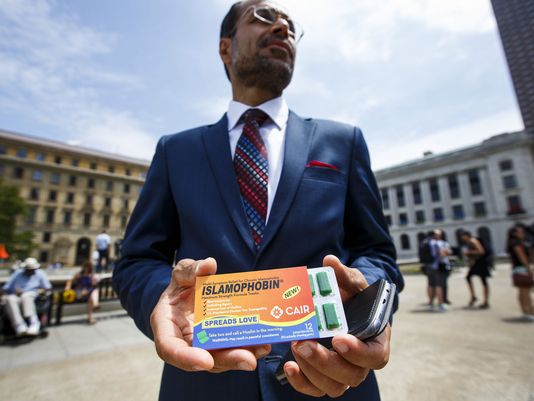
“For too long the Republican Party has been using fear as a political tool to drive a wedge between Islamic Americans and other Americans,” said Nihad Awad, executive director of the Council on American-Islamic Relations, speaking not far from the hall where the convention got under way Monday.

Awad and others with CAIR — which includes a chapter in southeast Michigan, home to one of the largest Arab-American and Muslim communities in the country — called for an end to what they called a “demonizing” of Muslim Americans, saying they want to bring an end to violence and radicalism based on a twisted interpretation of their religion as much as any other Americans.

Calling Islamophobia “a moral sickness and something we must reject together,” Awad called for “equal and fair treatment” of Muslims everywhere, accusing presumptive Republican nominee Donald Trump of emboldening “extreme voices of hatred.”

But even as some leading Republicans — Trump among them — have called for cracking down on immigration from Muslim countries and suggested Islamic communities in the U.S. aren’t doing enough to help law enforcement, other GOP regulars have called for less incendiary positions.

Michigan Attorney General Bill Schuette, for instance, denounced Trump’s comments about immigrants, while U.S. Rep. Fred Upton, R-St. Joseph, condemned Trump’s original proposal to ban Muslims from entering the U.S. saying it didn’t “follow the pattern of who America really is and what we stand for.”

And when the Rev. Dr. Lou Prues of the Jefferson Avenue Presbyterian Church in Detroit delivered the opening prayer at Monday’s breakfast meeting of the state’s Republican delegation in Cleveland, he struck a similar note, asking God to “enlarge our sympathies” toward others and “give us a deeper understanding of those people who dislike us.”

“I love these people,” Prues, a volunteer with the delegation, said after the prayer, referring to other Republicans. “But when I’m asked to pray I’m going to pray universally, globally. I’m not going to get caught up praying against this or that. I’m going to pray for a better understanding of all people.”

“I’m convinced radical anything is a danger,” he added.

Many in the party, meanwhile, have called for taking a hard line with Muslim immigrants and, in some cases, with those already in the U.S. Former House Speaker Newt Gingrich, following last week’s truck attack in Nice, France, suggested Muslims should be tested and deported if they believe in Sharia law — a legal process based on Islam. He later said his remarks had been exaggerated.

The Tennessean reported Monday that an outspoken critic of Islam from the Netherlands — Geert Wilders, founder of the right-wing Party for Freedom — was invited to the Republican National Convention by a Trump delegate, state Sen. Bill Ketron, R-Mufreesboro. Wilders, who has called Islam the “ideology of a retarded culture,” shook hands and took photos with many attendees at a Tennessee delegation meeting on Monday, including U.S. Sen. Bob Corker, who is chairman of the Senate Foreign Relations Committee.

In the Michigan delegation, soon-to-be-replaced national committeeman Dave Agema — no stranger to controversial comments — posted on Facebook last week his sentiments that, “When I hear the news commentators saying they don’t know the motive of the killer in France, I know they are completely ignorant of Islam.” He then says, in the same post, that laws are needed to ensure Sharia law doesn’t get a foothold in Michigan because of the state’s large Muslim community.

CAIR condemned the attack in France, just, as Awad said, “we have condemned previous ISIS or ISIS-inspired atrocities and the deviant ideology that produces such senseless and cowardly violence.” But many delegates, including some in Michigan, trust that Trump and his supporters know what they are doing.

“I totally have faith he is going to work with his advisers and make the right decision. I support everything he is saying,” said Diane Schindlbeck, a Trump delegate from Spring Lake. “We just have to have good policies in place on who is allowed into our country … We need a policy in place and not just let anyone here.”

State Sen. Joe Hune, R-Hamburg Township, a Trump delegate and member of the convention Platform Committee, said: “If you look at Donald Trump’s policy in terms of building the wall (to stop illegal immigration from Mexico) and making certain when you’re coming in the country and you’re not a citizen, there will be additional securities and safeguards, I don’t know how you can argue against that.”

Others weren’t as comfortable with Trump’s position, but said it’s little more than campaign rhetoric.

“I haven’t heard he wants a ban on Muslims; he wants to temporarily restrict things and I think that’s still a policy that I’m not comfortable with,” said state Rep. Ed McBroom, R-Vulcan, a Trump delegate. “He can target certain areas of the world, but it shouldn’t be based on ethnicity or religion.”

“I want to believe that what he is talking about is making sure we’re a lot more cautious about the process, not that we’re restricting anybody based on their religion or ethnicity,” he continued. “He speaks in very broad generalities and ultimately his policy has to get through Congress and meet Supreme Court muster. And a lot of these ideas, if you just take them as exactly the way he says, they won’t get through either of those processes. So it doesn’t really worry me that much because all of those other safeguards and checks and balances are in place.”

Source: www.freep.com

Jordan slams door on Gazans

BY: Enas Fares Ghannem, We Are Not Numbers/Contributing writer “We regret to inform you that your application was not accepted.” —The Jordanian Representative Office This message has been received by almost every Palestinian from Gaza who has applied for what is called a “non-objection” letter from Jordan since last August. Such a letter is required before … Continued

Watch the Conventions!

by James J. Zogby

Arab American Institute 

I grew up watching both parties’ conventions. Television networks covered them from beginning to end. Oftentimes, because the outcome was not assured, there was drama and tension. During the past several decades, conventions have lost their excitement. With the nominees known and the platform decided in advance, the events have become something akin to infomercials for the nominees and the party. As a result, television coverage has been limited to a few hours, or less, each night. And viewership has declined. This year, however, might be different, though maybe not in a good way or, at least in the way party leaders might hope for. This is because there are competing dynamics currently driving and dividing American politics and both will be on display over the next two weeks when Republicans and Democrats gather for their quadrennial conventions in Cleveland and Philadelphia.

In the first place, there is the hyper-partisanship that has created a disturbingly toxic political environment. The parties talk past each other and embarrassingly vitriolic rhetoric, once found only on the margins of our politics, has come to define our everyday political discourse. Add to that the fact that Congress is so paralyzed that many White House appointments remain in limbo and reasonable efforts to pass legislation making needed reforms go nowhere.    

Not only is there a deep division between the parties, but as we witnessed during this past primary season, Republicans and Democrats are fractured within.

With Donald Trump’s victory assured, traditional conservatives have, as one leader recently observed, “lost control” of their party. For this, they have only themselves to blame. During the past eight years, they fed the beasts of xenophobia and hatred of “all things Obama”. The monster they created has turned and has now devoured them.

While some conservatives held out hope for a “dump Trump” movement at the convention, that effort was defeated when the party’s Rules Committee quashed their designs. In one clear sign of Republican division, for the first time in recent history, none of the living former Republican presidents or presidential nominees (the two George Bushs, Bob Dole, John McCain, and Mitt Romney) will be in attendance. Some disgruntled delegates may follow suit and stay away. Who will be there, at this point, is anybody’s guess. And if Trumps’ opponents do go, it is uncertain how they will react. 

It, therefore, remains to be seen how the GOP Convention will unfold. Will it be an orchestrated Donald Trump made for TV variety show? Or will the dissidents still find a way to make their presence felt?   

Even without any disruption inside the convention hall, the scene outside promises to be tense as the many component elements of the social movement harnessed by Trump will square off against their equally aroused and passionate opponents. Cleveland is tense. It is a majority African American city that has had its share of controversial incidents of police violence. Add to that demonstrations sponsored by, among others, anti-immigrant, anti-Muslim, anti-gay, and pro-gun groups (and their opponents) and you have a potentially combustible mix.

The most worrisome news is that because Ohio has an “open carry” policy and provides for licensed individuals to carry concealed weapons–we have an “accident” (or better, a tragedy) waiting to happen. In anticipation of unrest, the city has emptied its jails, moving prisoners to other locations, and there will be a massive deployment of local, state, and federal law enforcement agencies throughout the city.  

Just a few days after Cleveland, Democrats will gather in Philadelphia to formally nominate Hillary Clinton as their candidate for President. With Bernie Sanders’ endorsement of Clinton and his decision not to continue his challenge by introducing minority planks to the party platform, party regulars were relieved—hoping for their own version of a peaceful made for TV convention. But, despite Sanders’ move toward unity, it would be important to note that fissures remain.

The Sanders candidacy was not an ordinary Democratic campaign. It was a social and political movement that brought together liberal Democrats and a number of progressive movement groups and activists with no strong ties to the party. While other candidates lose, endorse, and fade away, neither Sanders nor his followers appear to be interested in following this path.

It is important to note, that these movement activists will be in Philadelphia and will be both inside and outside of the convention. Inside, they will be among Sanders 1,900 delegates and outside, they will be demonstrating in the hundreds of thousands against unfair trade agreements, for universal health care, for racial justice and against police violence, for immigrant rights, and for Palestinian rights. These are the issues that drew activists to Sanders. While he can correctly claim that his campaign had a direct impact on the making the Democratic Party’s platform more progressive, it remains to be seen whether activists will find that sufficient or whether they are willing to follow Sanders in supporting the party’s nominee and believe that she will implement their progressive agenda. And so it is likely that in addition to demonstrations outside the convention, there may be signs of discontent within the hall.

In any case, despite the best efforts of the organizers of both the Cleveland and Philadelphia affairs, the unexpected may occur. Stay tuned.

Source: www.aaiusa.org

Michigan Muslims want a greater turnout in the November election

By STEVE CARMODY

Michigan Radio 


One result of Donald Trump’s call to ban immigrants from Muslim countries dealing with terrorism is a rise in efforts to get more Michigan Muslims registered to vote

 In Cleveland later this morning, a coalition of Muslim groups plan to hold a news conference to “Challenge the GOP’s  ‘Politics of Fear’.”

Concern about growing islamophobia has led to a push to get more Muslim Michiganders to the polls in November. 

Last month, services at mosques in Michigan were crowded with people observing Ramadan.

On the final Friday of Ramadan, as worshippers gathered at a mosque in Canton, they were greeted by volunteers trying to get them registered to vote.

Rabab Qamar helped organize the voter registration drive.    She says speeches by presumptive Republican Presidential nominee Donald Trump talking about banning Muslim immigrants and other Republicans calling for surveillance of mosques has disturbed Muslims. 

“One party has been almost ostracizing Muslims with their rhetoric,” says Qamar, “I think it’s kind of pushed a lot of people from the Muslim community out to vote.”

Traditionally, Arab and Muslim Americans vote in smaller numbers.   There’s a few reasons for this, including the fact that many are recent immigrants.   

But different groups are trying to change that.

Robert McCaw is the government affairs director for the Council on American Islamic Relations, or CAIR.    He says CAIR estimates there’s been a 60% increase in the number of Muslim Americans registered to vote in the United States since 2012.

“Voter registration just didn’t start happening in 2016,” says McCaw. “The community has been putting a lot of resources over the years in increasing our political and civic participation. I think this is just some of the fruits of that labor.”

McCaw says Michigan’s voter rolls have seen the number of Muslim and Arab voters grow to about 55,000. 

Polls show Muslim voters are more likely to vote for Democrats. 

But Michigan Republican Party State Chairwoman Ronna Romney-McDaniel says the GOP has a message she believes can convince Muslims voters to support Republican candidates.  

“Our policies are going to help everyone,” says Romney-McDaniel. “We want people to have jobs. We want Michigan to continue to rise. We don’t to lose the comeback that we’ve just started in this short period of time of Republican leadership since 2010. We want to keep that going.”

Romney-McDaniel, who’s a Trump delegate at this week’s convention in Cleveland, defends the presumptive nominee’s call to block refugees from Islamic countries where terrorism is active. 

While the 2016 presidential campaign is spurring many Muslim Michiganders to get involved, there are some Muslim leaders looking beyond the November election. 

On a sunny day this Spring in Lansing, dozens of people took part in the sixth annual Muslim Day at the state capitol.

Muzammil Ahmed is the chairperson of the Michigan Muslim Community Council. He organized the event where Michigan Muslims share their concerns with state lawmakers. He says many Republican legislators declined to meet with them. 

Ahmed hopes the current political climate will help create an atmosphere where people can have a frank conservation about what it means to be an American.

“We are here not to do it for just the Muslim community,” says Ahmed. “Many people have been feeling maligned and have been feeling isolated because of the environment and rhetoric that’s been out there currently.”

Ironically, Ahmed credits Donald Trump for inspiring many Muslims to register and vote for the first time, if just to vote against him.

Source: michiganradio.org

Tragedy in Nice, Countering New Extremism

By: Eugene Smith/Contributing Writer The Tragedy On Thursday night,  thousands were gathered along the historic Promenade des Anglais in coastal Nice to celebrate Bastille Day, a national holiday symbolic of freedom and French unity.  The fireworks had just ended and the festivities were beginning to calm. Other than a rainstorm on the horizon, it was … Continued

Is Gov. Mike Pence Good or Bad for Arab Americans?

BY: Nisreen Eadeh/Staff Writer Indiana Governor Mike Pence has been in the politics game for nearly 20 years, and was chosen as Donald Trump’s Vice Presidential running mate for the 2016 presidential elections. After unsuccessfully running for Congress in 1988 and 1990, Pence took a 10-year break. Finally, in 2000, Pence was elected to Congress and … Continued

A Response to Egyptian Criticism of American Race Relations

BY: Kristina Perry/Contributing Writer This past week, Egyptian officials released a statement condemning recent police brutality in the United States, and called for an exposure of the hypocrisy of American stances on human rights violations. Egypt has frequently been a subject of criticism from the United States government and international community for their human and civil … Continued

OC Arab American Activist Rida Hamida Invited to Speak at Women of Color DNC Event!

BY GABRIEL SAN ROMAN

OC Weekly

Rida Hamida celebrated the Muslim holiday of Eid last week with exciting and unexpected news. Steve Phillips, author of Brown is the New White: How the Demographic Revolution Created a New American Majority, invited the Palestinian-American activist to speak at a “Democracy in Color” event during the Democratic National Convention. “It didn’t even cross my mind,” Hamida says. “It was so humbling to be invited because I don’t see myself as a national figure, just as a person trying to make a difference in Orange County.”

But those efforts in making OC a better place, both politically and culturally, caught Phillips’ eye before, when he included Hamida’s work in his book and again when extending the invitation to the “Women of Color: Uniting the Party, Leading the Nation” luncheon launch. “We asked her to speak at our convention event so that more people can learn about her work fighting against anti-Muslim and anti-Arab bigotry as well as her efforts to foster multi-racial coalitions,” Phillips tells the Weekly. “Her excellent work identifying and engaging Arab and Muslim voters led me to use her as an example in my book.”

In 2014, Hamida organized communities to volunteer for seven pivotal campaigns in OC during the midterm elections that’d help turn the demographic tide. She assembled twenty people (all women save for her teenage son) after reaching out to local Islamic centers and nonprofits. Hamida asked for Political Data, Inc, (PDI) numbers on Arab and Muslim voter populations. A consultant returned with a staggeringly low number of 525. Knowing that couldn’t be right, she asked to dig into the data and identified a much larger universe of voters, 62,912 to be exact, by looking at Arab and Muslim majority country identifications rather than Arab sounding last names. Hamida put the new data to good use in turning out the vote.

In Phillips’ Brown is the New White bestseller published this year, the author notes how pivotal that work proved to be in Garden Grove’s mayor race where Bao Nguyen squeaked pass incumbent Bruce Broadwater by just 15 votes to become the first Vietnamese person to hold that office, not only in the city, but in any major city across the U.S. “Hamida’s story illustrates the invaluable difference a campaign consultant with cultural competence can make in an election,” Phillips wrote in the book. 

With OC having been majority-minority for more  than a decade now, reports proclaim its elections to be on the cusp of change. “The majority of voters in Orange County together encompass women of color, Latinos, Asian, South Asian, Pacific Islander and Arab American community,” Hamida says. “We use that model to build multi-racial coalitions in turning out the vote and in return win elections.” Hamida herself is the first hijabi in OC to work for public office, serving as a community liaison for Congresswoman Loretta Sanchez. “Muslim-American women are stronger than fear, we do not allow Islamophobes to define or dictate our destiny, we are stronger than that,” she says. 

Hamida’s multi-racial organizing work isn’t limited to electoral politics. In another volunteer effort, she spearheaded OC’s “Adventures of Al-Andalus” which brings Latinos and Muslims together. In tandem with Santa Ana Valley High School teacher Ben Vazquez, Hamida led Latino community members through a food tour of Anaheim’s Little Arabia, a simple act that generated big media buzz in the backdrop of Donald Trump’s bigotry against Muslims and Mexicans. “That created a movement that was bigger than us and spoke to people on a national level,” Hamida says. Al-Andalus isn’t just a cross-cultural undertaking, but a political one as well. “We are going to mobilize communities here on the ground against that hate rhetoric by turning out the vote in November 2016 at a presidential, statewide, congressional, county and city level.” 

While Hamida plans to take the lessons of Al-Andalus to the DNC in Philadelphia, there’s more volunteer initiatives to speak of. During the month of Ramadan, Hamida also organized an Iftar event in Garden Grove where Muslims and the LGBTQ community shared a meal at dusk. For years, the activist has chaired the annual World Refugee Day event in Anaheim, but reached out to OC’s Vietnamese community to make common cause with Syrian refugees during their time of crisis. They held a #Walk4Refugees event at Miles Square Park in Fountain Valley last year to raise funds for Syrians. 

Hamida at work during Little Arabia’s “Shawarma Summit.”
Photo by Gabriel San Roman / OC Weekly
“Rida’s proving to many that balancing domestic issues and global affairs is not only possible but a must for any U.S. Government leader,” says Suzanne Meriden, National Operations Director for the Syrian American Council. “I want to be at that DNC luncheon to witness what I know is the first in a series of triumphs not only for Rida but for Arab-American Muslim women in general.”

The relentlessness of Hamida’s work doesn’t go unnoticed by her fellow sisters in the struggle. “I met Rida throughout working in Orange County with my previous employer AFSCME International,” Karla Salazar, a Democratic Party and labor activist, says. The two women plan on working together in the future, but for now Salazar is excited that her friend and colleague is going to the DNC. “As women of color, we don’t get that attention. I’m happy that Rida is going to have that opportunity to share her experience of working across cultural, religious and community lines.” 

Hamida is humbled by the all-expenses paid invitation to speak at DNC women of color luncheon event, where she’ll join former Nevada state legislator Lucy Flores, Georgia House Minority Leader Stacy Adams and San Francisco supervisor Jane Kim. “I’m taking Orange County with me to Philadelphia,” Hamida says with a smile. “We are going to have one voice in this movement when I come back.” 

Source: www.ocweekly.com

1,530 Results (Page 88 of 128)