
Subscribe
to receive news by email

Poll
Will the Trump Administration Shift U.S. Policy in Favor of Palestine?
- No (86%)
- Yes (14%)
 Loading ...
Copyright © 2026 Arab America
Go topEvicted Bodies, Lost Spaces: Rethinking Women’s Role During Interwar Algeria
By Mitzi Tapang / Arab America Contributing Writer
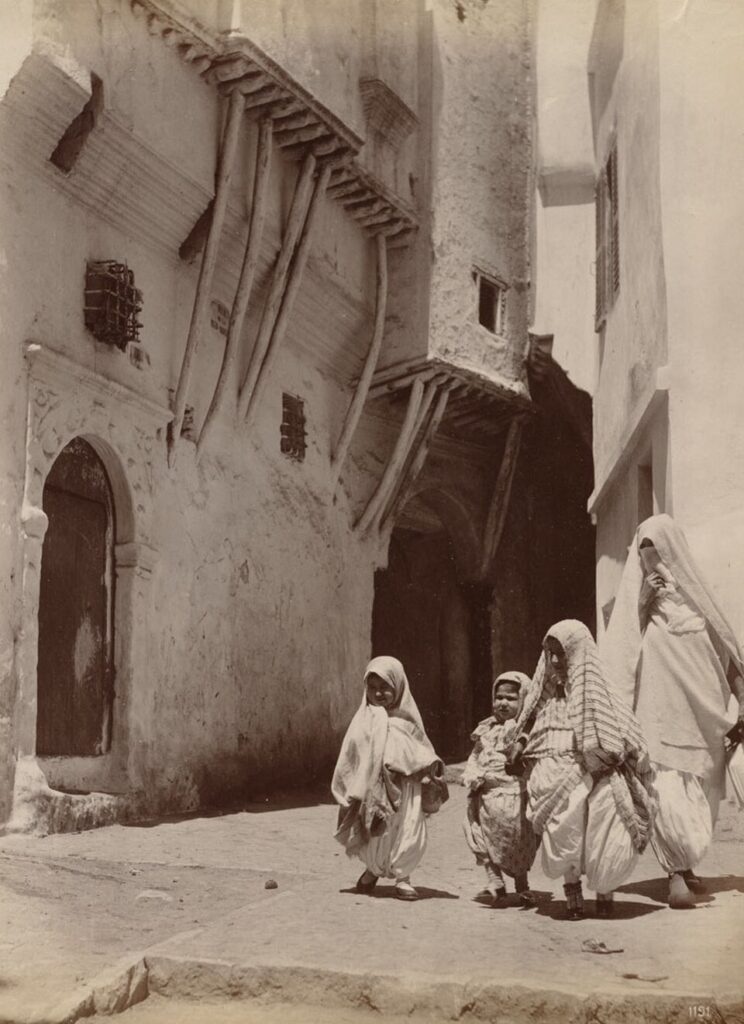
Colonial imagination, more than an ideology, is also a play on the desires of the foreign eye; one that sees an interior space and turns into a scene of aesthetic enclosure, with actors suspended in stillness, all but a “free image,” richly adorned yet spatially contained. It is a wandering eye that narrows its gaze into a strip of land in a distinctly colonial lens and realizes its potential to become “a cult—” precisely, “of the exotic.”
The “Pioneers”
This eye, imagined all-consuming, prepossessingly marked French Romantic painter Eugène Delacroix’s pioneering image of the Women of Algiers in Their Apartment. Painted after his 1832 trip to North Africa, the work occupies a central place in North African colonial history and beyond, as it helped establish the visual grammar through which the continent would be imagined and confined in European cultures. Composed as an image of deceptive intimacy, the viewer is implicated to feel both invited in and kept out, as if granted access to a hidden chamber whose seclusion legitimizes the claim to exoticize its inhabitants. The eponymous women, as are those outside the painting’s frame but are within its landscape, are arranged as figures of contemplation, their garments and surroundings, even so much as the sway of their hips, made to signify something in this enclosure.
Likewise, in 1858, the English schoolteacher Barbara Leigh Smith Bodichon published a guidebook to Algeria, noting the place as “a winter residence for the English.” Often recognized as one of the early women to push for feminist travel narratives, she presents the figure of the modern heroine “Madame Luce,” the French schoolteacher whose role was tied to the so-called civilizing mission. The mission, far from benevolence, was deeply concerned with remaking Algerian society through the attempted erasure of Algerian Moorish women, who were seen as themselves needing to be “civilized.”
Gender, in this context, never stands the chance of being understood in lone terms. Not when it is braided with an authority whose gaze depends on the idea that women’s emancipation can be spoken of while the structures that produce that same domination remain intact. In such an enclosure, in this invented space, women are all but self-defining—metaphorically visible and present.
Colonial Algeria
The French occupation of Algeria began in 1830 through military conquest followed by civil administration. A major force behind the growth of the settler population was the colonial desire to assimilate Algerians into French cultural and political life, a process that was presented as a civilizing project. In practice, this meant that education became one of the main tools of pacification and domination. Like a placeholder, women were placed at the center of this process, the supposed key for intervention.
In most of the panegyric texts of the colonial times, the certain Madame Luce, as in English philanthropist Véronique Eugénie Allix-Luce arrived in Algeria “in hopes of finding a better life,” only to encounter what she describes as a suffering population marked by “misery, ignorance… drunkenness” of her “new homeland,” which she believed she could address through “courageous perseverance.”
More importantly, it was in such stories, brought about by transnational interests and adamantly invested women with great symbolic significance. They were imagined as the way to narrow the distance between the conquered and the conquering race, rendering them the substitute to the colonial fantasy of transformation “virtue of assimilation.” In December of 1845, Allix-Luce opened a school for Muslim girls, an act that was reportedly met with great indignation from the Muslim population.
As a matter of automatic response, by 1848, surveys suggested that bilingual Arab-French schools could provide native students with an education that preserved Arab culture while also teaching French, thereby preparing them for said assimilative practice. Count Guyot, then Director of the Interior and Public Works, supported this vision since he believed that women had a role in “moralizing” the population. Governor-General Thomas Robert Bugeaud similarly claimed that the “degree of misery among native women” justified efforts to “pull them from their misery.”
Interwar Algeria
By 1954, only 4.5% of Algerian women were literate, and most had little access to formal employment except in low-status sectors that did not require professional training. Those who possessed skills that might have opened the door to public life usually acquired them informally, through necessity and experience, as part of the labor of survival. Even institutions that represented colonial modernity remained deeply exclusionary. The University of Algiers, founded in 1909 by the French colonial administration, consisted of no more than 500 Algerian students, and only 50 of them girls.
When war broke out between France and Algeria in 1954, women’s political participation, however, was more than impossible to ignore. Among the almost 11,000 Algerian women reported to have fought for the liberation of their country, 3% were taking part in active combat. Even so, the women officially counted as militants represented only the visible core of a much wider network of participation. Historian and former Algerian mujahida (woman fighter) Daniele Djamila Amrane-Minne emphasized that women’s wartime activities were “many and varied,” and that others, with the aid of female neighbors, played the crucial role of sheltering and receiving resistance fighters.
As urban arrest became increasingly likely, urban educated women moved into the mountains, “where they taught others about colonial rule and the independence struggle.” Women who were captured were not spared by the French military or police repression. Among the remembered figures of resistance was Hassiba Ben Bouali, whose presence would later be invoked again in 1992, within a different political context, in a different spatial language—in the recourse of street politics.
Dominoes of History
In January 1992, posters with Hassiba Ben Bouali appeared across Algiers and other major urban centers, citing the promise “Hassiba Ben Bouali, We Will Not Betray You.” The protest, led by Algerian feminists, was directed against the Islamic Salvation Front (FIS), following their victory in the national elections of 1991. At its root was the targeting of women by Islamist militants for not veiling, for working, or simply for appearing in public spaces.
Nearly thirty years later, in February 2019, the Hirak movement brought Algerians into the streets every Friday to express dissatisfaction with the country’s sociopolitical condition. Women’s participation in this movement carried demands that extended beyond opposition to the regime, as they themselves are in disparage with patriarchal norms and values in Algerian society. As a result, many male protestors resisted the enfolding of women’s rights, believing they were “dividing and depoliticizing the movement.”
Within organized spaces, women’s presence, historically understood as a negotiation of the private and public spheres of participation, may be understood as inhabiting a political non-space. In this being that challenges the either/or of civilization, the constant fatigue in spaces that women occupy encounters the chaos that no “virtue of assimilation” can concile; so that in this being, the “woman question” of Algeria becomes the all-encompassing “Algerian question.”
Want more articles like this? Sign up for our e-newsletter!
Check out our blog here!