

Subscribe
to receive news by email

Poll
Will the Trump Administration Shift U.S. Policy in Favor of Palestine?
- No (86%)
- Yes (14%)
 Loading ...
Copyright © 2026 Arab America
Go topForgotten Arab Mining Towns of the American West
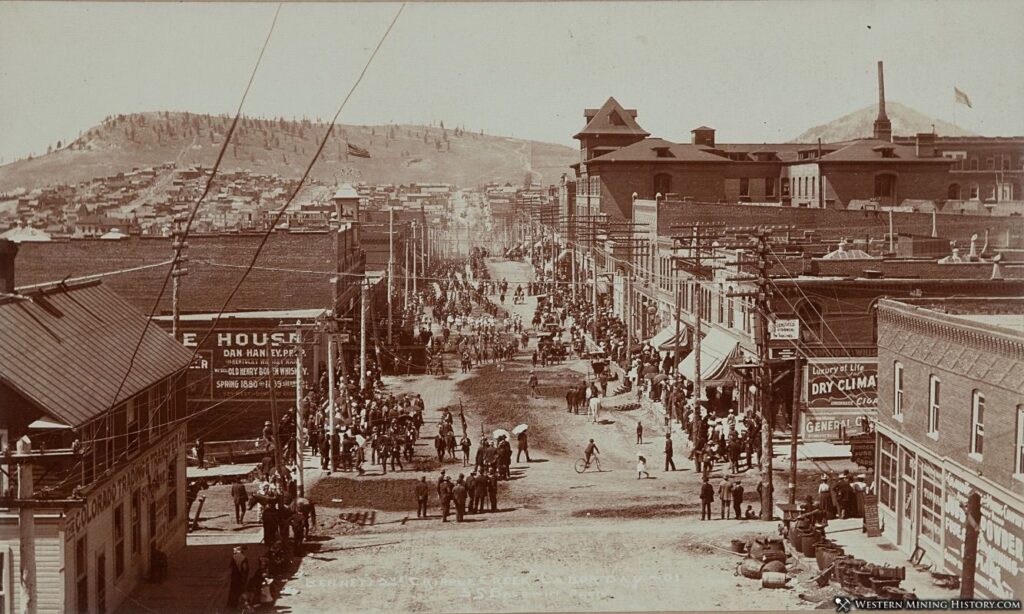
Photo Credit: High Resolution Scan by Western Mining History, public domain
By Shayla Frank / Arab America Contributing Writer
Drive northwest out of Walsenburg, Colorado, into the upper Huerfano Valley, and you pass through a place called Farisita. In 1869 the Montoya family raised the adobe building that anchors the site, and Asperidon Faris, who had come from Syria with his wife, Louise John, bought it in 1908 and ran a store and a post office out of it. What makes Farisita unique is when Faris died in 1923, mourners heard the service in English, Spanish, and Arabic. Even now, family descendants are buried in the cemetery, some as recently as 2010.
When you look at old text books from Colorado, hardly any talk about the Arabs who made these cities. State maps of the area and digital records regularly confuse Farisita with Farista, a second Huerfano County place name drawn from the same family’s Faris Land and Cattle Co.
Two doors
The West was no stranger to visitors, and Arabs made their way into the boom in two ways. Some walked in the shafts with the same hopes as many other miners; others were led out to the road to build something different.
To understand Arabs in the early West, many need to understand their classification at the time. Nearly everyone was recorded as Syrian, because Greater Syria under the Ottomans took in what are now Lebanon, Syria, Jordan, and Palestine, and American clerks used the single label for all of it. Thus, families who thought of themselves as Lebanese appear in the ledgers as Syrians, and in the earliest years as Turks. The Faris family of Huerfano County turns up both ways in the record, which is part of why they are so hard to find.
The first Syro-Lebanese immigrant on record in Utah, Brahim Howa, reached Carbon County around 1896 as a peddler carrying carpets and jewelry. His luck was short in mining and farming but later ended up as a successful businessman who brought his three brothers and sister to work alongside him. In Salt Lake City, Lebanese families settled beside Greek Town and peddled jewelry, lace, linens, and bedspreads across the state, while the same households drew wages at the Bingham Copper Mine and the Utah Fire Clay Company.
Syrian mine workers were on the Bingham Canyon payroll in 1912, when 5,000 men, some 4,000 of them foreign-born, walked out against the Utah Copper Company. Bob Rossi, a retired union organizer who has documented Syrian and Lebanese families in the Colorado coalfields since the 1980s, argues that Bingham and the Lawrence textile strike that same year shaped a working-class Syrian identity in America.
Not only this, but Rossi also found little evidence that any of them stayed underground long.
The man who got there first
Long before many Arabs entered coalfields, the West had already buried its first Arab prospector. Hadji Ali was born around 1828 in Smyrna, to a Syrian father and a Greek mother, and he landed at Indianola, Texas, in 1856 as lead camel driver for the U.S. Army’s experiment in desert transport. Soldiers turned his name into Hi Jolly. When Congress lost interest in the camels, he stayed on, working as a prospector, desert guide, freight hauler, and courier for the mail route known as the Jackass Mail. In Tucson in 1880, Ali married and naturalized under the name Philip Tedro, and died at Quartzsite in December 1902, poor and separated from his family.
A stone pyramid topped with a copper camel, now on the National Register of Historic Places, stands over his grave, and it is the most visited site in Quartzsite. Visitors come for the camels.
Against the company store
Across Walsenburg, Trinidad, and Aguilar, Rossi found that most Syrian men who worked underground used their wages as a way to get out. They opened markets and taverns and bakeries, moved into sheep and cattle ranching, kept books, tended bar. Around them grew a peddling economy that served the camps directly, so that mine workers across Las Animas County bought their work clothing off Syrian packs, and stores in Segundo stocked goods for miners and their families.
Joseph Sawaya got his start in Trinidad carrying bags of groceries up to the mines, and in 1912 he opened a wholesale grocery house that serves southern Colorado to this day. The founders of Hadad’s Home Furnishings started out as peddlers in Segundo in the 1910s, and as late as the 1990s the family spoke of what they owed the miners who had bought from them.
This pattern exists in eastern coalfields as well. West Virginia’s state encyclopedia notes that Lebanese and Syrians there almost never worked in the mines and that men and women both carried fabric and household goods on foot through remote mineral country. These same families often prospered as they introduced retail competition into regions where coal and timber companies had monopolized through their own stores. The Arab contribution to the mining West was not muscle in the shaft but leverage against the company store.
The Cost of Acceptance
However, finding acceptance in the growing west did not come all at once. The Habib family settled in Walsenburg around 1920 and ran a grocery that carried baccalà, the dried salt cod common to nearly every nationality in town, which was a small piece of commercial diplomacy. At home they held on to their culture by listening to Arabic music, eating Syrian food, and taking the Arabic newspapers that the postman referred to as Mr. Habib’s saxophone music. When his son planned to marry an Anglo-German woman, members of the local Masonic lodge tried to stop the wedding, using a racial slurs against the couple’s daughter, Joyce Habib Ballotti. Ballotti grew up so far inside the household’s Arabic that she married without knowing the English words for the spices she cooked with.
The visual record was policed as well. In 1906 Walsenburg passed an ordinance restricting itinerant photographers, a law still on the books, and Rossi reads it as an attempt to make the work of Syrian photographers harder. Whatever the intent, the effect can be measured, because photographs taken by Syrians in these towns are hard to find now.
Twice in 1914 a South Carolina district court denied George Dow naturalization, reasoning that a Syrian was Asiatic and therefore not a free white person under the 1790 statute. The Fourth Circuit reversed in 1915 and held that Syrians counted as white persons, but until that ruling the families running stores in Walsenburg and working the pits at Bingham held a status the courts had not settled.
The shape of the silence
Butte, Montana, drew Lebanese immigrants who settled along East Galena and East Mercury Streets, clustering their houses the way they had at home, and almost nothing has been written about them. The Wyoming coalfields at Rock Springs, Hanna, and Kemmerer yield nothing Arab-specific at all, and neither does Nevada’s second mining boom at Tonopah and Goldfield.
When 172 men died at Castle Gate, Utah, in March 1924, the dead were counted by nationality. Greeks and Italians and Japanese and English and Austrians and Scots, one Belgian, 76 Americans. No Syrians.
Some of that absence is real, since Syrians were never numerous in the pits, and the mass migration out of Ottoman Syria did not gather force until the 1880s, decades after California in 1849 and the Comstock in 1859.
Historian Sarah Gualtieri argues that the archives themselves bent Arab American history eastward. The repositories sit in New York and Washington, and Ellis Island exerts a pull of its own, functioning as monument and museum and heritage industry at once, so that the field it produces leans toward the East Coast and toward tidy stories of immigrant success. Syrians, she writes, are woven through the western United States, in communities scattered from the border towns of the Imperial Valley to the suburbs above Los Angeles.
The route west often skipped New York entirely. Rossi documented a Walsenburg grandfather whose journey from Lebanon to Brazil, then through Mexico and New Mexico into Colorado, took 12 years, and Utah families came in through Mexico by design, to avoid the ordeal of inspection at Ellis Island. Gualtieri’s naturalization records trace the same corridor, Syria to Mexico to El Paso and onward to California. A history assembled from Ellis Island manifests will never locate these people, because they took some trouble not to be there.
Rossi’s files remain the only sustained documentation these families have. A retired union organizer built the archive that no history department did, which is itself a fact about how the West gets remembered.
What remains
By the 1920s and 1930s the coal camps were emptying. Blue-collar populations fell, families moved on or drifted between the mining country and the farms, and the towns began a long contraction that has not stopped since. Against that, Rossi found young people from Syrian families finishing university and coming back to Las Animas and Huerfano counties to take over the family store or the family ranch, and many of them kept their Arabic surnames while they did it.
Farisita’s post office closed for good in 1934, and the Faris family stayed on at Montoya Ranch until 1943. The cemetery remains, and the name is still on the map, which is more than most of these places managed to leave behind.