
Subscribe
to receive news by email

Poll
Will the Trump Administration Shift U.S. Policy in Favor of Palestine?
- No (86%)
- Yes (14%)
 Loading ...
Copyright © 2026 Arab America
Go topPublic Health Crisis on Women in Gaza
By: Nadia Boughanmi / Contributing Arab America Writer
1 million, the amount of women that are lacking food resources in Gaza. 250,000: the amount of women who need nutritional support, particularly pregnant women and breastfeeding mothers whose nutritional support is crucial for their safety and the safety of their babies. These women are deprived of clean and accessible water, food, sanitation and medical attention which all factor into a violation of the right to health. The World Health Organization also sees health as a fundamental human right, something all beings should have, yet that is being stripped from the women in Gaza. Palestine has been left to catastrophic destruction of the health infrastructures, leaving medical care scarce for the people.
Context on Gaza
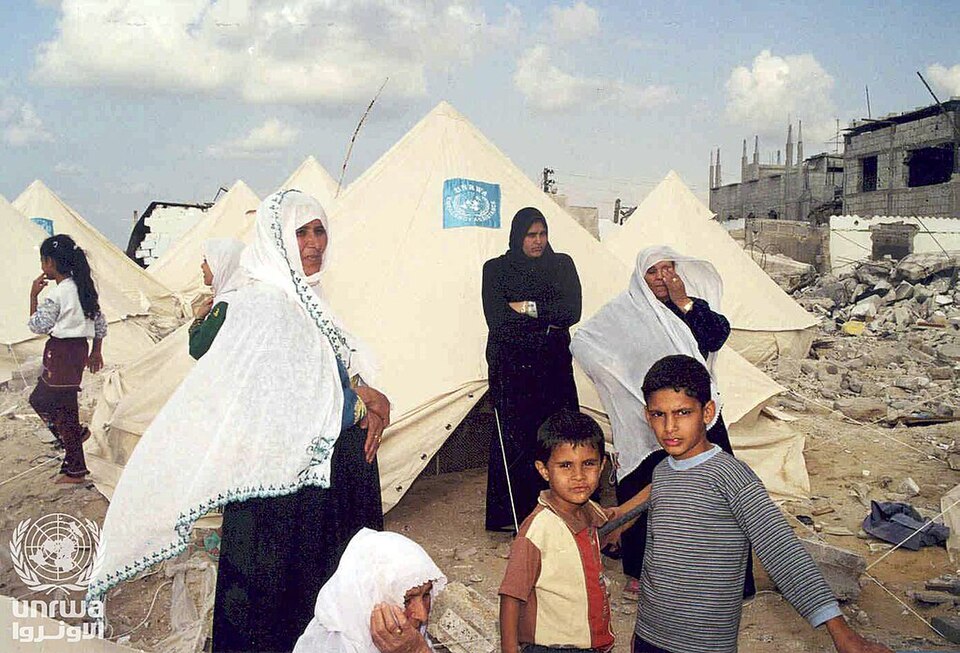
Gaza is currently considered catastrophic by the United Nations pertaining to its health system. It is currently facing an “on-going war” with Israel, that the UN has more recently labeled as a genocide. The genocide has been occurring since October 7th 2023. Israel has launched military advances on Gaza which has led the medical infrastructure to be severely harmed. Gaza has been effectively destroyed in the past 2 years being unlivable for civilians. Entire infrastructures disappeared leaving little aid, food and water for the civilians. Israel’s blockades have also made it nearly impossible to keep imports and exports flowing into Gaza in order to rebuild communities.
Medical infrastructures have been collapsing, with hospitals being bombed and destroyed. Only 16 of the 36 previous hospitals currently remain in Gaza. Due to the shortage of hospitals, the few left are overwhelmed and operating above their usual threshold. Al-Shifa has been operating at 250% capacity and Nasser with 180% capacity. Another major hospital Al-Ahil has been operating at 300% capacity. The medical system is extremely overcrowded with hundreds coming through to be treated for war wounds.
The system is also collapsing due to the shortage of water and the lack of clean water. The health system runs majorly on water due to it being a basic need for people’s bodies and also the key for sanitization. Israel has cut water lines, with over 80% of water facilities in Gaza being damaged. Without access to these water pipes, there is very little clean water to be used for sanitization and as nourishment. Aid trucks carrying food and water have been denied access into Gaza due to Israel’s strict regulations, leaving resources at the border. Food sources are very limited with people resorting to eating sand to fill their stomachs.
Public Health Crisis on Women in Gaza
The right to health, which is contributed by the right to water, are basic human rights, and human rights are women’s rights. Gaza is 49.3% women, which is nearly half the population. On paper, the right to health and water exists greatly, but in Gaza, this isn’t the reality for women who lack proper sanitation, nutrition and dignity.
1 million women total in the state are lacking food resources. 250,000 women are in great need of nutritional support and lack the proper food resources to keep themselves healthy. There has also been mass starvation done by the Israeli government due to the restrictions on food aid trucks entering the region leading to malnutrition in women, young girls and babies. Pregnant and nursing mothers are amongst the top struggling with malnutrition because it harms both them and the fetus or baby. Without proper nutrition pregnant women cannot carry a healthy pregnancy, leading to illness, miscarriages and health risks with the fetus. Young girls are not getting the proper nutrition they need to grow, with children dying from famine.
Medical infrastructures are extremely overcrowded and lacking, so there isn’t enough care for women to get the pre and post-natal care they need. Due to a lack of check-ups, there are greater risks for the pregnancy. They are giving birth in active war zones that are extremely unsafe for themselves and their babies. Oftentimes victims of war and children are prioritized with the limited care available, so pregnant women get their consistent need for care neglected.
This health crisis impacts women greatly because of the different biological processes they go through compared to men such as menstruation. Not having water to clean oneself during menstruation and lack of feminine hygiene products can lead to infections of the vaginal and uterus regions, with little medical access to treat said infections. Menstruation can also be affected by lack of nutrition. With poor nutrition, women can lose their period or have irregular cycles, which can lead to future fertility issues and complications.
Want more articles like this? Sign up for our e-newsletter!
Check our blog here!
Works Cited
Transnational advocacy networks in international and regional politics*, https://courses.washington.edu/pbaf531/KeckSikkink.pdf. Accessed 19 April 2026.
AA. “UNRWA says aid warehouses in Egypt, Jordan ready to send 6,000 trucks to Gaza.” AA, https://www.aa.com.tr/en/middle-east/unrwa-says-aid-warehouses-in-egypt-jordan-ready-to-send-6-000-trucks-to-gaza-/3673578.
“Conflict in Israel and the occupied Palestinian territory and region.” World Health Organization (WHO), https://www.who.int/emergencies/situations/conflict-in-Israel-and-oPt. Accessed 19 April 2026.
CSIS. “Starvation Crimes and International Law: A New Era.” CSIS, https://www.csis.org/analysis/starvation-crimes-and-international-law-new-era#:~:text=Article%2054%2C%20Paragraph%202%20of,as%20a%20method%20of%20warfare.
Douthat, Ross. “Charlotte Bunch Interview: “Women’s Rights are Human Rights.”” YouTube, 12 December 2023, https://www.youtube.com/watch?v=rYlL67yq7vw. Accessed 19 April 2026.
France 24 English. “We are eating sand instead of bread,” says 12-year-old Palestinian boy amid starvation.” https://www.google.com/url?sa=t&source=web&rct=j&opi=89978449&url=https://www.youtube.com/watch%3Fv%3DvE7sA773Sdc&ved=2ahUKEwj1z_WL5fqTAxXYFlkFHcDGAccQtwJ6BAgZEAI&usg=AOvVaw3gi4XEDn0f23SM_9PCifKG.
Harb, Ali. “How Israel destroyed Gaza’s health system ‘deliberately and methodically.’” Al Jazeera, 4 February 2026, https://www.aljazeera.com/news/2026/2/4/how-israel-destroyed-gazas-health-system-deliberately-and-methodically. Accessed 19 April 2026.
“Health system at breaking point as hostilities further intensify in Gaza, WHO warns.” World Health Organization (WHO), 22 May 2025, https://www.who.int/news/item/22-05-2025-health-system-at-breaking-point-as-hostilities-further-intensify–who-warns. Accessed 19 April 2026.
“International Covenant on Economic, Social and Cultural Rights – Manual for Human Rights Education with Young people.” The Council of Europe, https://www.coe.int/en/web/compass/international-covenant-on-economic-social-and-cultural-rights. Accessed 19 April 2026.
Relief Web. “Gender alert: The gendered impact of the crisis in Gaza.” relief web, https://reliefweb.int/report/occupied-palestinian-territory/gender-alert-gendered-impact-crisis-gaza-enar#:~:text=With%20acute%20food%20insecurity%20at,for%20themselves%20and%20their%20babies.
““Thirst as a weapon”: UN experts condemn Israel’s deliberate dehydration and starvation of the Palestinian people.” ohchr, 29 July 2025, https://www.ohchr.org/en/press-releases/2025/07/thirst-weapon-un-experts-condemn-israels-deliberate-dehydration-and. Accessed 19 April 2026.
United Nations. “https://www.un.org/sexualviolenceinconflict/wp-content/uploads/2024/09/gender-alert-gaza-a-war-on-womens-health/gender-alert-gaza-a-war-on-womens-health-en.pdf.” UN Women’s Org.
United Nations Women. “Women in Gaza: What they need now as the ceasefire holds.” UN Women Org, https://www.un.org/sexualviolenceinconflict/wp-content/uploads/2024/09/gender-alert-gaza-a-war-on-womens-health/gender-alert-gaza-a-war-on-womens-health-en.pdf.
WHO Foundation. “Families in Gaza face unimaginable suffering, worsened by recent major funding cuts.” WHO Foundation, https://www.who.foundation/campaigns/gaza#:~:text=%E2%80%8DEvery%20moment%20matters%2C%20and%20every,children%2C%20reach%20safety%20and%20care.