

Subscribe
to receive news by email

Poll
Will the Trump Administration Shift U.S. Policy in Favor of Palestine?
- No (87%)
- Yes (13%)
 Loading ...
Copyright © 2026 Arab America
Go topHistory In Ink: The Arabic Document That Confirms a Nubian King
By: Claire Keefe/ Arab America Contributing Writer
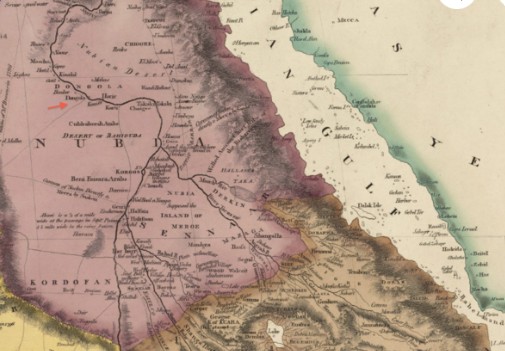
A small slab discarded centuries ago has been identified as bearing the name of a historically verifiable ruler. This is the first archaeological document that provides proof of the existence of King Qashqash, which has been debated for years. He was a part of a Nubian monarchy that showed power during a transitional period in Sudan’s pre-colonial history.
Big Step from Literary Legend to Truth
Old Dongola, located in modern-day Northern Sudan, faced a long period of poor documentation following the 14th century. This period is known for its time of gradual Islamization, when Arabic began replacing common written traditions. While it has been studied for years, it has not been until recently that archaeological records of Islamic heritage have been evident. Still, very little is known about the progressive period of Arabization and Islamization.
The finding of the Qashqash slab helps fill major gaps about the governance and leadership that were once completely unknown.
The Discovery
The document was excavated within Dongola’s citadel, a structure regionally associated with the presence of the mekk, or minor king. These were carried out under the UMMA project, which found numerous artifacts, suggesting the residence of the elite at the time: textiles of silk, leather footwear, a gold ring, and a dagger handle carved from ivory or rhino horn. Among those, about 20 Arabic papers were discovered, and the order was catalogued as Dongola inv. 1990. The most notable find was the text explicitly stating “From King Qashqash,” and is addressed to a subordinate named Khiḍr. The context of the text helps scholars establish a more stable timeline from this period of history. Based on this discovery, studies indicate that Qashqash most likely ruled during the late sixteenth or early seventeenth century, marking him as one of the first securely documented Dongola rulers.
The text reveals numerous details exchange of livestock and textiles, rather than historical facts like military triumphs. According to the source, “The king instructs Khiḍr to collect goods described as ʾRDWYĀT—likely a type of textile—deliver a ewe and her offspring, and transfer cotton cloth or possibly cotton headwear to another individual. The order concludes with a brief greeting and identifies the royal scribe, Ḥamad.”
Rather than a monarch striving for territorial power and involved in wars, the texts suggest that Qashqash appears as a king at work, taking care of trade networks and maintaining social networks.
Links to Arabization
The language featured in the document provides rare insight into cultural evolutions in Dongola. While the text was written in Arabic, there were patterns of grammatical irregularities and improper pronoun usage. These details indicate that Arabic became the primary written language, but was in the process of transitioning. The document ultimately captures political authority, as well as linguistic evolution.
Ultimately, the Arabic document from Dongola demonstrates how a small note can reshape historical narrative.
Want more articles like this? Sign up for our e-newsletter!
Check out our blog here!