
Subscribe
to receive news by email
Poll
Will the Trump Administration Shift U.S. Policy in Favor of Palestine?
- No (87%)
- Yes (13%)
 Loading ...
Copyright © 2026 Arab America
Go topIn a Time of War, NUSACC’s Iftar Promotes Compassion and Healing
Private Sector Leaders and Senior Government Officials –
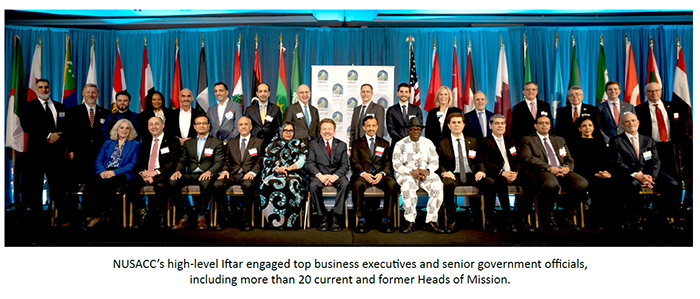
Including More Than 20 Current and Former Heads of Mission – “Break Bread” in the Spirit of Ramadan
Imam Naghavi: “Fasting, silence, remembrance, and mindfulness – practices that we refer to as Muhasaba, or self-accountability – enable us to manage compulsions and achieve greater clarity in our lives.”
NUSACC’s President & CEO Draws Lessons for Today from
Iraq in the Golden Age of Islamic Science (750 – 1258 CE)
In recent days, the National U.S. – Arab Chamber of Commerce (NUSACC) – America’s #1 business gateway to the Middle East and North Africa (MENA) – hosted its fifteenth annual Iftar dinner in honor of the Arab diplomatic missions in the United States. With war raging in the Middle East, the thoughtful gathering revolved around reflection and solace.
(A short video highlighting the 2026 Iftar may be found here.)
This high-level event engaged top business executives and senior government officials, including more than 20 current and former Heads of Mission. For the first time, NUSACC also included Ambassadors to the United States who are representing Muslim-majority nations.
The NUSACC Iftar, in partnership with the Ritz-Carlton Hotel, has become a Washington tradition over the past 15 years. Back in 2012, it was the first Iftar of its kind, and it continues to be recognized as the most elegant Iftar in America.
Thank You to NUSACC’s Generous Sponsors
This special event would not be possible without the generous support of NUSACC’s sponsors. This year’s Lead Sponsor was Al Watania Holding, one of Iraq’s most successful companies, and the Legal Partner was Reed Smith LLP, with more than 1,600 lawyers in 30 offices around the globe.
Government sponsors included the Embassy of the Kingdom of Bahrain, the Embassy of the United Arab Emirates, and the Secretariat of the Gulf Cooperation Council (GCC).
“Blue-chip” companies serving as sponsors this year included Boeing, Citibank, Ford Motor Company, General Atomics Aeronautical Systems, and Kuwait Finance House.
Medium-sized enterprises represent the lifeblood of NUSACC, and Gold Sponsors this year included: Abaris Capital, the American University of Iraq – Baghdad, Assured Communications Advisors, Comet International Corporation, Dhaman (the Arab Investment and Export Credit Guarantee Corporation), Fintech Transactions, Leo A. Daly, and Sahouri Insurance.
Additional sponsors included Heartland-based companies that certify high-quality Halal products for international markets: Halal Transactions of Omaha, IFANCA (Islamic Food and Nutrition Council of America), and Islamic Services of America.
Ramadan in a Time of War
In his welcoming remarks, David Hamod, NUSACC’s President & CEO, stated, “Tonight, our nation is at war. Our prayers go out to the families who are affected by this war: Families here at home, and families in the Middle East region – including the families of NUSACC team members.”
NUSACC, as a Chamber that works to build bridges across cultures and regions, generally eschews politics. The Chamber’s annual Iftar, while grounded in tradition and community, is also a call to conscience in the name of peace. In that spirit, Hamod called for a moment of silence for the innocent victims of this war and their families.
He went on to say, “NUSACC thought long and hard about whether tonight’s Iftar should go forward. In the end, in the spirit of Ramadan, we made the decision to proceed. Ramadan is a time of compassion and healing, and my sense is that we are going to need a lot of both in the challenging days ahead.”
Breaking the fast (Iftar) during Ramadan is a traditional event performed daily by the estimated two billion Muslims around the globe. Ramadan is a holy month of spiritual cleansing in which adherents of Islam rededicate themselves to God, worship, and reading the Quran, Islam’s holiest book. The month-long period is marked by fasting, personal sacrifice, self-discipline, and increased generosity, especially toward the underprivileged.
NUSACC’s Iftar – which attracts people from all walks of life – provides an opportunity to gain a better understanding of Arab and Islamic customs and traditions. The event also highlights Arab embassies and consulates in the United States, which are dedicated to promoting political and commercial relations with the USA.
Imam Rasoul Naghavi on Managing the Compulsive Self
Dr. Sheikh Rasoul Naghavi, affiliated with Georgetown University, is a peacebuilder and conflict-resolution specialist who serves as an Imam in the Washington DC area. In his comments at the NUSACC Iftar, he highlighted the challenges of “The Compulsive Self” (Surah Yusuf in the Holy Quran).
“This concept refers to the aspect of the inner self that inclines toward haste, reaction, and instant gratification,” he said. “These impulses can cloud our perception if left unaddressed.”
During the Holy Month of Ramadan, he noted, “Fasting, silence, remembrance, and mindfulness – practices that we refer to as Muhasaba, or self-accountability – enable us to manage compulsions and achieve greater clarity in our lives.”
He went on to say, “Islam teaches us that justice begins with the restraint of anger – a sign of true strength – and that purifying one’s intention is a fundamental responsibility, part of leadership (khalifa).”
The Imam noted, “Real strength is found not in loudness, but in composure and authenticity. It is defined by moral clarity rather than domination. By operating from a sense of security instead of fear-based reactions, we demonstrate wisdom and true strength.”
He emphasized that reflection is not merely a private spiritual practice, but a vital discipline for leaders making decisions about war and peace. He noted that political judgment is often shaped by unseen inner forces such as fear, pride, trauma, and cognitive bias, and that reflection helps leaders cultivate the clarity, restraint, and moral discernment needed for wise decision-making.
Imam Rasoul concluded, “The month of Ramadan serves as an opportune time to know oneself and uncover the invisible forces within.”
Iraq: The Golden Age of Islamic Science (750 – 1258 CE)
During the Iftar celebration, NUSACC’s David Hamod typically shares stories that provide insights about the Arab world. These stories serve to highlight the shared experience of Americans and Arabs.
(A video of Hamod’s 2026 Iftar speech may be found here.)
This year, Hamod talked about his recent visit to the Republic of Iraq, a nation that offers a front row seat to 7,000 years of history. The capital, Baghdad, was once called “Madinat al-Salam,” the City of Peace. Today, Hamod said, Baghdad is a bustling, booming metropolis of 8 million people – one that is reinventing itself.
But the focus of Hamod’s remarks this year was on Iraq as the “beating heart” of the Golden Age of Islamic Science. For five fateful centuries (750 to 1258 CE), corresponding to the rise and fall of the Abbasid Empire, Dar al-Hikma – Baghdad’s House of Wisdom – was the intellectual capital of the world. This remarkable period set the stage for the Renaissance in Europe and, much later, the Industrial Revolution.
In the year 900, Baghdad had a population exceeding one million persons, making it the largest city on earth. In so many ways, Hamod said, the House of Wisdom served as the “Silicon Valley of the 9th Century.” Iraq attracted brilliant scholars and explorers from around the world, establishing an ecosystem in which mathematicians, physicians, engineers, astronomers, and jurists worked side by side.
In many cases, these remarkable scholars created wondrous things from scratch. But more often than not, Hamod said, they stood on the shoulders of earlier empires: Greek, Persian, Roman, Indian, and the Umayyad Caliphate.
In other words, Baghdad not only inherited knowledge. The House of Wisdom refined it, operationalized it, institutionalized it, and even popularized it.
Hamod described breakthroughs during this period in navigation, mathematics, medicine, and engineering that changed the course of history. The work of brilliant Arab world scholars in the 9th and 10th centuries heavily influenced European thought hundreds of years later, including such figures as Copernicus, Michelangelo, Leonardo da Vinci, Galileo Galilei, Christopher Columbus, and René Descartes.
Of course, Islam’s Golden Age relied upon many accomplished women as well. For example, Rufaida Al-Aslamia is widely regarded as the first female Muslim surgeon. Working closely with the Prophet Muhammad in the battlefields of the 7th Century, Rufaida cared for the wounded more than 1,200 years before the better–known Florence Nightingale. She laid the foundations of organized nursing and pioneered the establishment of bimaristans – the world’s first mobile medical care systems that brought treatment directly to those in need.
It is said that “civilizations rise when they make knowledge a public good.” This is one of the most important lessons of the Golden Age, Hamod pointed out, when knowledge was shared across disciplines, cultures, ethnicities, and religions.
This transformative period – taking place more than 1,000 years ago – matters today because its contributions and legacy underpin every facet of our lives, Hamod noted. Those thousand-year-old innovations in navigation, mathematics, medicine, and engineering are integral to today’s technologies, Hamod concluded, and the interdisciplinary approach of Dar Al-Hikma to research and exploration offers valuable lessons for today in international collaborations and partnerships.
To read the full report in PDF, please click here.
Want more articles like this? Sign up for our e-newsletter!
Check our blog here!